This week on retreat, I spent a lot of time walking in the nearby woods and meandering on the grounds at St. Raphaela Retreat Center.
This week I also discovered a new hauntingly beautiful song called In Everything by Paper Horses, a singer songwriter supergroup made up of Jess Ray, Sandra McCracken, Taylor Leonhart, and Leslie Jordan. These four artists, individually, are often the soundtrack for my prayer. Together, well, just take a listen in this video prayer I made matching some of my photos and videos from my walks to their song.
Yesterday I had the opportunity to watch the opera Dead Man Walking performed at the Meteopolitan Opera House in New York.
The story and witness of Sister Helen Prejean is familiar to me. I have read her memoir and of course saw the movie. On a personal note, when I was sharing my surprising news of becoming a Catholic Sister, she was a helpful reference point. More than once I found myself saying, “Think more Susan Sarandon in Dead Man Walking than Sally Field in Flying Nun,” especially to my non-Catholic friends.
I have also met Sister Helen, several years ago, when she spoke at an event for one of our CSJP sponsored ministries and I have heard her talk several times. I was delighted to discover that the Opera does justice to her sense of humor. I have long thought that her sense of humor must be part of what keeps her going in her ministry as an advocate to stop the death penalty.
Yesterday afternoon, absorbed in the Opera, I also saw depicted what I also suspect is part of what keeps her going … being part of a community.
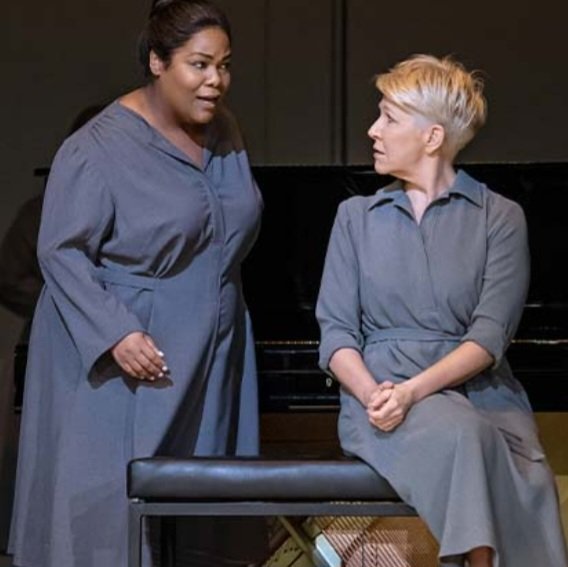
From the very beginning of the Opera, she is supported and challenged by her religious sisters, from her decision to visit an inmate on death row she has been writing all the way through the heartache of accompanying him to his final breath. There is one scene at the beginning of Act II, pictured above, where one of her sisters hears Helen cry out in a nightmare and comes to check on her. Their duet is lovely and real and grounded in the charism of the Sisters of St Joseph of Medaille to serve the dear neighbor. Sister Rose neighbors her friend Helen. More than that, she shares the journey with her sister and friend in a very real way.
You can feel as Sister Helen takes the next heart breaking steps of the journey with Joseph, the man on death row, that she brings the strength from her community with her. She builds a relationship with Joe, as she calls him. She neighbors him.
We have a saying in our community, where one of us ministers, we are all there. This depiction of Sister Helen’s story, the combination of the beautiful music and the creative if stark staging and incredible performances somehow made this clear. Even when it was only Sister Helen on stage with the warden or the priest or Joe, or with the victims’ parents, I could sense her sense that she was not alone. God was with her, and so were her sisters.
To be honest, despite the costume choice (all the sisters were wearing the same drab gray dress rather than the clothes of the day Sister Helen and the CSJs actually wear), the opera was one of the best expressions of apostolic religious life lived in community I have ever seen in art.
On the morning of my 51st birthday last week, I awoke with a lovely ear worm – “I love you Lord, for you have delivered me.” These are the opening words of Psalm 116 (I Love You Lord) by Mission House. I had discovered a new acoustic version of the song the night before, and to my joy and delight it was still in my heart and head when I awoke that day filled with gratitude for the gift of life and God’s love.
Daily life, with its periodic ups and downs, stumbles and misteps, chaos and noise sometimes makes it harder for me to remember the awesome mystery that God loves me and you and everyone else no matter what. I find it helpful from time to time to take some time away to spot the unmistakable gift of God’s love in nature.
Just the week before I’d gone on an afternoon walk in a local park in Bayonne, New Jersey where I observed two turtles out for a swim on a very hot day. For my birthday present I gifted myself with some quiet time with God in Maryland, in St. Mary’s City and on the Eastern Shore. On my walks and meanderings a cardinal allowed me to take its portrait, some trees gave me shade, and a great blue heron stood still in witness of the wonder of it all. If you don’t believe me, you can watch the video prayer I made set to the beautiful song by Jess Ray and Taylor Leonhardt of Mission House, in which all these friends make a guest appearance.
I love You, Lord For You have delivered me I love You, Lord For You have delivered My soul from death My feet from stumbling I will walk in the land of the living My soul from death My feet from stumbling I will walk in the land of the living
I will bless You, Lord for You heard my cry I reached out my hand and You saved my life I will bless You, Lord for You heard my plea And the God of Heaven turned His ear to me
I will bless You, Lord for unending love For Your grace and mercy raining down from above And I will bless You, Lord to the very end I will call on You as long as I may live
In today’s reading from the Book of Exodus (3: 13-20) God is revealed to Moses as I AM. Years ago my spiritual director helped me to appreciate this in a particular way. God does not reveal God’s self as I was or I will be but rather I AM. Here and now in this present moment. In every present moment.
This morning as I prayed with this passage, my attention was caught by what Moses is told to tell the people.
“Go and assemble the elders of Israel, and tell them: The Lord, the God of your fathers, the God of Abraham, Isaac, and Jacob, has appeared to me and said: I am concerned about you and about the way you are being treated in Egypt; so I have decided to lead you up out of the misery of Egypt into the land of the Canaanites, Hittites, Amorites, Perizzites, Hivites, and Jebusites, a land flowing with milk and honey.”
God is concerned about us, in our present, always. We are God’s concern.
Sit with that a minute.
As I sat with that realization this morning I was reminded of a video prayer I made a few years ago while on retreat, set to I Am by singer songwriter Jill Phillips.
I am constant, I am near I am peace that shatters all your secret fears I am holy, I am wise I’m the only one who knows your hearts desires Your hearts desires
Amen.
What would it be like if we knew this truth in the depths of our hearts … and acted accordingly? Sharing the concern of the Great I AM for ourselves, each other, and our wounded world?
Today is the Feast day of St. Kateri Tekakwitha. In today’s Blessed Among Us feature in Give Us This Day, Robert Ellsberg writes:
St. Kateri was born in 1656 near present-day Auriesville, New York. Her mother, a captured Algonquin, was a Christian, while her father, a Mohawk chief, viewed the new religion with deep suspicion. Both parents died from smallpox when Kateri was four. Her own scarred face showed the marks of the disease, which also darkened her vision, causing her to stumble in the light. As a result her people called her Tekakwitha—“the one who walks groping her way.” When a Jesuit missionary arrived in her village in 1674 she requested baptism. She was given the name Kateri—a Mohawk version of Katherine.
Don’t we all stumble at times and grope our way forward? I know I do. Kateri Tekakwitha may be just the companion we need for these complex days of chaos and uncertainty. Just because we stumble in the light does not mean the light is not there. And even if we must at times grope our way, we can walk the way of peace, love, justice, and integrity in gratitude and hope.
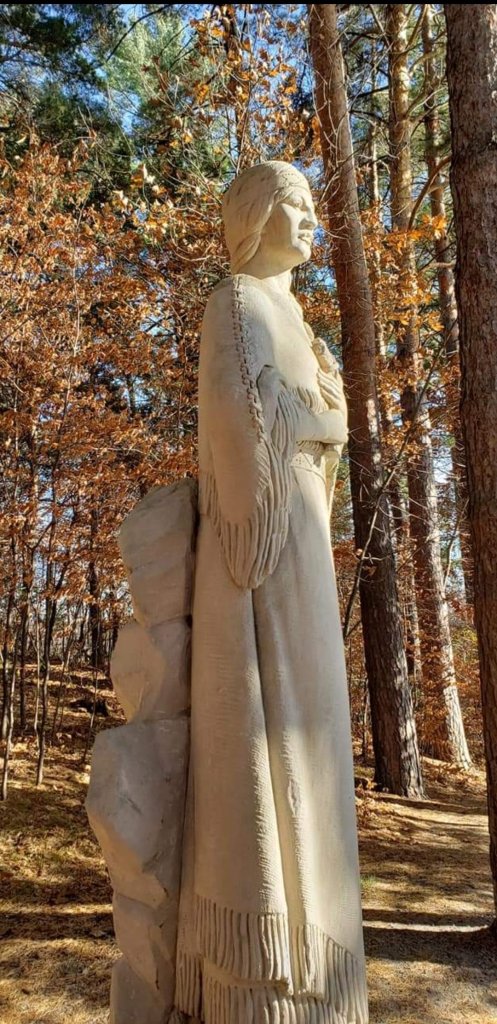
Painting by Nancy Marek (mareksaints.com)Statue of Kateri Tekakwitha in Collegeville, MN
I love these two images of Kateri Tekakwitha. The first, a painting by Nancy Marek, is new to me. The second is a photo I took of a statue on the path near a lake in Collegeville a few years ago. Knowing what I now know about her name and her challenge making her way in the light I love these images even more.
Do you see her posture? Sitting in one, standing in the other, looking ahead in both in faith, wonder, and awe, she is surrounded by the goodness of God’s creation. So too are we, even if we don’t always see it.
Pray for us St. Kateri Tekakwitha. Help us to face forward in hope, love, and trust even if we stumble or grope to find our way. Journey with us as we nevertheless walk together in faith. Inspire us to look for goodness and wonder. Be with us on the journey.
When I was a novice, we attended classes with those in formation with other religious congregations. One day, we were sharing the words of our different Constitutions on the vows. That is when I discovered that what has become one of my favorite passages in our CSJP Constitutions is rather unique. Not only does it talk about the value of leisure, it is part of our vow of poverty section!
In solidarity with our sisters and brothers
we engage in human labor
as a means of service and sustenance.
We recognize the value of leisure
as contributing to restoration and wholeness.
In these ways we come to share
in the creative power of God.
(Constitution 54)
Work is good and important and part of the way we participate in the creative power of God. But so too is leisure. We are called to be whole persons, and this requires making time and space for rest, relaxation and renewal.
I am so blessed to be a Sister of St. Joseph of Peace for many reasons, including this commitment to holding each other accountable to this balance.
Starting today I am stepping away from my day to day ministry life for a mix of some restorative work and leisure. Over the next ten days or so, I will be visiting with friends and family. I will also be joining two sister writer friends for a writing retreat. Did I mention how blessed I am that my community supports me in making time and space for this in my busy life?
How are you making space for restoration, wholeness, and the creative power of God in your life these summer months?
In our lives, lived amidst more than a dash of chaos at times, whether of the daily variety or the cosmic, we owe it to ourselves to take time to BE STILL. Sometimes we might actually be able to get away, but even a walk in the neighborhood or a moment to stop and breathe can be enough to refill our energy and restock our knowing of whose we are and who we are at our core.
Recently I was reminded of the words of Honoria Gaffney (Mother Evangelista Joseph, first Superior General of my religious community). Writing on humility, she said: “Empty yourselves of yourselves and you will find God.” She wrote those words over a century ago. Wisdom.
This Sunday morning I took some time with one of my favorite prayer forms, setting some of my contemplative photos of the goodness of God’s creation to music, in this case “I Will Be Still” by Young Oceans, featuring Molly Parden. Enjoy!
[Chorus] I will be still I will be still And know, and know And know You
[Verse 1] Though the Earth give way Though the mountains fall to the sea Though its waters roar I will cling to Thee
[Verse 2] Though the nations rage And creation yearns for the Lord Though the Earth may melt I’m forever Yours
[Pre-Chorus] There is no fear As I look upon You
[Chorus] I will be still I will be still And know And know You are God
“Accompany us in times of prosperity when the opportunity is given for an honest enjoyment of the fruits of our labors; sustain us in our hours of sadness…”
~ Pope Pius XII
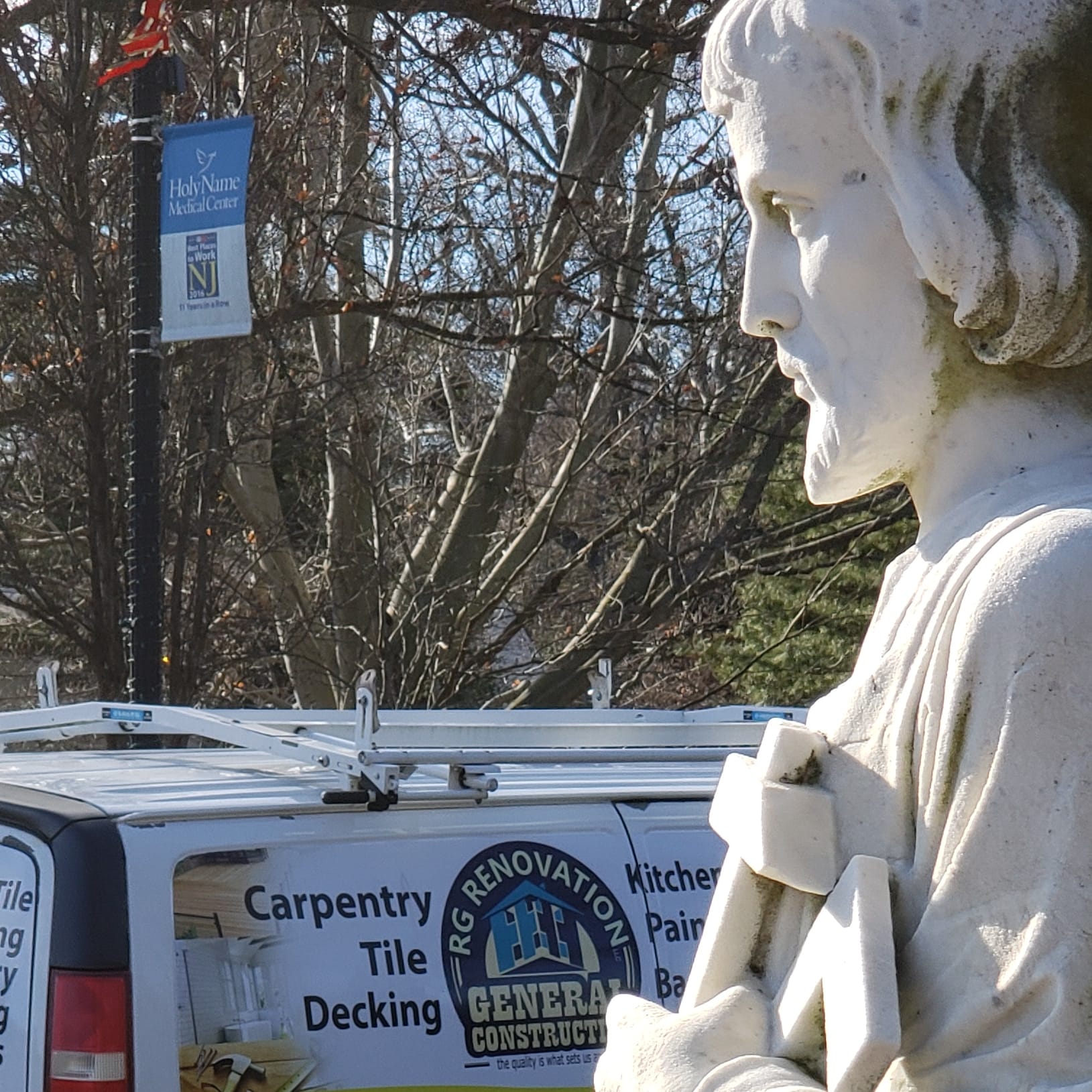
WHILE THERE is a lot we don’t know for sure about the life of St. Joseph, scripture and tradition tell us pretty confidently that he provided for his family with the work of his hands as a carpenter. It is not uncommon to find statues, like this one, depicting St. Joseph the Worker, where he is holding close to his heart the tools of his trade.
This statue of St. Joseph stands behind Holy Name Medical Center, a hospital in Teaneck, New Jersey, founded in 1925 by the Sisters of St. Joseph of Peace and local doctors. Holy Name continues to provide quality care today. This particular scene caught my eye on a winter’s day in January 2019, as I was walking to my car after a meeting at the hospital. My attention was drawn not so much by Joseph as by what just happened to be parked in the background that day—a carpenter’s van. My initial caption for the photo was “St. Joseph checks out the competition.” At the time, I found it to be ironic.
Every day, no matter what is parked in the background, this statue of St. Joseph watches over the hospital. He has an unobstructed view of the entrance to both the emergency room and the Sister Patricia Lynch Cancer Center. Not only does he watch over the hospital workers who provide compassionate care day in and day out, he also watches over the patients seeking care and the family members who entrust their loved ones to the hospital. He has witnessed a lot of sadness and joy over the years—lives lost, lives healed, and new lives coming into the world.
* * *
A little over a year after I took this photo, Northern New Jersey became the epicenter of the coronavirus pandemic. Suddenly, Joseph had a lot more to watch over. The parking lot that Joseph overlooks was soon filled with tents to provide a safe space for outdoor testing and screening. Ambulances drove past Joseph as they brought patients with advanced symptoms of COVID-19 to the emergency room. Families dropped loved ones off, unable to enter the hospital with them or even hold their hands as they faced this new and unknown virus. Essential workers, from doctors and nurses to security guards, housekeepers, and kitchen staff, faithfully and courageously arrived for their shifts each day, not sure what they would face in their personal protective equipment. Sadly, several hospital workers lost their own lives to the virus.
While I may have found it ironic when I snapped the photo of Joseph checking out his fellow carpenters, soon he had lots of construction work to oversee. In just 30 days, the construction and maintenance staff at Holy Name created 276 negative pressure rooms and 120 intensive care beds to accommodate the influx of patients.[1] Their creativity was astounding, especially given that supplies were very limited. Much of the materials they used was purchased at local hardware stores. The spaces they designed ingeniously protected both patients and caregivers. It was nothing short of a miracle, and all under the watchful eye of St. Joseph.
Our religious community continues to sponsor Holy Name Medical Center. As a member of our Leadership Team, one of my roles is as liaison to our sponsored ministries. All I could really offer during those days was my prayer and a commitment to stay up to date on the situation by calling the hotline set up by the hospital to provide regular updates on the fast-moving crisis for staff and board members. Dr. Ron White recorded the hotline updates. In addition to giving status reports on the numbers of patients being treated in the hospital with coronavirus, he also used the power of storytelling to paint a vivid picture of the heroic work by the hospital’s caregivers, in all departments.
Each morning, as part of my prayer time, I would dial the phone number, anxious to hear how things were going. Each evening, I would do the same. In between I would hold all the patients, staff, and family members in my prayer. Often, I would think of that statue of St. Joseph the Worker, overlooking all the activity. It gave me comfort, knowing that he was on the job, watching over and protecting all involved, a worker praying for workers in their hour of need.
During those initial months of quarantine, the voice of Dr. White was a lifeline of sorts for me, offering honesty, humor, and hope amid the crisis. Isolated at home in the safety of my own pandemic bubble with the sisters, I nevertheless felt connected to the heroic efforts taking place just a few miles away at the hospital.
* * *
I couldn’t help but reflect on our early sisters who, in 1890, answered the call to serve when a smallpox epidemic broke out in Passaic, New Jersey. They too worked tirelessly to provide compassionate care during trying circumstances. And they too did it all while carpenters hammered away adding space on the other end of the building—no doubt also under the watchful eye of St. Joseph. An account of the time says that when that epidemic ended, the sisters were exhausted, while the doctors, visitors, and undertaker marveled at their superhuman courage and greatness of heart that sustained them almost beyond human endurance.[2]
The Constitutions of the Sisters of St. Joseph of Peace say that Joseph’s “courage to live a life of faith inspires us to trust in God’s abiding love, especially in times of struggle and uncertainty” (Constitution 36). While scripture is light on the details of his daily struggles and work, our Christian story is testament to the fact that he faced uncertainty with courage and greatness of heart. “God acted by trusting in Joseph’s creative courage,” writes Pope Francis.[3] Who better to have standing over the comings and goings of the workers and patients at the hospital, watching out in good times and bad?
From the Tradition
The Gospel according to Matthew tells us directly, and early on, that Joseph was “a righteous man” (Matthew 1: 19). It’s not until much later, however, when an adult Jesus faces his dubious home crowd in Nazareth, that we hear indirectly about Joseph’s profession. Almost as an aside, his neighbors dismiss Jesus and his message by asking, “Is he not the carpenter’s son?” (Matthew 13: 55). Mark’s Gospel echoes the dismissal, “Is he not the carpenter,” (Mark 6:3), leaving out even the oblique reference to Joseph. There we have it—the length and breadth of the scriptural references to the work of Joseph.
These references, in particular the way the word carpenter is dropped as one snide remark among many, do not seem to make the case that it was considered to be a very dignified or noble profession, at least not in the recorded opinion of these naysayers. Yet tradition expands the biography and profession of Joseph so much that, in 1955, Pope Pius XII announced the creation of a new feast day to be celebrated on May 1st in honor of St. Joseph the Worker, “the humble craftsman of Nazareth,” who personifies the “dignity of the worker.”[4]
* * *
Human experience teaches us that a skill or trade is often passed down from parent to child. It is therefore not surprising that church tradition, informed by lived experience, fills in some of the details over time.
For example, texts such as the apocryphal Syriac Infancy Gospels, compiled as early as the sixth century, paint the picture of Jesus helping Joseph in his carpentry work.
And Joseph used to go about through the whole city, and take the Lord Jesus with him, when people sent for him in the way of his trade to make for them doors, and milk-pails, and beds, and chests; and the Lord Jesus was with him wherever he went. As often, therefore, as Joseph had to make anything a cubit or a span longer or shorter, wider or narrower, the Lord Jesus stretched His hand towards it; and as soon as He did so, it became such as Joseph wished. Nor was it necessary for him to make anything with his own hand, for Joseph was not very skillful in carpentry.[5]
The passage is both practical and mystical, with references to doors, milk-pails and cubits and the awesome power of Jesus even as a child. It also is audacious enough, in order to stress the divinity of Jesus, to throw doubt on the actual human skills and craftsmanship of Joseph!
Fourteen centuries later in Redemptoris Custos, his apostolic exhortation on St. Joseph, Pope John Paul II claims that the scant references to Josephs’ profession as a carpenter in the canonical Gospels are nevertheless enough to tell the whole story. “This simple word,” carpenter, “sums up Joseph’s entire life.” He was a carpenter who raised his son to know the value and dignity of work. Jesus, “having learned the work of his presumed father,” was known as “the carpenter’s son.”[6]
John Paul II teaches that through the institution of May 1st as the liturgical memorial of St. Joseph the Worker, the church recognizes the “special prominence” of human work, especially manual labor. “Along with the humanity of the Son of God, work too has been taken up in the mystery of the Incarnation, and has also been redeemed in a special way.” Jesus, working alongside Joseph, “brought human work closer to the mystery of the Redemption.”[7]
O Glorious Patriarch, St. Joseph, humble and just artisan of Nazareth, thou hast given to all Christians and particularly to us an example of a perfect life through diligent labor and admirable union with Jesus and Mary. Assist us in our daily work in order that we, Catholic artisans, may also see in it an effective means of glorifying God, of sanctifying ourselves, and of being a useful member in the society in which we live. These should be the highest ideals for all our actions.
O Dearest Protector, obtain for us from the Lord humility and simplicity of heart; love for our work and kindness toward our fellow-laborers; conformity to God’s will in the unavoidable trials of this life together with joy in bearing them; recognition of our specific social mission and a sense of responsibility; the spirit and discipline of prayer; docility and respectfulness toward superiors; the spirit of brotherhood [and sisterhood] towards our equals; charity and indulgence with our dependents.
Accompany us in times of prosperity when the opportunity is given for an honest enjoyment of the fruits of our labors; sustain us in our hours of sadness, when Heaven seems to be shut in our regard, and even the very tools with which our hands toil appear to rebel against us.
Grant that, in imitation of thee, we may keep our eyes fixed on our Mother, Mary, thy dearest Spouse, who, as she spun silently in the corner of thy shop, would let her sweetest smile course over her lips. Besides, may we never take our eyes off Jesus, who was busily occupied with thee at the carpenter’s bench, in order that we in like manner may lead on earth a peaceful and holy life, a prelude to the life of eternal happiness that awaits us in Heaven forever and ever. Amen.
Prayer for Our Daily Work
Dear St. Joseph, you who used your skills as a carpenter to provide for your family, watch over and protect us. Inspire us to embrace the God-given gift of the co-creative power of work. Your humble example, barely recorded in the Gospels, is enough to help us understand the dignity of human work and workers. Be our companion in good times and bad. Help us to face the daily challenges, and the extraordinary ones too, even as we pause to spot glimpses of joy in our shared life. We pray that policy makers and employers will recognize and respect the rights of workers. Knowing that you passed along your knowledge to Jesus, we ask you to guide us in our daily work.
[5] A. Cleveland Coxe, Alexander Roberts, and James Donaldson, eds., “The Arabic Gospel of the Infancy of the Saviour,” in Ante-Nicene Fathers. New York: Christian Literature Publishing Co., 1886. http://gnosis.org/library/infarab.htm.
I have an affinity for those Scripture passages where the people or disciples complain to God. Because, who hasn’t? In today’s first reading Moses is also a target, the fate of leaders throughout history. (Numbers 21)
From Mount Hor the children of Israel set out on the Red Sea road, to bypass the land of Edom. But with their patience worn out by the journey, the people complained against God and Moses, “Why have you brought us up from Egypt to die in this desert, where there is no food or water? We are disgusted with this wretched food!”
Disgusted. Wretched. Very descriptive. And real.
The story continues that God sent serpents to bite the people as punishment for their complaints! Which spurred the folks to apologize, and then God helped Moses get everyone to chill out by making a bronze serpent on a pole, and everyone who looked at it lived.
The nitty gritty reality of the complaining is what sticks with me. And makes me laugh every time this reading comes up in the lectionary. Because if I am honest, my own conversations with my loving creator sometimes fall into the complaint variety. Sometimes they are substantive and grounded in true issues. Sometimes they are of the more petty variety. Most often probably in the middle? And if I am to be real before God, I can’t stuff it down or pretend I don’t feel all the feelings.
When my Mom was dying of cancer twenty years ago, I had my first true (adult) crisis of faith. It was accompanied by a lot of complaining of the substantive variety. I had a valid beef with the reality of suffering and most particularly the suffering my Mom was going through, and how God was seemingly ok with it. Still do all these years later, truth be told. A wise priest friend encouraged me to spend some time with the psalms. They were filled not only with complaining, he told me, but even anger at God. And anger, he pointed out, is a pretty intimate emotion.
Somehow reading those ancient complaints and screeds against God brought me closer to God in the midst of the reality of suffering. Here’s the thing … while in today’s story from Numbers, God may have punished the people first, the story ends with mercy. The story always ends with God’s mercy. God listens. God is with us. And God wants to hear our complaints! As we hear today in Psalm 102:
Let this be written for the generation to come, and let his future creatures praise the Lord:
“The Lord looked down from his holy height, from heaven he beheld the earth, To hear the groaning of the prisoners,to release those doomed to die.
So go ahead. Groan. Complain…. God has heard worse. We won’t find the way through by ignoring the death dealing realities of life, real and figurative. We might miss life giving opportunities if we do. God invites us always to bring our realities to our relationship with our loving creator. And for that I am very grateful.
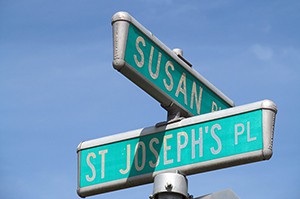
Today, as I was driving to Heathrow airport to return my rental car before my departure,I drove by a street called “Makepeace Road.” What a name!
I wonder how often the residents of Makepeace Road think about the name. Is it something so familiar that it does not give them pause. Or do they see the name as they drive onto their street or write their return address on an envelope and think … yes, I should make peace with … [fill in blank].
As we finish the third week of Advent and begin what this year is an actual full fourth week of the Advent season, it is a good time to ponder how I am called to make peace
In my own heart.
With those I love, but where there may be some strained relationships or hurts.
With those who drive me a little crazy.
With those with whom I disagree or just don’t understand.
Peace is possible, but it begins at home and it takes effort and intention.
May we all strive to make peace in our lives, community, and world, no matter what street we happen to live on.



 At the Corner of Susan and St. Joseph