I have been pondering what, if anything, to share regarding my post election thoughts. It hasn’t quite been a week, but I have been reading the national temperature and preparing for this result for a while now. So here goes…
First, before you ask, I have already discerned that this time around, I will not be reviving my daily practice of posting a prayer for President Trump.
Why?
For one thing, the platform itself has changed from Twitter to X, resulting in a significant change in ownership, philosophy, and audience. Somehow (the grace of God?), for the most part, I avoided being trolled or harassed last time. I suspect that may not be true this time around, and dealing with that possibility is not where I wish to place my energy.
This does not mean I stop praying. I pray for our elected leaders each and every day, and the 47th President and his administration will certainly be included in my daily prayers. As will the most vulnerable people and ecosystems who will be impacted by policy changes he proposes.
I have been posting short videos that share some simple messages about God’s love, goodness, the beauty of God’s creation, human dignity, the call to be still and grounded…
These are simple yet profound truths that seem to be lost or drowned out in the noise of the globalization of indifference and toxic nature of our (un)civil discourse that makes fertile ground for misinformation and the sowing of fear, hate and division. These posts seem to be finding an audience, if modest in size. More importantly, I believe this type of messaging is urgently needed in our public space. Let me explain.
When I was in graduate theological studies, my research focused on resistance to social sin. One of my key findings had to do with identity and moral choice.
Political psychologist Kristen Renwick Monroe analyzed first hand accounts of ordinary Germans during the Nazi regime and found that how they saw themselves directly impacted how they responded. I believe there are lessons to be learned for our present moment.
Those who supported the regime saw themselves as victims. They were willing to act preemptively against the other out of a desire for self-preservation.
Bystanders saw themselves as helpless, just one person alone against the Nazis. What could they do?
Rescuers saw themselves as connected with everyone and able to effect change. Notably, Monroe also discovered that they were the only group who “had integrated the value of human life into their worldview.”
She concludes that “identity constrains choice” across all three groups. In other words, one’s identity—in relation to self, other, world, and agency—radically influences one’s ethical response and actions. Monroe believes that her findings suggest that identity constitutes “the force that moves us beyond generalized feelings of sympathy, sorrow, or even outrage to a sense of moral imperative.”
So, in addition to getting ready to be a strong, vocal, and persistent advocate for the common good, human rights, peace, and the integrity of creation in the face of likely policy, legislative, and economic changes over the next four years, I also want to do my part to help (re)form our collective sense of identity and expand our menu of moral choice.
I see myself as connected to everyone. My worldview, informed and inspired by my parents and their/my Catholic faith, calls me to see human life and dignity and the goodness of all of God’s creation as central to my worldview and demanding of my action. My religious community strengthens and expands this understanding through our common life, prayer, mission, and charism.
I feel a deep sense of call to use my gifts, talents, and influence to spread that message in the belief that it will make a difference. Also, I am hoping it will help me stay grounded during the next four years.
In today’s reading from Hosea we hear: “I will heal their defection, says the Lord, / I will love them freely.”
God loves freely. We who are made in the image and likeness of God are called to do no less.
In the words of this song by Joy Ike (Wearing Love).
Slow your breathing No more scheming Quit competing Just love
Silly humans that we are though, we limit our God given ability to love, whether it is ourselves, those who annoy us, those who hurt us, those we disagree with, those we just don’t particularly like.
Jesus reiterates this central call to love in today’s Gospel (Mark 12):
One of the scribes came to Jesus and asked him, “Which is the first of all the commandments?” Jesus replied, “The first is this: Hear, O Israel! The Lord our God is Lord alone! You shall love the Lord your God with all your heart, with all your soul, with all your mind, and with all your strength. The second is this: You shall love your neighbor as yourself. There is no other commandment greater than these.”
Love God. Love neighbor. Love yourself.
Freely and with our whole heart, soul, mind and strength.
As Joy Ike sings in her song: “All that works is the love that you bring.”
A friend just sent me an internet meme with the Grinch and this note: “This year I decided to do something different. I stole the last week of Advent.”
Today is the 4th Sunday of Advent AND Christmas Eve. I love Advent, perhaps because of the contrast with the hustle and bustle of this season in our society. This year too there has been the added weight of war and suffering, well sadly always there is war and suffering. This year it hits closer to our spiritual home as millions are at risk of starvation and death in the Holy Land while bombs and weapons have already killed tens of thousands, including children.
It is in the midst of this chaos and indifference that we are called for four weeks (more or less) to practice expectant waiting and hope as we yearn for love and peace. More than that, WE are called to make room for the incarnation of Christ in our world, hearts, and homes.
In the words of Margaret Anna Cusack, founder of the Sisters of St. Joseph of Peace, in her reflection for today, Christmas Eve (well written in 1866 but you know what I mean): “Today we are decking our houses for His divine visit: let us not forget to deck our hearts.”
Happy last day of Advent as we await the coming of Christ our love and peace!
Today I had the opportunity to talk about St. Joseph with some Year 4 students at a Catholic School in Bradford, England. One of our CSJP sisters lives in the parish and is a regular visitor to the school. Sister Catherine arranged for me to visit and talk about St Joseph.
As it happens, the students (many of whom in this multicultural Yorkshire town are Muslim) happened to already know a lot about Joseph! St. Joseph is the patron saint of their class in fact.
When I asked what they could tell me about him, they answered one after the other, raising their hands. Joseph was the foster father of Jesus. He helped Mary take care of Jesus. He was the step father of God. He was a good man. They knew that he worked as a carpenter. He is a Saint. He was there with Mary when Jesus was born. He took his family to find safety .
I told them that the founder of the Sisters of St Joseph of Peace chose Joseph as the patron of my religious community because he is a model of peace. When I asked why we needed peace today, again their hands quickly went in the air. Peace for Ukraine. Peace for people who are arguing. Peace for everyone.
I really enjoyed the chance to visit with these 8 and 9 year olds. They seemed amazed that I had actually written a book and asked me lots of questions about how long it took, how I researched it, and how I put it together.
The nun thing was of course also one of the questions. How did I become a Sister? And finally, the best question, if I am a Sister of St Joseph, am I actually related to him? We are all children of God, I said, so we’re all related. I am related to Joseph and so are you!
Joseph and Jesus (statue spotted at our CSJP house in Scotland)
Who does not have half their attention elsewhere these days.
The horror facing civilians in Ukraine. The dawning reality of the climate crisis. Political polarization even in families and churches. Racial and economic disparity that seems entrenched and at the same time dismissed.
These are the signs of the times that led my religious Congregation, the Sisters of St Joseph of Peace, to commit in our Chapter Act this week To Be Who We Say We Are.
“Urged by a burning desire to speak and act boldly with open, loving and adventurous hearts, and in collaboration with others, we now commit to:
Cultivating and practicing peace through justice by the intentional living of interculturality, anti-racism, and inclusion
Addressing, healing, and being present to the wounds and broken relationships among ourselves and all of God’s Creation
Resisting every form of war and violence
Making a place for everyone at the table where all are welcomed and gifts are honored
It is time to be who we have always said we are. It is time to live our words. We embrace these promptings of the Spirit with courage, humility, hope and trust.”
As I have prayed with the Chapter experience and these words, the words of the song Free by the Good Shepherd Collective and Liz Vice keep playing in my head and heart. So I did what I do and made a video prayer.
🎵 So let the light in, keep it shining, let it break into the darkness … Love shall overcome 🎵
Margaret Anna Cusack, our founder, said: “The very name Sisters of Peace will, it is hoped, inspire a love and desire for it.”
Bishop Bagshawe, who we claim as a co-founder, told the first Sisters at their profession in 1884: “To secure this divine peace for ourselves and procure its blessing for others in the midst of the sin, turmoil, and restless anxiety of this modern world is the object of your institute.
So on the one hand the task can seem huge and overwhelming. Impossible even. And yet … Love shall overcome. Peace is possible. Peace is God’s gift. A gift to love and desire and work for and share. For then, indeed, we will all be free.
I prayed this morning with this song by The Porter’s Gate: Teach Us Your Ways.
Such a fitting prayer as we lean into 2022 and all it will hold. A prayer that we will:
Learn from one another.
Learn to love each other.
Give ourselves for one another.
Weep with one another.
There will certainly be lots to learn this year, lots to give, and tears to be shed. This is life. And we are learning, this is life in times of uncertainty and ambiguity.
I’m spending some time with my sister and her family in Chicago this week. Today’s rainy day activity? Teaching my 6th grader nephew how to build a website!
Just in time for the end of the Year of St. Joseph, I am excited to share the news that my little book of reflections on St. Joseph has been published by Kenmare Press: My Friend Joe: Reflections on St. Joseph. It is available for purchase as a paperback ($8) or ebook ($1) from the Kenmare Press Online Bookstore.
Description:
St. Joseph, husband of Mary and foster-father of Jesus, is central to the Christian story. Yet, so little is known about St. Joseph, either as an historical figure or as recorded in scripture. Much of what we understand about Joseph comes to us from tradition, art, and the lived experience of the faithful over the centuries. Sister of St. Joseph of Peace Susan Rose Francois reflects on her growing spiritual friendship with St. Joseph, who she affectionately calls her friend Joe. Inspired by photographs of Joseph taken by the author, she reflects on her personal encounters with Joseph in conversation with church tradition around this saint. Through art, prose, history, and prayer she encourages the reader to discover, or deepen, their own spiritual friendship with St. Joseph.
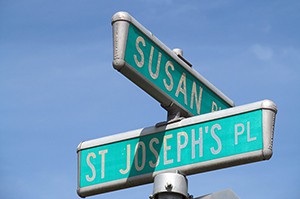








 At the Corner of Susan and St. Joseph