Today is the Feast of All Souls, also known as the Day of the Dead.
This morning I celebrated this Feast with immigrant families waiting to visit their detained loved ones outside Delaney Hall, the private for-profit immigrant prison in Newark, NJ. Despite the estimated $60 million annual profit GEO Corporation makes on the operation, they force families to wait outside for hours on an active driveway for a chance to see their loved ones. Thankfully a group of dedicated volunteers are there each visiting day to provide practical support with beverages, food, chairs, blankets, hats, gloves and perhaps most importantly compassion.
In the first reading for today from the Book of Wisdom we hear: “The souls of the just are in the hand of God.” And in the second reading from Romans: “Hope does not disappoint, because the love of God has been poured out into our hearts through the Holy Spirit that has been given to us.” Every time I am at Delaney Hall I leave with more hope, even in the face of the intentional cruelty done in the name of my country, because of the goodness of people.
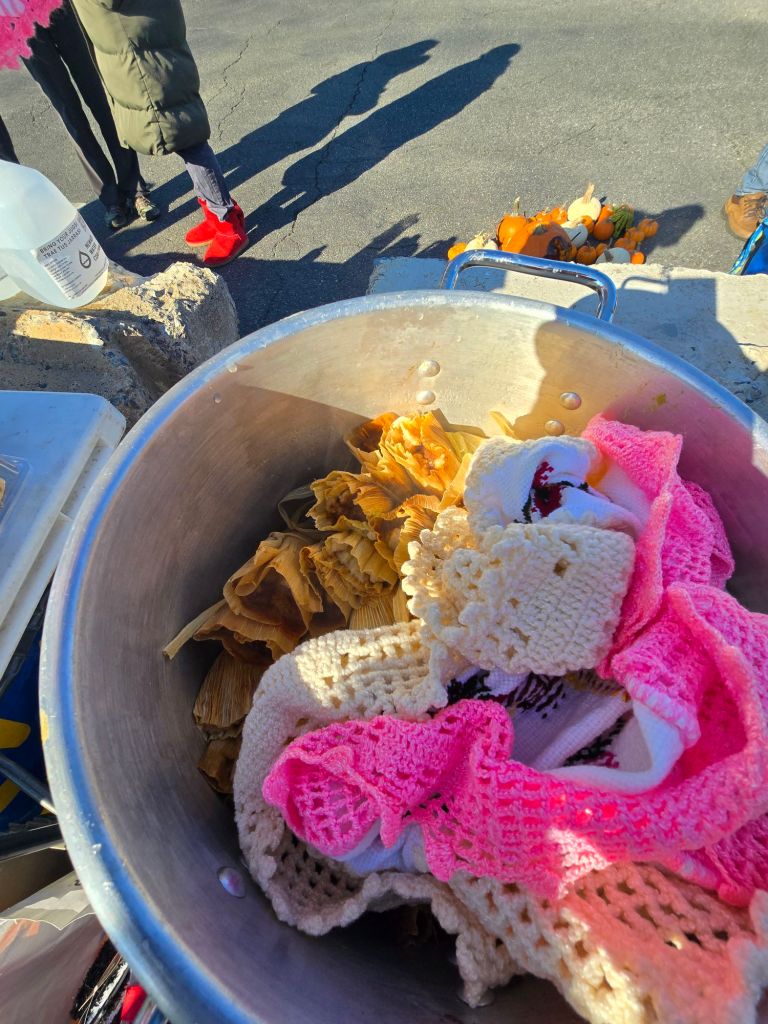
Today one of the families woke up at 5 am to make tamales and Mexican hot chocolate which they brought to share with others families and the faithful volunteers who are there during visiting hours to support the visitors. The family told us they wanted to give to us like we give to them. I will admit this brought tears to my eyes. And I was not the only one. (Plus the tamales and hot chocolate were delicious)
Homemade tamales!
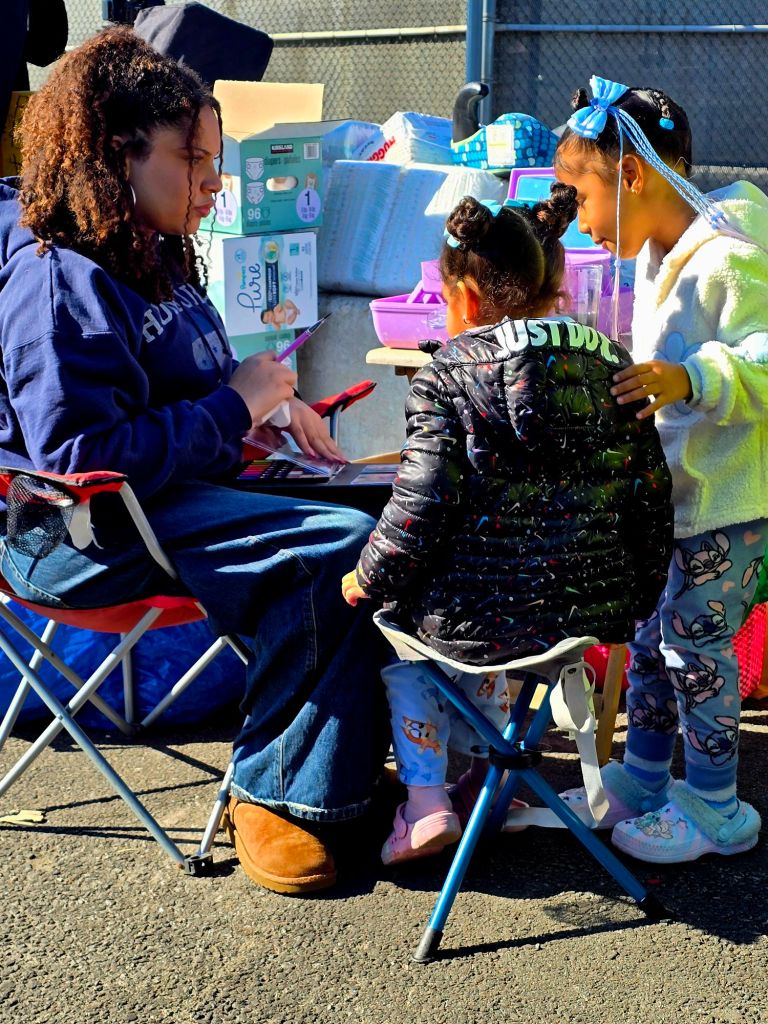
Other volunteers brought toys and art supplies for the kids. And there was even a face painting station. For children whose families have been torn apart and who wait for hours outside a chain link fence topped with concertina wire for a chance to see their detained mom or dad, these simple gestures also give them a chance to be a kid and have some good memories to see them through.
Face painting
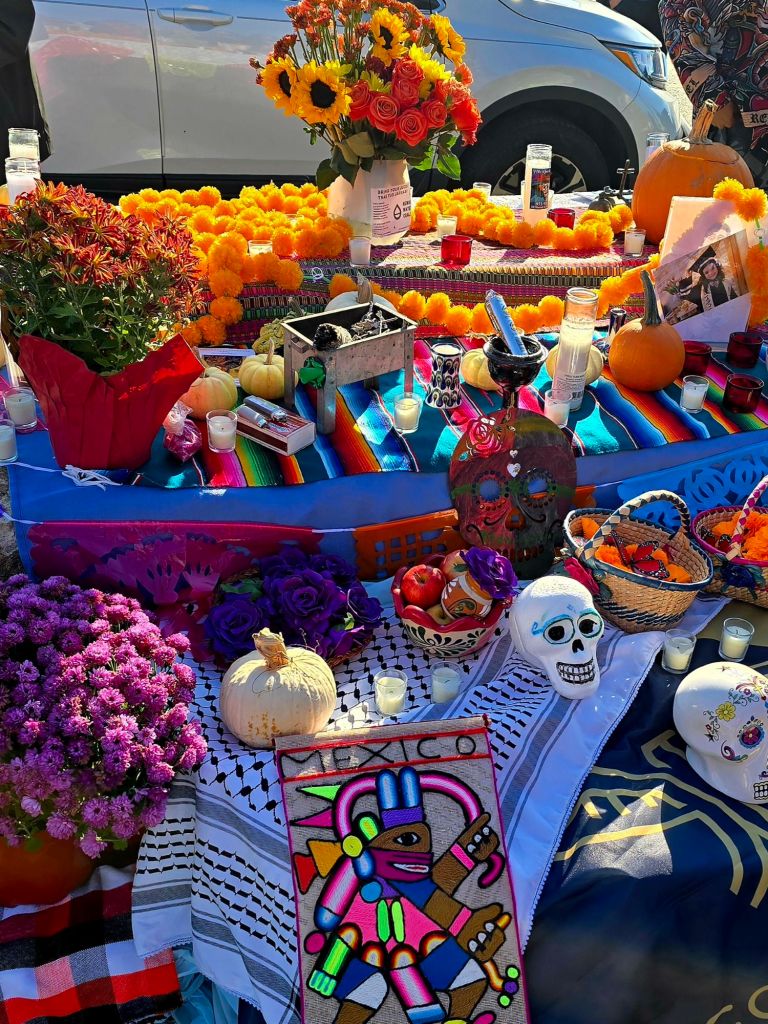
Other volunteers set up a colorful altar, an ofrenda, for the Day of the Dead. We remember our loved ones who have gone before, so fitting as an emotional and spiritual support for the families visiting their detained loved ones.
Indeed hope does not disappoint because God’s love is poured out freely into our hearts. We in turn pour this love into the world, especially places and spaces of suffering and oppression.
In the words of the collect from today’s liturgy:
Listen kindly to our prayers, O Lord,
and, as our faith in your Son,
raised from the dead, is deepened,
so may our hope of resurrection for your departed servants
also find new strength.
Through our Lord Jesus Christ, your Son,
who lives and reigns with you in the unity of the Holy Spirit,
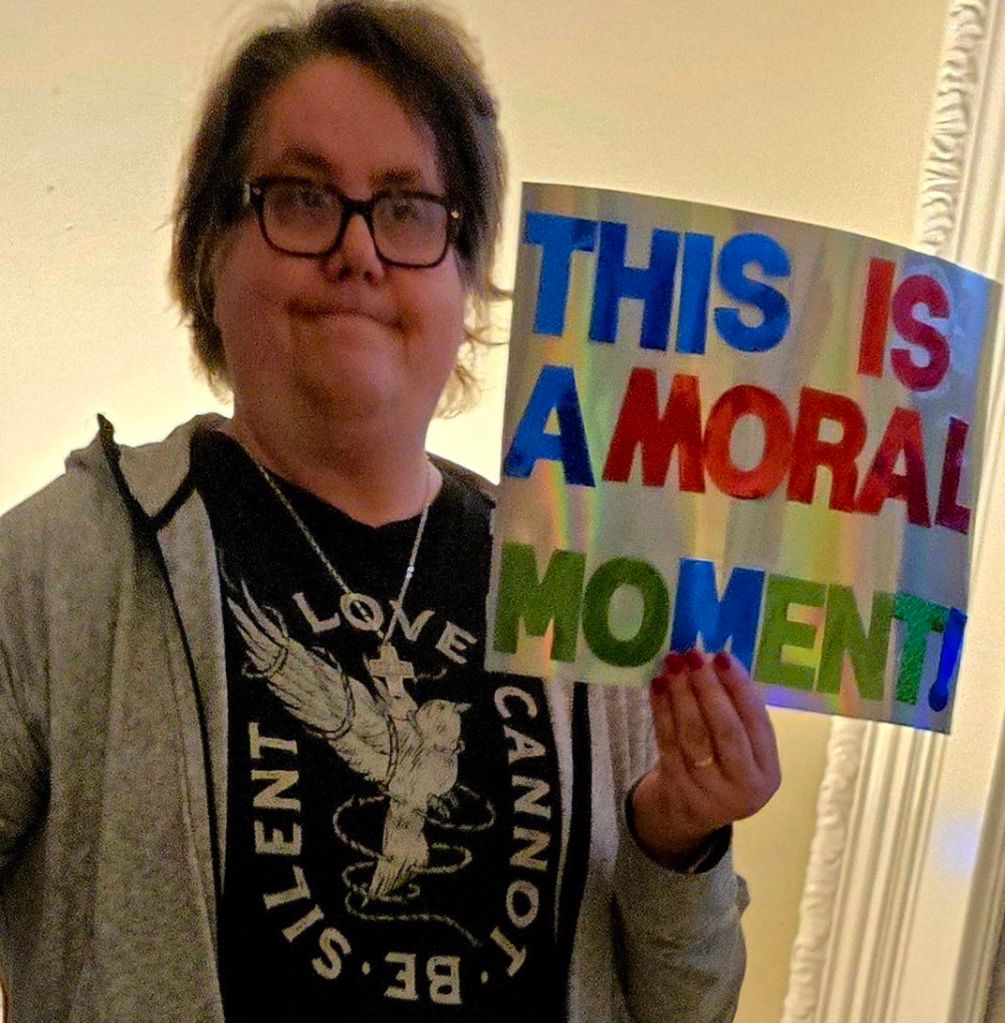
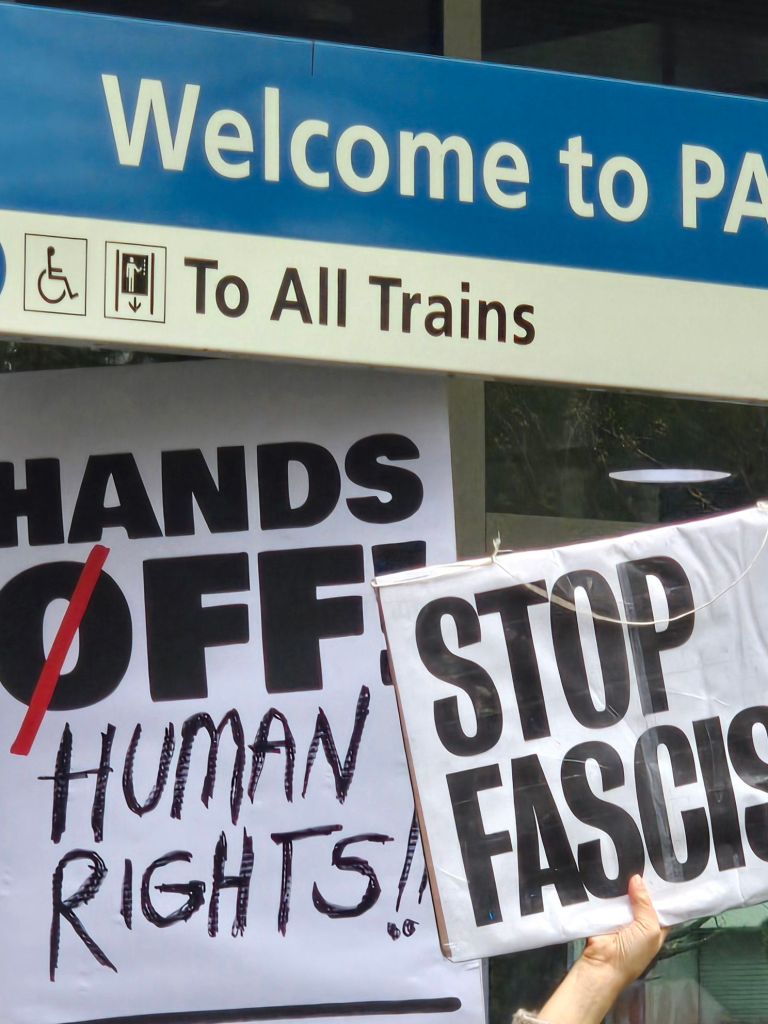
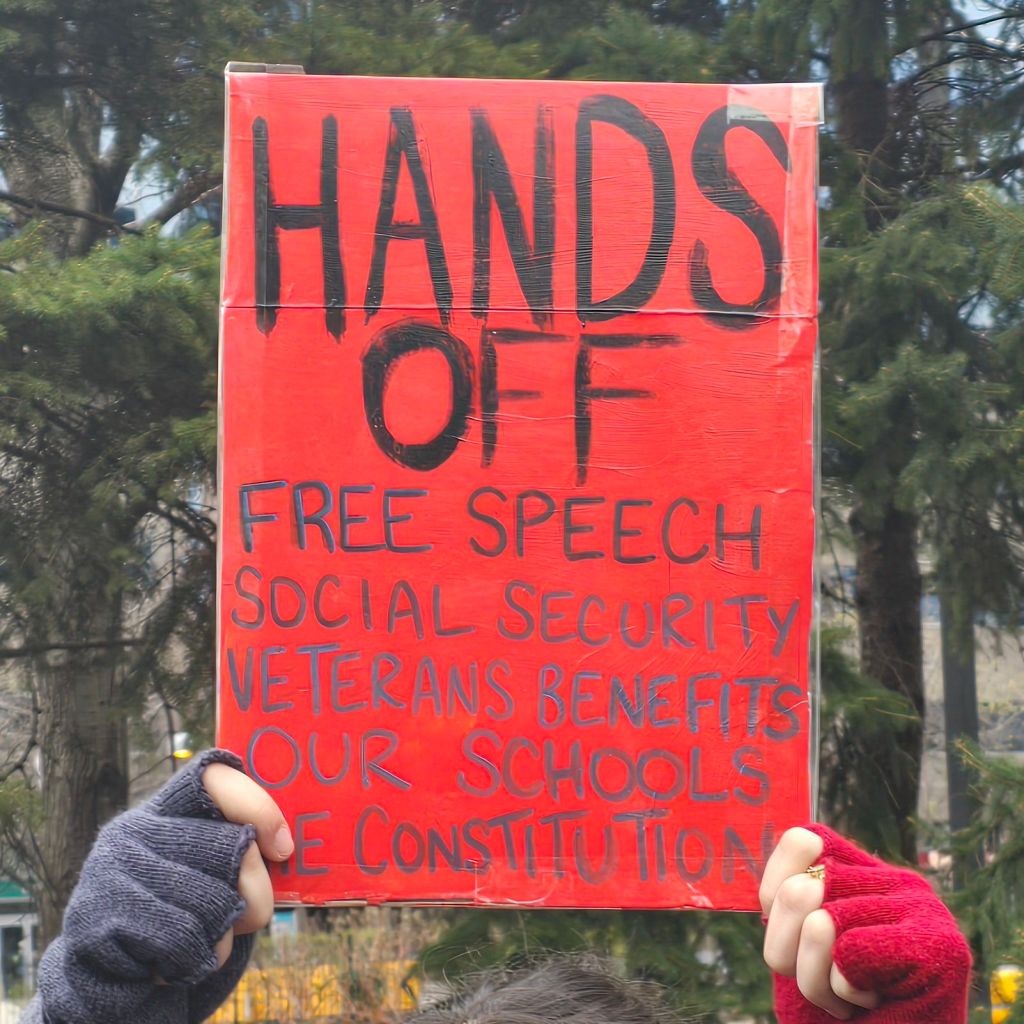
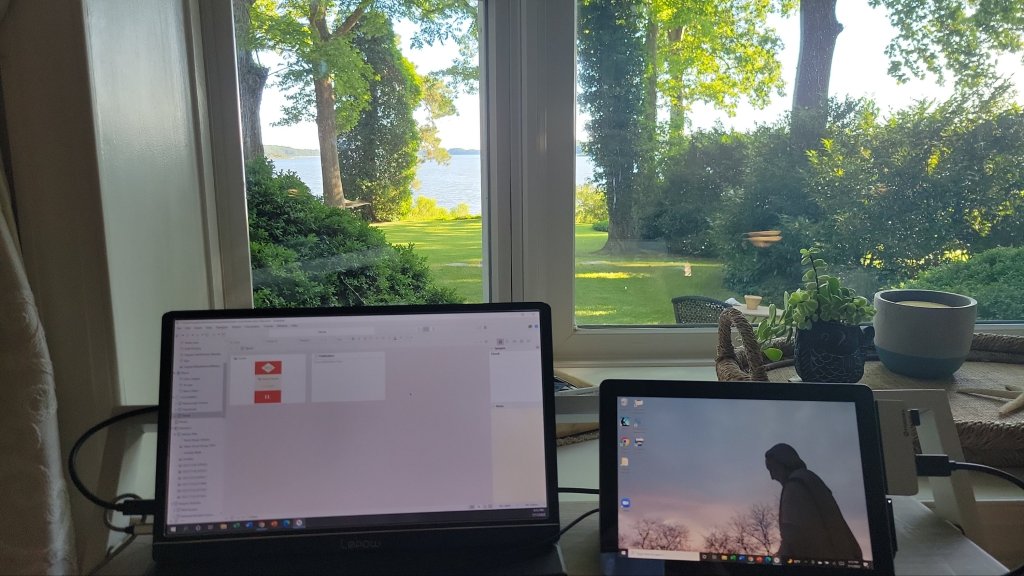
I started my day with a community of strangers outside a downtown subway station in Jersey City this morning, standing up and speaking out for our democracy, the common good, and human rights (among other things). This was one of over 1,300 events organized for today across the country under the unifying theme of #HandsOff. I carried my homemade sign which said on one side, “This is a moral moment” (quoting my Senator Cory Booker), and “Time 4 Good Trouble” (quoting John Lewis) onthe other. Under my raincoat I wore my “Love cannot be silent” t-shirt. (Before I left the house I prayed with St. Joseph and showed him my signs, because, well, I am me!)
Some reflections …
People of all ages showed up, even with the forecasted rainy weather. From families with toddlers in tow and even a mom-to-be with a very visible baby bump to grandparents and retirees and every generation in between. They even stayed when it rained, although thankfully the organizers had premptively shifted to a location that provided some shelter. Good organizing is appreciated and important and Knitty Gritty JC, a new to me local organization, did a great job planning this event.
For the most part these were not your standard protest goers (although some of us were there to be sure) but ordinary folks who answered the call to do something! They quickly went from standing around awkwardly to learning and loudly joining the chants, from the oldie but goodies (Tell me what democracy looks like, this is what democracy looks like) to hot off the news cycle ones (Ho ho, hey hey, Donald Trump crashed your 401k). Moreover, they held their signs high and joined in boisterously. I particularly loved seeing the toddlers dancing to the chants.
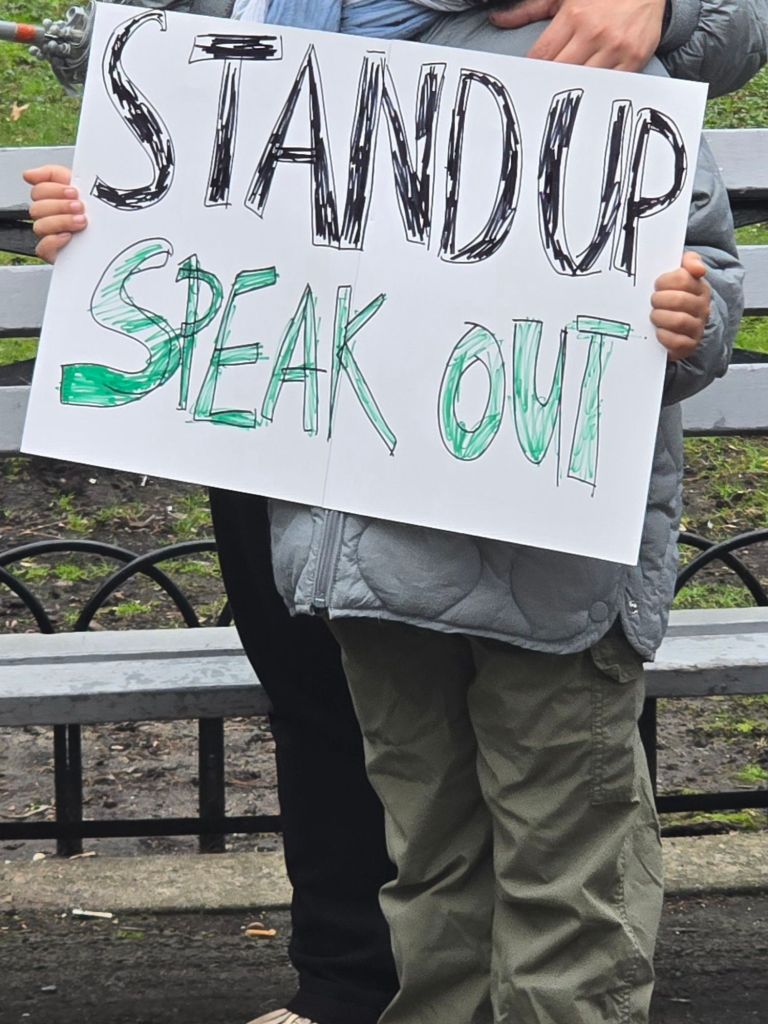
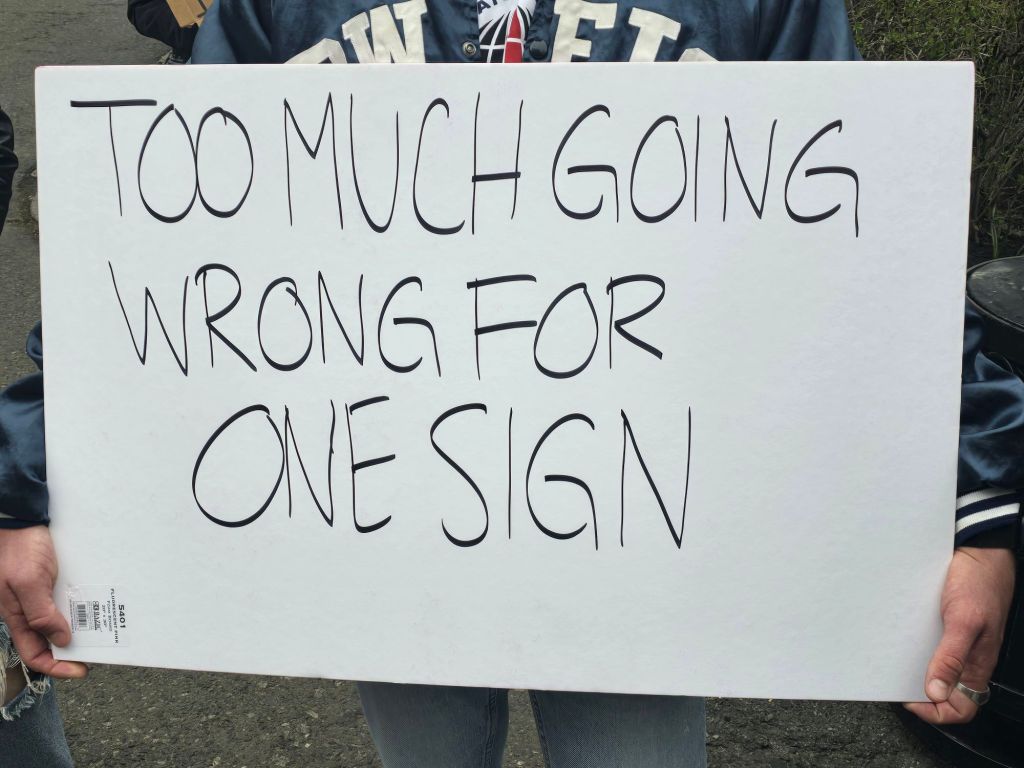
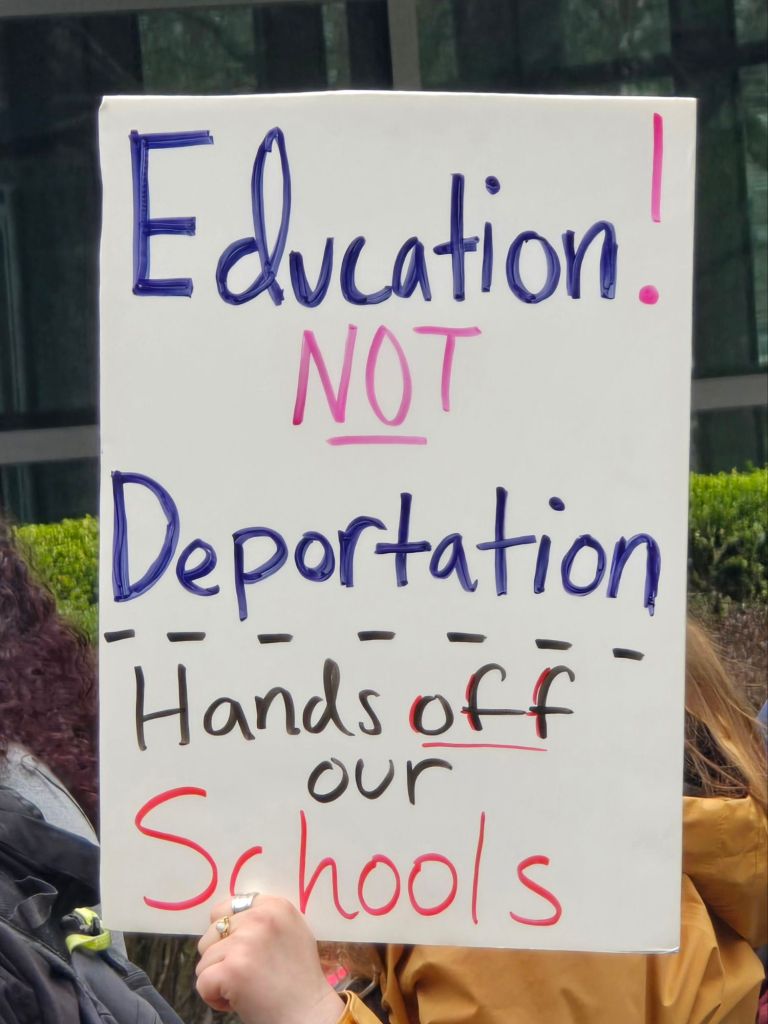
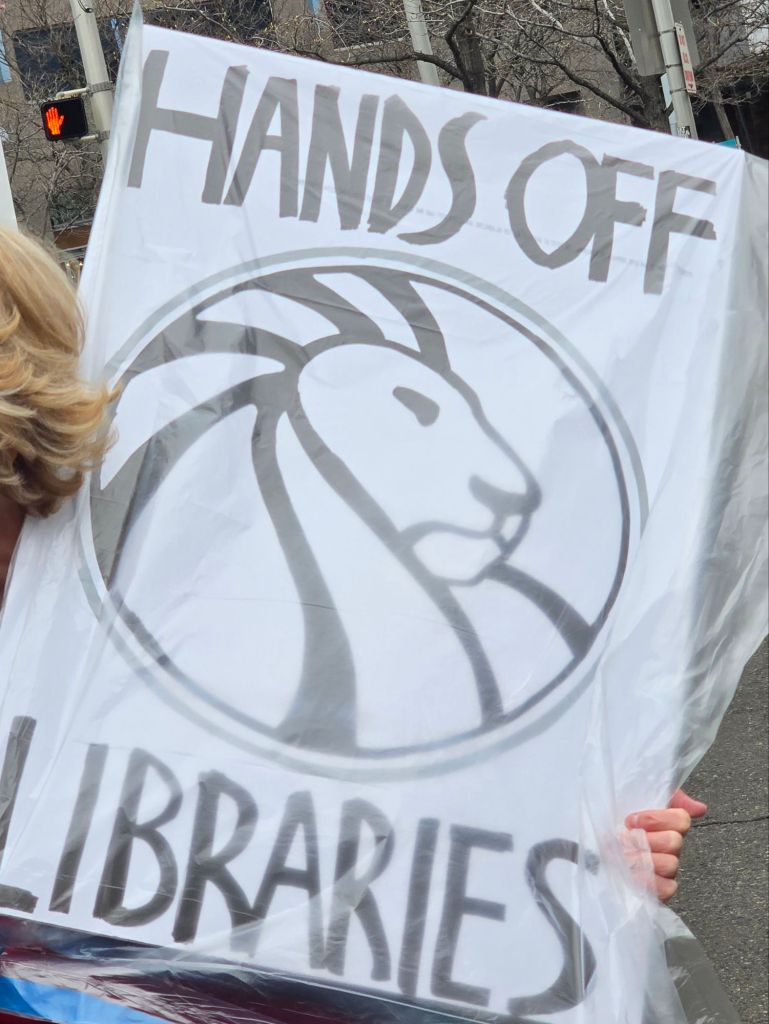
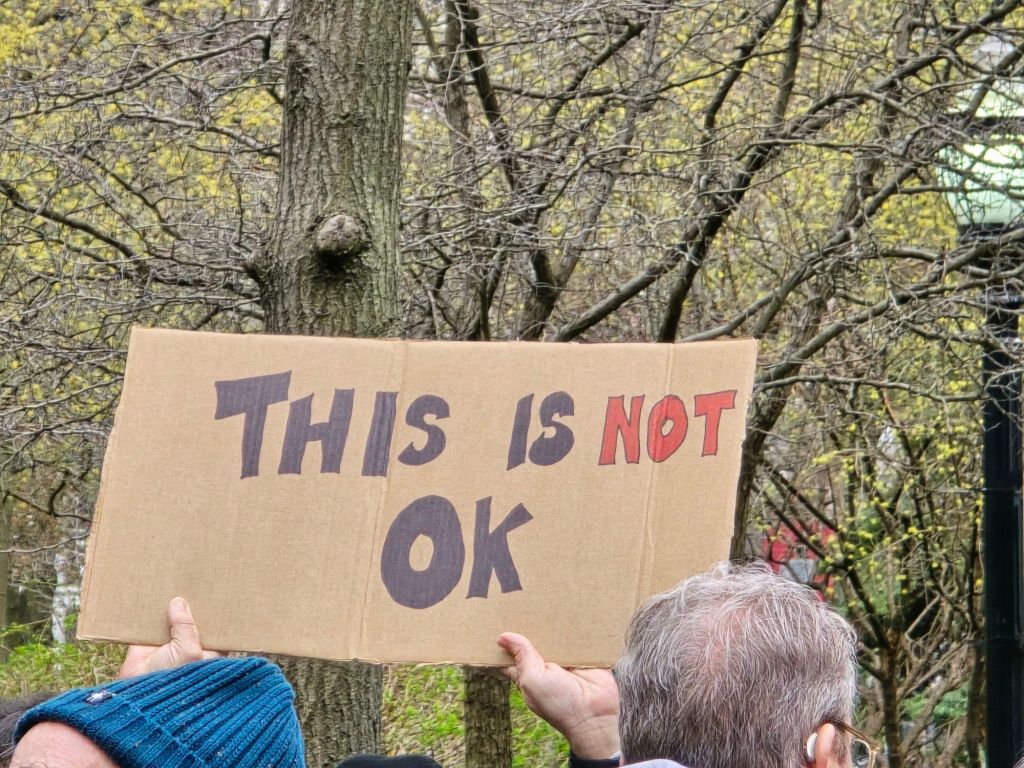
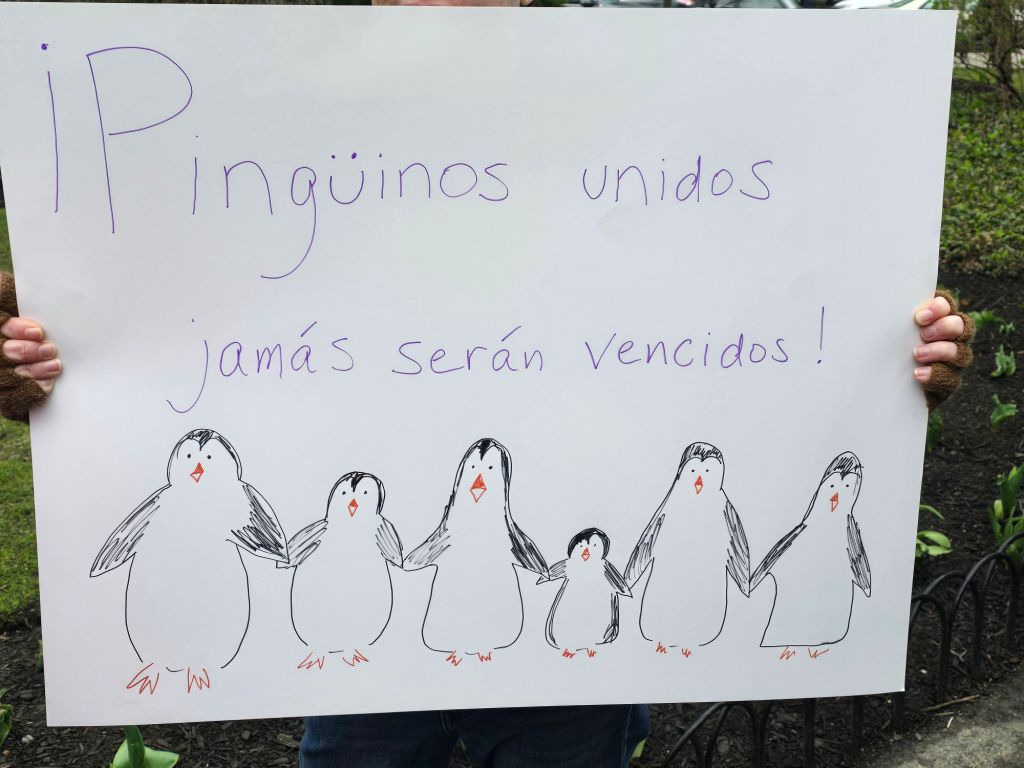
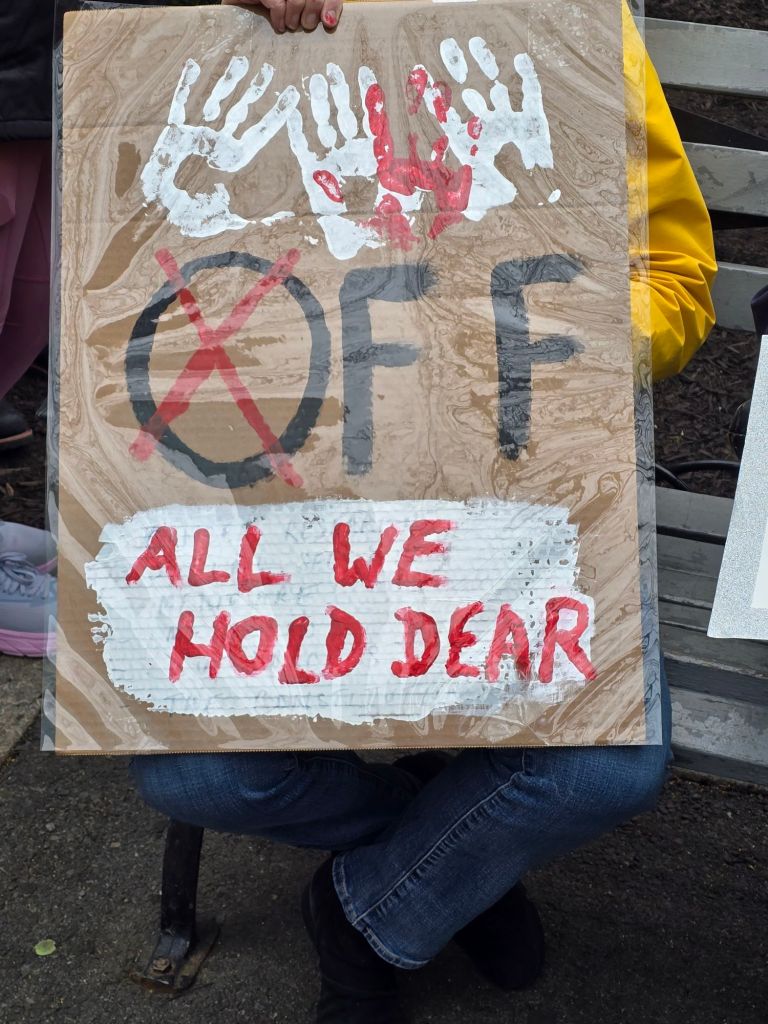
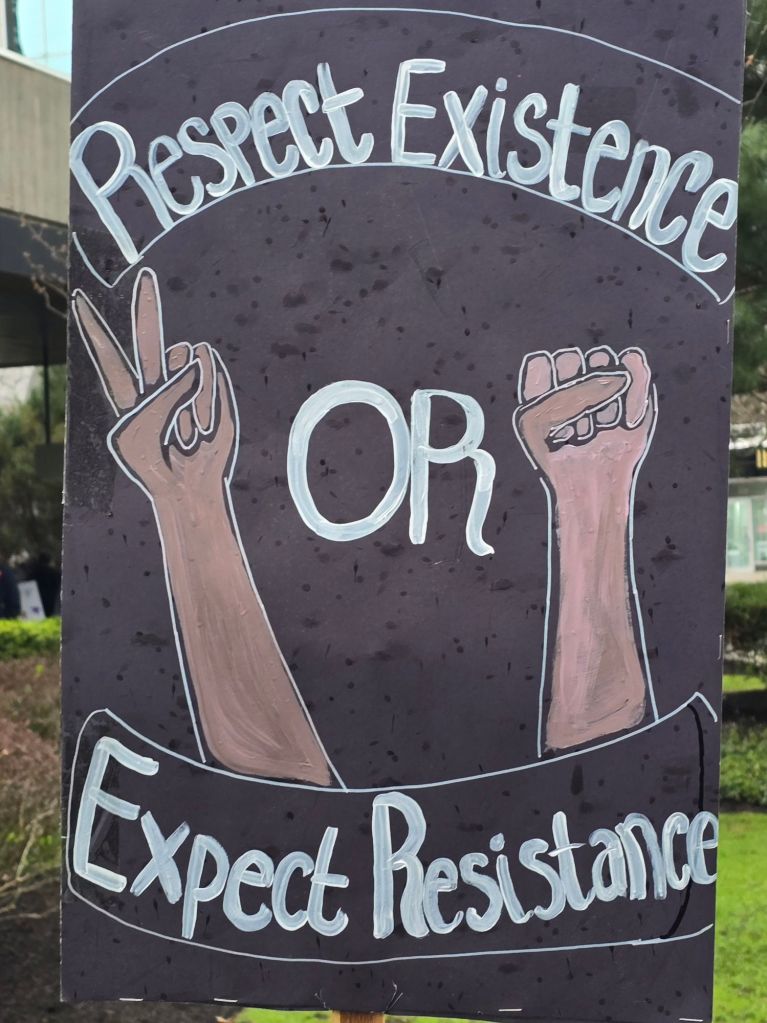
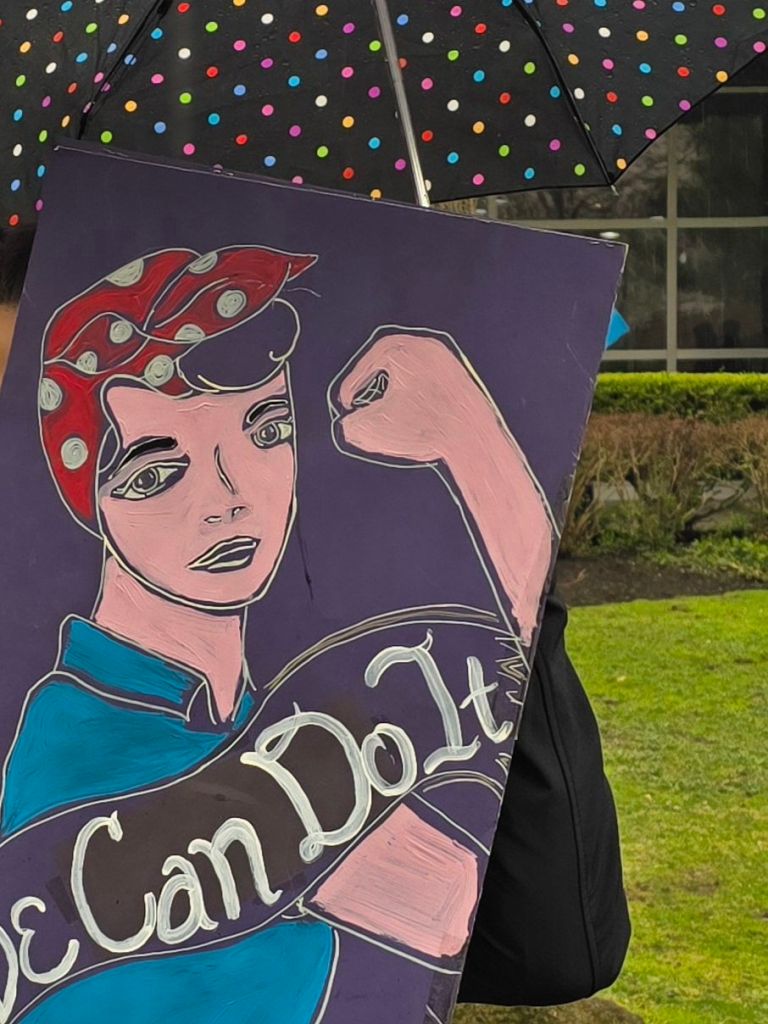
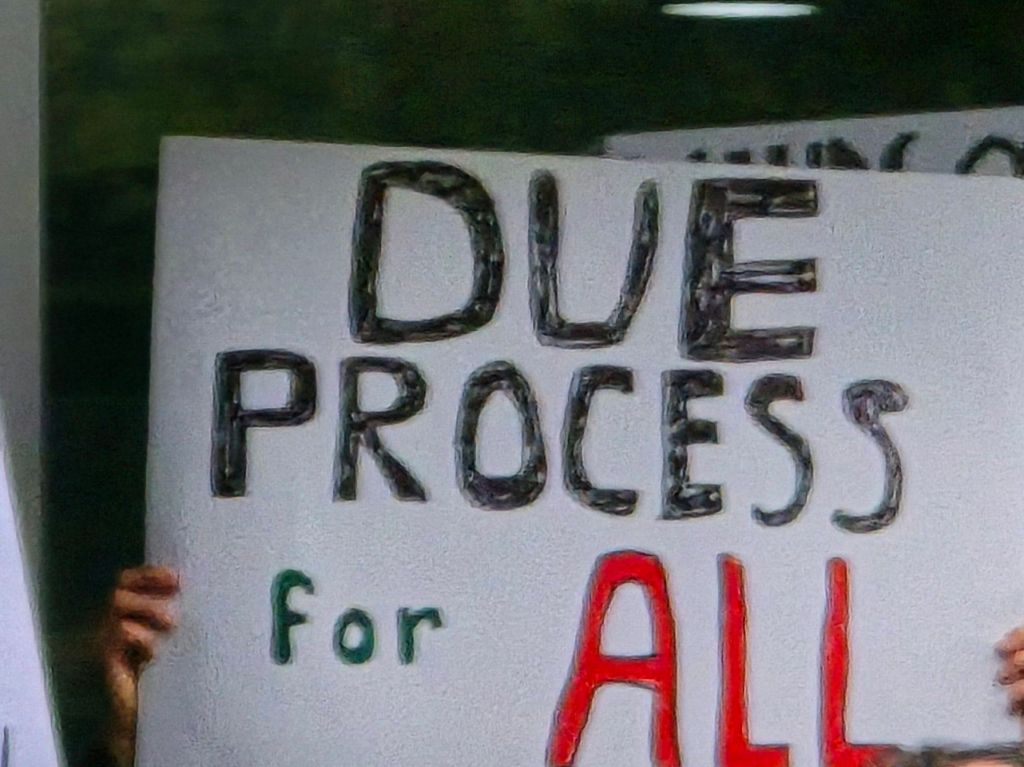
Speaking of signs … such creativity! Careful thought and consideration clearly went into these signs, messages of extreme concern for things we have been used to taking for granted like due process, libraries, and social security. There was a laundry list, but that is only because everything that serves the common good seems to be on the chopping block under the current regime. And yes, it feels more like a regime than an administration, if I am honest, just three months in.
A personal observation. This was not my first protest. I always come with my id and a form of payment just in case my right to protest is challenged by law enforcement or things go south. However, this was the first time that I decided it was prudent to bring my Global Entry card, which is government issued ID that declares my US citizenship. I am a US born white woman, yet current events led me to this precaution in these extraordinary times when our human and civil rights are under attack like never before in my lifetime. I will say that the Jersey City police were polite and just asked us to make sure we were not blocking pedestrian access to the PATH station.
Having been to many protests over the years, standing up for peace and justice from the Gulf War under Bush Senior to Title 42 under Biden, this moment feels different. As Senator Booker named it on the Senate floor this week, this is not a right or left moment but a right and wrong moment. The general vibe of today carried a particular unifying ethos and for lack of a better word, simply felt different, even from the President’s Day event I attended earlier this year. This morning’s energy was a mix of joy and anger. It felt like a community, people showing up when a family member is sick. It felt like an all hands on deck moment. And it gave me hope. Indeed, as we chanted: The people united will never be defeated.
I find myself reminded of and praying with these words from Gaudium et Spes, the Pastoral Constitution of the Second Vatican Council:
“The joys and the hopes, the griefs and the anxieties of the people of this age, especially those who are poor or in any way afflicted, these are the joys and hopes, the griefs and anxieties of the followers of Christ. Indeed, nothing genuinely human fails to raise an echo in their hearts. .. That is why this community realizes that it is truly linked with humankind and its history by the deepest of bonds.”
May we, people of all and no faiths, be bound together in hope and loving action for all that is good. May we resist joyfully. Amen
I am sharing excerpts from my theological research on the Ethics of Resistance to Social Sin. In Episode 2, I share critical learnings from the experience of ordinary Christians resisting the death dealing reality of the Nazi regime in Germany and occupied territories. One major finding is that identity constrains the menu of moral choice. So how you see yourself, and the world, matters! Will you be a bystander who feels they are one person alone and can’t make a difference? A perpetrator/supporter who lashes out preemptively? Or a resister/rescuer who understands we all have agency to effect change and incorporate human dignity into your worldview? The choice my friends is ours!
NAZI HOLOCAUST: RESISTING EXTREME SOCIAL SIN The metanarrative of the Nazi Holocaust rightly focuses on the violence, repression, and death-dealing atrocities committed against millions of innocent people in the name of National Socialism and its corresponding ideology. Yet, there is another narrative, sometimes neglected, which is also set within Nazi Germany and the territories it occupied by force. It is the story of ordinary people—farmers, college students, and average citizens—who resisted the Nazi regime from within their own spheres of influence, frequently paying for their resistance with their own lives.
To be sure, many Germans supported Adolf Hitler and company when they assumed power, while others chose a position on the sidelines. As of 1941, the majority of the population had not become members of the Nazi party or its organizations. What is less well known is the story of the thousands of people arrested or executed for acts of resistance: 300,000 German political resisters were in prison by 1939; 5,000 active resisters were executed; and 15,000 members of the military were killed for desertion or other actions deemed subversive. (Kidder, vii-viii)
Mark A. Wolfgam asserts that, behind these numbers, one can discern still other “very ordinary Germans [who] were able to carry out meaningful acts of resistance.” The reason these acts of resistance by ordinary persons are not well known, at least in part, is because in the immediate decades after the war, resistance narratives “were focused primarily upon heroic elite resistance.” More recent efforts to collect oral histories from the wider population who survived the war, however, have illustrated that many ordinary people “sought to work for the end of the regime in more limited and private ways.” (Wolfgam, 202-203)
Those who sought to resist this extreme reality of social sin were faced with an overarching bureaucratic machine that impacted and controlled many facets of daily life. Hence, the path to resistance was not an easy one, nor was it easy to sustain.
“Sometimes a single gesture was all that could be dared. The range of actions that constitute resistance is very broad, encompassing flight, hiding, sheltering those in danger, participating in forbidden activities, maintaining a sense of humanity in a dehumanizing environment, and engaging in military or quasi-military actions that would physically harm the Nazi machine.” (Gurewitsch, 221)
Some, like Franz Jägerstätter, an Austrian farmer beatified by the Catholic Church in 2007, resisted military involvement all together. Jägerstätter was beheaded in 1943 for his refusal to serve in the Nazi military, despite repeated counsel to the contrary by Church officials. (Kidder, 34) He wrote of his discernment to resist: “Does it still bear witness to Christian love of neighbor if I commit an act, which I truly regard as evil and very unjust, and yet I continue to commit the act because otherwise I would suffer either physical or economic harm?” (Putz, 70)1
Other ordinary people sought to transform the social context by raising consciousness and conscience regarding the atrocities of the Nazi regime. In Munich, Germany, a group of college students calling themselves the White Rose Society widely distributed six strongly worded leaflets “to encourage passive resistance to the Nazi regime by unmasking its evil.” (Kidder, 34) They asked: “Why do the German people behave so apathetically in the face of all these abominable crimes, crimes so unworthy of the human race?” (White Rose Society, “Second Leaflet”) In February 1942, after being caught in the act of distributing the sixth leaflet on the campus of the University of Munich, siblings Hans and Sophie Scholl were arrested, sentenced with high treason, and executed. Other White Rose Society members were later executed. (Michalczyk and Müller, 49)
Seven months after the arrest of the Scholl siblings, thousands of ordinary people in Denmark managed a remarkable act of resistance on a grand scale. Within two days of a leaked announcement of a Nazi plan to round up the Danish Jewish population en masse—around 7,000 people—on the eve of Rosh Hashanah, “most Jews had succeeding in finding refuge with other Danes or in going into hiding.” They were helped by “thousands of unknown individuals” across the wide spectrum of Danish society. Still other Danes “knew what was going on, from neighbors to the staff on trains to the Danish police, and did not tell the Germans.” Within two months, most Danish Jews had escaped via small fishing boats to safety in neutral Sweden. (Trautner-Kromann, 91-93)
The contemporary reader, reflecting on what is now known of the extent of the atrocities of the Nazi holocaust and the probable cost for these acts of resistance, might be forgiven for thinking that these ordinary resisters were extraordinary, if not heroic. Andrew Michael Flescher contends that even those named “heroes” are both “ordinary and extraordinary.” They are extraordinary in that they “perform considerable altruistic actions at great costs,” yet they are ordinary because “they affirm rather than transcend their humanity.” 2 (Flescher, 154-155)
Reflecting on his own study of oral histories by ordinary Germans who resisted the Nazi regime, Wolfgam observes that “these acts of resistance … open new questions as to why more was not done.” (Wolfgam, 216-217) This key ethical question has relevance beyond the Nazi holocaust, to contemporary genocide, and to individual and collective response to other forms of social sin. It is helpful to ask the reverse of this key question: what was it that enabled thousands of ordinary people to counter the dehumanization of the Nazi regime through acts of resistance to extreme social sin in their daily lives?
Political psychologist Kristen Renwick Monroe offers a critical insight on this reverse question of motive. Analyzing extensive interviews with rescuers, bystanders, and Nazi supporters to examine their “diverse responses to Genocide,” Monroe concludes that “identity constrains choice” across all three groups. (Monroe, 190) In other words, one’s identity—in relation to self, other, world, and agency—radically influences one’s ethical response and actions. (Monroe, 245) She proposes thinking of one’s identity as providing a “cognitive menu” of moral choice. “Acts not on the cognitive menu are not considered, just as pizza is not an option in a Japanese restaurant.” (Monroe, 200)
Monroe found that bystanders “saw themselves as weak, low on efficacy, with little control over the situation.” (Monroe, 193) Their common response was: “But what could I do? I was one person alone against the Nazis.” (Monroe, 214) Supporters of the Nazi regime, paradoxically, saw themselves as victims, “besieged by threats to their well-being.” (Monroe, 197) They were willing to strike “preemptively” at target groups out of a perceived need for self preservation. (Monroe, 200) They also perceived themselves as constrained by “forces beyond human control that drive world events.” (Monroe, 214) By contrast, Monroe found that rescuers saw themselves as “connected with everyone” and able to effect change. (Monroe, 192) Notably, she also discovered that they were the only group who “had integrated the value of human life into their worldview.” Monroe believes that her findings suggest that identity constitutes “the force that moves us beyond generalized feelings of sympathy, sorrow, or even outrage to a sense of moral imperative…” Finally, she encourages “other scholars to test” her results in various contexts. (Monroe, 247) It seems clear that a key question from her findings for the field of ethics, particularly as it regards the response to contemporary and enduring forms of social sin, is how to broaden the menu of moral choice.
Next Up in the Series – Episode 3, Contemporary Resistance in Everyday Actions
1 Putz is a biographer and editor of the writings of Jägerstatter. She does not cite the exact source of this quotation.
2 Emphasis in the original text.
Sources
Andrew Michael Flescher, Heroes, Saints and Ordinary Morality (Washington, DC: Georgetown University, 2003)
Brana Gurewitsch, ed., Mothers, Sisters, Resisters: Oral Histories of Women Who Survived the Holocaust (Tuscaloosa, AL: University of Alabama Press, 1998)
Annemarie S. Kidder, Ultimate Price: Testimonies of Christians Who Resisted the Third Reich (Maryknoll, NY: Orbis Books, 2012)
John J. Michalczyk and Franz J. Müller, “The White Rose Student Movement in Germany: Its History and Relevance Today,” in Resisters, Rescuers, and Refugees: Historical and Ethical Issues, ed. John J. Michalczyk (Kansas City: Sheed & Ward, 1997)
Kristen Renwick Monroe, Ethics in an Age of Terror and Genocide: Identity and Moral Choice (Princeton: Princeton University Press, 2012)
Erna Putz, “Franz Jägerstatter: Better the Hands in Chains than the Will,” in Christianity and Resistance in the 20th Century (Boston: Brill, 2009)
Hanne Trautner-Kromann, “The Role of Moral Examples in Teaching Ethics after the Holocaust,” in The Double Binds of Ethics After the Holocaust: Salvaging the Fragments, eds. Jennifer L. Geddes, John K. Roth, and Jules Simon (New York: Palgrave Macmillan, 2009),
Mark A. Wolfgam, “Rediscovering Narratives of German Resistance: Opposing the Nazi ‘Terror-State,” Rethinking History 10 (June 2006)
Excerpt from: “Human Trafficking as Social Sin: An Ethic of Resistance,” by Susan Rose Francois, CSJP. Submitted to the Faculty of The Catholic Theological Union at Chicago in partial fulfillment of the requirement for the degree of Masters of Arts in Theology, March 2015.
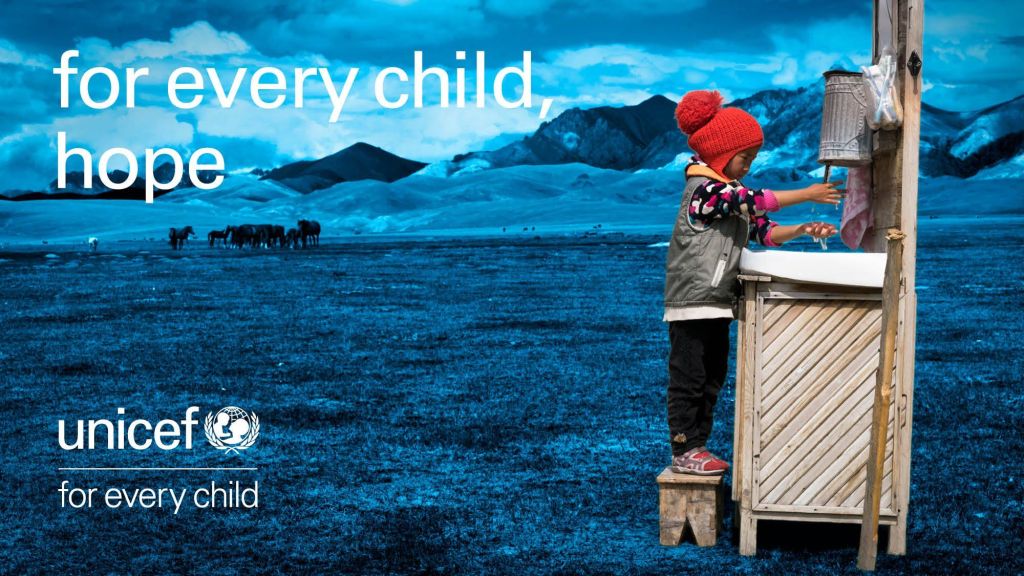
Yesterday, I was blessed to spend the day at the first ever UNICEF USA Interfaith Convening on the Rights of Children. (Tomorrow is World Children’s Day). UNICEF gathered a diverse group of interfaith partners to learn about and explore how to address the equity gap in meeting the “polycrises” impacting the world’s children.
In 2023 alone, UNICEF responded to more than 400 humanitarian crises, but just 5 received 50 percent of the funding, while others don’t make the headlines. For example, I have to admit I was not aware that over 2 million people are displaced in Burkina Faso because of armed conflict. I committed to coming home and researching this particular crisis.
The Convening was an important learning opportunity. More importantly, it was a time to connect across our faith traditions. What became more clear as each speaker shared was that we are all motivated by universal truths to meet universal needs. There is power and possibility as we come together to act for the children of our world. Change is possible when we build community.
Hope was palpable in the room as people from faith traditions that are, at this very moment, engaged in armed conflicts that are harming children, came together not to debate politics but to commit to serving our common humanity. Differences arose, but we did not get stuck there. We all agreed that we need to cultivate more spaces like this to spend time on common ground. Rooted in our own traditions, we came together to plant seeds of hope.
During my sharing time, in the format of a fireside chat (minus the fireside!), I was asked what I think is the greatest crisis facing children. Reflecting on the millions of children at risk every day from dangerous conditions resulting from armed conflict and environmental disasters, I shared what Pope Francis says about the globalization of indifference. How can we be indifferent to the need of EVERY Child for safety, food, shelter, health, and education? And yet as a global community we are failing so many children.
We must resist the temptation to feel numb. We need community, we need to cultivate our common ground, and we need to act. For every child.
Because of the equity crisis, there is a desperate need for flexible funding. I was there because my Congregation supports the UNICEF Every Child Fund, a fund that enables UNICEF to help reach children with critical support when and where they need it the most. YOU can too! Click the link to learn more. And if you feel so called, to make a donation no matter how small.
I have been pondering what, if anything, to share regarding my post election thoughts. It hasn’t quite been a week, but I have been reading the national temperature and preparing for this result for a while now. So here goes…
First, before you ask, I have already discerned that this time around, I will not be reviving my daily practice of posting a prayer for President Trump.
Why?
For one thing, the platform itself has changed from Twitter to X, resulting in a significant change in ownership, philosophy, and audience. Somehow (the grace of God?), for the most part, I avoided being trolled or harassed last time. I suspect that may not be true this time around, and dealing with that possibility is not where I wish to place my energy.
This does not mean I stop praying. I pray for our elected leaders each and every day, and the 47th President and his administration will certainly be included in my daily prayers. As will the most vulnerable people and ecosystems who will be impacted by policy changes he proposes.
I have been posting short videos that share some simple messages about God’s love, goodness, the beauty of God’s creation, human dignity, the call to be still and grounded…
These are simple yet profound truths that seem to be lost or drowned out in the noise of the globalization of indifference and toxic nature of our (un)civil discourse that makes fertile ground for misinformation and the sowing of fear, hate and division. These posts seem to be finding an audience, if modest in size. More importantly, I believe this type of messaging is urgently needed in our public space. Let me explain.
When I was in graduate theological studies, my research focused on resistance to social sin. One of my key findings had to do with identity and moral choice.
Political psychologist Kristen Renwick Monroe analyzed first hand accounts of ordinary Germans during the Nazi regime and found that how they saw themselves directly impacted how they responded. I believe there are lessons to be learned for our present moment.
Those who supported the regime saw themselves as victims. They were willing to act preemptively against the other out of a desire for self-preservation.
Bystanders saw themselves as helpless, just one person alone against the Nazis. What could they do?
Rescuers saw themselves as connected with everyone and able to effect change. Notably, Monroe also discovered that they were the only group who “had integrated the value of human life into their worldview.”
She concludes that “identity constrains choice” across all three groups. In other words, one’s identity—in relation to self, other, world, and agency—radically influences one’s ethical response and actions. Monroe believes that her findings suggest that identity constitutes “the force that moves us beyond generalized feelings of sympathy, sorrow, or even outrage to a sense of moral imperative.”
So, in addition to getting ready to be a strong, vocal, and persistent advocate for the common good, human rights, peace, and the integrity of creation in the face of likely policy, legislative, and economic changes over the next four years, I also want to do my part to help (re)form our collective sense of identity and expand our menu of moral choice.
I see myself as connected to everyone. My worldview, informed and inspired by my parents and their/my Catholic faith, calls me to see human life and dignity and the goodness of all of God’s creation as central to my worldview and demanding of my action. My religious community strengthens and expands this understanding through our common life, prayer, mission, and charism.
I feel a deep sense of call to use my gifts, talents, and influence to spread that message in the belief that it will make a difference. Also, I am hoping it will help me stay grounded during the next four years.
Yesterday I had the opportunity to watch the opera Dead Man Walking performed at the Meteopolitan Opera House in New York.
The story and witness of Sister Helen Prejean is familiar to me. I have read her memoir and of course saw the movie. On a personal note, when I was sharing my surprising news of becoming a Catholic Sister, she was a helpful reference point. More than once I found myself saying, “Think more Susan Sarandon in Dead Man Walking than Sally Field in Flying Nun,” especially to my non-Catholic friends.
I have also met Sister Helen, several years ago, when she spoke at an event for one of our CSJP sponsored ministries and I have heard her talk several times. I was delighted to discover that the Opera does justice to her sense of humor. I have long thought that her sense of humor must be part of what keeps her going in her ministry as an advocate to stop the death penalty.
Yesterday afternoon, absorbed in the Opera, I also saw depicted what I also suspect is part of what keeps her going … being part of a community.
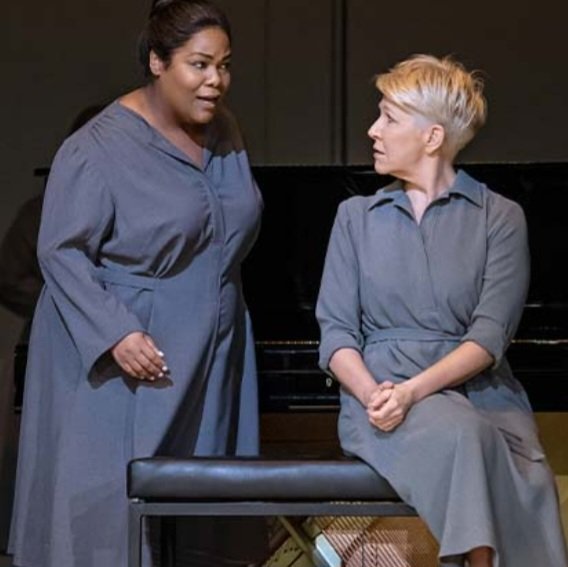
From the very beginning of the Opera, she is supported and challenged by her religious sisters, from her decision to visit an inmate on death row she has been writing all the way through the heartache of accompanying him to his final breath. There is one scene at the beginning of Act II, pictured above, where one of her sisters hears Helen cry out in a nightmare and comes to check on her. Their duet is lovely and real and grounded in the charism of the Sisters of St Joseph of Medaille to serve the dear neighbor. Sister Rose neighbors her friend Helen. More than that, she shares the journey with her sister and friend in a very real way.
You can feel as Sister Helen takes the next heart breaking steps of the journey with Joseph, the man on death row, that she brings the strength from her community with her. She builds a relationship with Joe, as she calls him. She neighbors him.
We have a saying in our community, where one of us ministers, we are all there. This depiction of Sister Helen’s story, the combination of the beautiful music and the creative if stark staging and incredible performances somehow made this clear. Even when it was only Sister Helen on stage with the warden or the priest or Joe, or with the victims’ parents, I could sense her sense that she was not alone. God was with her, and so were her sisters.
To be honest, despite the costume choice (all the sisters were wearing the same drab gray dress rather than the clothes of the day Sister Helen and the CSJs actually wear), the opera was one of the best expressions of apostolic religious life lived in community I have ever seen in art.
When I was a novice, we attended classes with those in formation with other religious congregations. One day, we were sharing the words of our different Constitutions on the vows. That is when I discovered that what has become one of my favorite passages in our CSJP Constitutions is rather unique. Not only does it talk about the value of leisure, it is part of our vow of poverty section!
In solidarity with our sisters and brothers
we engage in human labor
as a means of service and sustenance.
We recognize the value of leisure
as contributing to restoration and wholeness.
In these ways we come to share
in the creative power of God.
(Constitution 54)
Work is good and important and part of the way we participate in the creative power of God. But so too is leisure. We are called to be whole persons, and this requires making time and space for rest, relaxation and renewal.
I am so blessed to be a Sister of St. Joseph of Peace for many reasons, including this commitment to holding each other accountable to this balance.
Starting today I am stepping away from my day to day ministry life for a mix of some restorative work and leisure. Over the next ten days or so, I will be visiting with friends and family. I will also be joining two sister writer friends for a writing retreat. Did I mention how blessed I am that my community supports me in making time and space for this in my busy life?
How are you making space for restoration, wholeness, and the creative power of God in your life these summer months?
Four years ago it was my honor and privilege to be a Nun on the Bus. You remember that election I am sure. I was on the bus from Janesville, Wisconsin to Cleveland, Ohio. Along the way I met some amazing people and heard incredible stories about the joys and struggles of our brothers and sisters. My leg on the trip ended at the Republican National Convention where we passed out lemonade to delegates and asked them three questions: 1. Who is difficult to talk to about politics in your family and why. 2. What conerns you about the election. 3. What gives you hope for our nation.
“Our diversity is our strength,” one man from Wisconsin told me. “It can be scary, but over time our country will heal based on our strong values.” Another from Tennessee said, “We have overcome a lot before as a nation and can do it again.”
For that to be possible, we need to bridge the growing political divide. We need to sweeten the sour conversations in our body politic, in our families and in our communities. We need to talk with people with whom we do not normally engage. If we want to mend the gaps and reweave the fabric of society, then we need to move beyond trading barbs, attacks and presumed facts and focus instead on our hearts, probe our fears, and dare to hope for our nation.
(you can read other reflections I wrote from the bus in 2016 here, here, here, and here.
Sadly, the divide has deepened and the gaps seem even wider today. I believe that this 2020 election comes at a critical time in our nation’s story. The theme of the 2020 Nuns on the Bus Tour–which will of course be virtual given our COVID reality–is therefore quite fitting: Who We Elect Matters. For this reason, I decided to get back on the bus this year to talk about how I feel called to be a multi issue voter.
In many ways, the voter I am today is because of my Mom. My Mom knew in her bones that who we elect matters in the lives of real people, especially those who are poor and vulnerable. She taught me to care for life at all stages, to promote human dignity and the common good and to bring all those concerns into the voting booth (or onto the pages of a mail in ballot, as the case may be.)
Now, you might be wondering what a virtual Nuns on the Bus Tour looks like! Well, the journey officially begins on September 23, but the website is live now. When you click on the link you will find a map of our great country, with various stops you can make, including:
-Meet a Nun on the Bus Videos (you can watch my video here) and Site Visit videos where you can meet people involved in social service agencies and community organizations
-Sign up for live events, including Site Visits, Town Halls for Spirit Filled Voters and Dialogues Across Geographic Divides.
I will be attending events in New York City, New Jersey, Florida, Kansas, St. Louis, and Arizona — all virtually of course. I hope to maybe see some of you there!
But most importantly, I pray that all voters will take this election seriously, follow their conscience, and vote for the common good.
This post is dedicated to the people in my life who are most directly impacted by the sin of racism.
My prayer of late is percolating, filled with emotion and low on words. I am a very strong “T” on the Myers Briggs (those who know me will not be surprised), but my thought bubbles right now are being outpaced by my heart bubbles.
Love for the people in my life most directly impacted by racism. Frustration at the daily challenge they face just going through life, microagressions, burdens, barriers and other things I can intellectually try to understand but never really will. Care and concern for them, especially at this time when everything is, just, everything.
Anger at the lives lost and put in danger because of the lie of white supremacy. Kids with candy or toys killed. Young men running or walking killed. Young women in their own homes or cars killed. Enough says my heart. When will it stop cries my heart.
Suprise that many well meaning people with skin tones close to mine, who normally don’t see color, are now making the NYT nonfiction best seller list decidedly anti-racist themed. Grateful even if they are late to the party. Worried that a crash course or binge read may not be the best way to do systemic work.
Hope. This moment does feel different. Fervent hope that it truly is different.
Because of the LOVE I feel deep in my heart for the people I have been blessed to call friend and family and community who are most impacted, each moment, each day, each hour, each minute by the sin of racism.
Because of the LOVE that created us and knitted us together. In the beginning, now and forever.
My novice classmate, sister, and friend Chero reminded me that yesterday was the 11th anniversary of our first profession of vows.
So much had happened since then: four years of social justice ministry, two and a half years of graduate school, and now four and a half years of community ministry on the leadership team. Many moves. And so much in between!
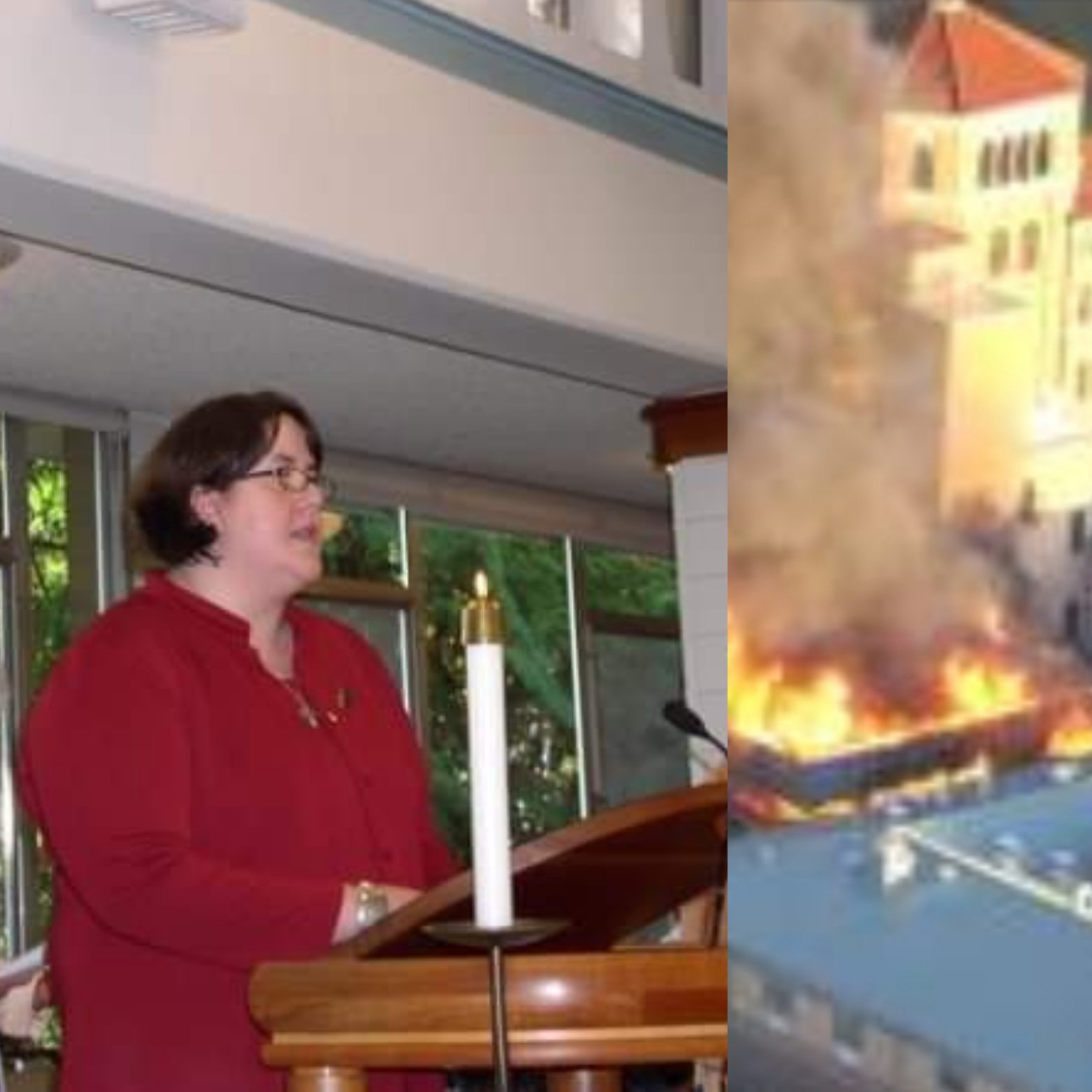
This morning, as I walked down the stairs in my pajamas to get my morning coffee, I remembered that today is the 3rd anniversary of the fire at St. Michael Villa, our regional center where I happen to live. While we are back in our corner of the house that received less smoke damage, we are anxiously anticipating the reopening of the main house soon. Lots of losses and discoveries and moves to temporary housing since waking up to a very real fire alarm.
Both memories lead me to give thanks for the gifts of community and belonging.
The past eleven years have been filled with so much love in action.
Prayers, hopes, and dreams shared.
Challenges and disasters navigated together.
Waiting in joyful hope, and maybe a bit of impatience thrown in for good measure.
Invitations and opportunities.
Roadblocks and detours.
Growing together as community for mission.
Finding my voice as a writer and discovering bit by bit my role as a leader.
It is the big moments and the little ones that make up this adventure called life, and God is always in the mix if we care to look.
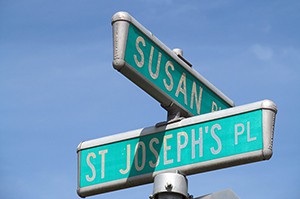



















 At the Corner of Susan and St. Joseph