This morning during my contemplative prayer time, these words came to me over and over: “YOU are God.”
God is love. God is the source of everything that is good. God is God, and we are not … hence all the humanness of our shared reality.
God is.
As the saying goes in the Black church: “God is good all the time. All the time, God is good.”
YOU are God. These words grounded my heart during my silent prayer this morning, as my mind wandered to the many troubles plaguing our human and earth community. God is God. Those humans in power and those abusing power are not God.
Later, I found myself reflecting on the character Groot in the Marvel Guardians of the Galaxy movies. Just as the one phrase, “YOU are God,” repeated over and over again in my heart during my meditation this morning, Groot has just one phrase: “I am Groot.”
Yet this phrase has a surplus of meaning. In the Marvel universe, Groot is a a member of the Flora Colossi, a race of treelike alien beings from Planet X. Highly intelligent creatures, Flora Colossi have a stiff larynx that is only capable of making a sequence of sounds that we hear as “I am Groot.” His friend Rocket apparently understands Groot’s language, and helpfully offers his interpretation skills for the benefit of all. What sounds to us like three simple words can carry a variety of meanings, depending on the context and delivery. Without giving away any serious spoilers, at one point Groot’s sequence of sounds meaningfully shifts to “We are Groot” after a moment of self-sacrificing love for his friends.
Now, WE are not God. Yet we are made in the image and likeness of God. We are made to love. We are made to be and do good. We are made to care for creation and one another. We are not good all the time, but all the time we are called back to love and goodness through the mercy of God. And for that, I am very grateful.
Today, this brown eyed Susan turns another year older. Three years into my fifth decade and I continue to be astounded.
Astounded by the love of God who created all things even you and me and everyone and everything in between, for all eternity … created out of and for love.
Astounded by the beauty of creation. No words necessary.
Astounded by the gift of life and the invitation to share my gifts (and even vulnerablities) for the good of the whole, to be present to the beauty and the pain, to witness to God’s love even amidst suffering, and to remember and re-member in service of God’s dreams for us.
Astounded by the witness, love and challenge of family, friends, community, colleagues, strangers, bunny rabbits and birds and dragonflies. You name it.
Today on the Feast of St. Joseph, I am reminded of the many ways God breaks through and into our lives and our world, often unexpected. Think of the story of Joseph, the unexpected message he received in a dream from an angel and his faithful response despite the pressures of society.
There’s a song that captures this moment by Waterdeep, which I recently illustrated in a prayer video using a favorite picture of stained glass window depicting this critical moment in our faith history.
Mary’s annunciation gets a lot of attention, and rightly so. But how often do we reflect on this other annunciation? And what might Joseph’s response teach us today as we face our own uncertain and confusing moments?
I love this stained glass window of Joseph receiving the message of the angel. It is so very human. When I would visit my father at St. Joseph Village in Chicago, the nursing home on the North Side of Chicago where my Dad lived his last years, I would see this window behind the altar in the chapel. St. Joseph Village was the first ministry of the Franciscan Sisters of Chicago, founded in 1897. The current building is a new construction, and it is clear that special attention was given to the design of the chapel. It is a beautiful place to pray, filled with light.
Joseph does not respond to the angel’s heavenly message with words, at least not according to Matthew’s Gospel account (2: 18-25). This stained-glass window, however, implies what must have been his natural response. “His expression,” notes the booklet describing the chapel artwork, “seems to suggest the question, ‘What does this mean?’”
Not only does his expression speak volumes, but also Joseph’s posture—hands open, shoulders shrugged, one knee on the ground. He has even dropped his tools. His life will never be the same.
The angel tells Joseph not to be afraid to welcome Mary into his home, to form a family. “For it is through the Holy Spirit that this child has been conceived in her.”
Joseph, a man of few words—or no words at least that have been recorded—spoke instead with his actions. Joseph was open to the unexpected.
Joseph took Mary into his home and helped to raise Jesus. “Joseph’s ordinary life of labor and purity of intention have been transformed into an extraordinary element of God’s holy plan.”
WHAT WOULD you do if an angel appeared to you in a dream and told you something completely unexpected, life changing, and a little bit crazy?
God often speaks to us through the unexpected. Most likely we do not have visions or angelic messages, but then again, what else are friends and family and those “aha” moments? God’s love surprises us again and again, often in unexpected ways. And the message is clear … Be Not Afraid. Respond with love in return. And all will be well.
Prayer for Unexpected Moments St. Joseph, inspire us to be open to the unexpected Spirit-filled moments of life. Pray with and for us, that we too may see the extraordinary possibilities hidden in the ordinariness of life. Thank you for the many ways you modeled acceptance and loving response to God’s love. May we too respond to God’s gifts with faith, gratitude, and loving action. Amen
I am sharing excerpts from my theological research on the Ethics of Resistance to Social Sin. In Episode 2, I share critical learnings from the experience of ordinary Christians resisting the death dealing reality of the Nazi regime in Germany and occupied territories. One major finding is that identity constrains the menu of moral choice. So how you see yourself, and the world, matters! Will you be a bystander who feels they are one person alone and can’t make a difference? A perpetrator/supporter who lashes out preemptively? Or a resister/rescuer who understands we all have agency to effect change and incorporate human dignity into your worldview? The choice my friends is ours!
NAZI HOLOCAUST: RESISTING EXTREME SOCIAL SIN The metanarrative of the Nazi Holocaust rightly focuses on the violence, repression, and death-dealing atrocities committed against millions of innocent people in the name of National Socialism and its corresponding ideology. Yet, there is another narrative, sometimes neglected, which is also set within Nazi Germany and the territories it occupied by force. It is the story of ordinary people—farmers, college students, and average citizens—who resisted the Nazi regime from within their own spheres of influence, frequently paying for their resistance with their own lives.
To be sure, many Germans supported Adolf Hitler and company when they assumed power, while others chose a position on the sidelines. As of 1941, the majority of the population had not become members of the Nazi party or its organizations. What is less well known is the story of the thousands of people arrested or executed for acts of resistance: 300,000 German political resisters were in prison by 1939; 5,000 active resisters were executed; and 15,000 members of the military were killed for desertion or other actions deemed subversive. (Kidder, vii-viii)
Mark A. Wolfgam asserts that, behind these numbers, one can discern still other “very ordinary Germans [who] were able to carry out meaningful acts of resistance.” The reason these acts of resistance by ordinary persons are not well known, at least in part, is because in the immediate decades after the war, resistance narratives “were focused primarily upon heroic elite resistance.” More recent efforts to collect oral histories from the wider population who survived the war, however, have illustrated that many ordinary people “sought to work for the end of the regime in more limited and private ways.” (Wolfgam, 202-203)
Those who sought to resist this extreme reality of social sin were faced with an overarching bureaucratic machine that impacted and controlled many facets of daily life. Hence, the path to resistance was not an easy one, nor was it easy to sustain.
“Sometimes a single gesture was all that could be dared. The range of actions that constitute resistance is very broad, encompassing flight, hiding, sheltering those in danger, participating in forbidden activities, maintaining a sense of humanity in a dehumanizing environment, and engaging in military or quasi-military actions that would physically harm the Nazi machine.” (Gurewitsch, 221)
Some, like Franz Jägerstätter, an Austrian farmer beatified by the Catholic Church in 2007, resisted military involvement all together. Jägerstätter was beheaded in 1943 for his refusal to serve in the Nazi military, despite repeated counsel to the contrary by Church officials. (Kidder, 34) He wrote of his discernment to resist: “Does it still bear witness to Christian love of neighbor if I commit an act, which I truly regard as evil and very unjust, and yet I continue to commit the act because otherwise I would suffer either physical or economic harm?” (Putz, 70)1
Other ordinary people sought to transform the social context by raising consciousness and conscience regarding the atrocities of the Nazi regime. In Munich, Germany, a group of college students calling themselves the White Rose Society widely distributed six strongly worded leaflets “to encourage passive resistance to the Nazi regime by unmasking its evil.” (Kidder, 34) They asked: “Why do the German people behave so apathetically in the face of all these abominable crimes, crimes so unworthy of the human race?” (White Rose Society, “Second Leaflet”) In February 1942, after being caught in the act of distributing the sixth leaflet on the campus of the University of Munich, siblings Hans and Sophie Scholl were arrested, sentenced with high treason, and executed. Other White Rose Society members were later executed. (Michalczyk and Müller, 49)
Seven months after the arrest of the Scholl siblings, thousands of ordinary people in Denmark managed a remarkable act of resistance on a grand scale. Within two days of a leaked announcement of a Nazi plan to round up the Danish Jewish population en masse—around 7,000 people—on the eve of Rosh Hashanah, “most Jews had succeeding in finding refuge with other Danes or in going into hiding.” They were helped by “thousands of unknown individuals” across the wide spectrum of Danish society. Still other Danes “knew what was going on, from neighbors to the staff on trains to the Danish police, and did not tell the Germans.” Within two months, most Danish Jews had escaped via small fishing boats to safety in neutral Sweden. (Trautner-Kromann, 91-93)
The contemporary reader, reflecting on what is now known of the extent of the atrocities of the Nazi holocaust and the probable cost for these acts of resistance, might be forgiven for thinking that these ordinary resisters were extraordinary, if not heroic. Andrew Michael Flescher contends that even those named “heroes” are both “ordinary and extraordinary.” They are extraordinary in that they “perform considerable altruistic actions at great costs,” yet they are ordinary because “they affirm rather than transcend their humanity.” 2 (Flescher, 154-155)
Reflecting on his own study of oral histories by ordinary Germans who resisted the Nazi regime, Wolfgam observes that “these acts of resistance … open new questions as to why more was not done.” (Wolfgam, 216-217) This key ethical question has relevance beyond the Nazi holocaust, to contemporary genocide, and to individual and collective response to other forms of social sin. It is helpful to ask the reverse of this key question: what was it that enabled thousands of ordinary people to counter the dehumanization of the Nazi regime through acts of resistance to extreme social sin in their daily lives?
Political psychologist Kristen Renwick Monroe offers a critical insight on this reverse question of motive. Analyzing extensive interviews with rescuers, bystanders, and Nazi supporters to examine their “diverse responses to Genocide,” Monroe concludes that “identity constrains choice” across all three groups. (Monroe, 190) In other words, one’s identity—in relation to self, other, world, and agency—radically influences one’s ethical response and actions. (Monroe, 245) She proposes thinking of one’s identity as providing a “cognitive menu” of moral choice. “Acts not on the cognitive menu are not considered, just as pizza is not an option in a Japanese restaurant.” (Monroe, 200)
Monroe found that bystanders “saw themselves as weak, low on efficacy, with little control over the situation.” (Monroe, 193) Their common response was: “But what could I do? I was one person alone against the Nazis.” (Monroe, 214) Supporters of the Nazi regime, paradoxically, saw themselves as victims, “besieged by threats to their well-being.” (Monroe, 197) They were willing to strike “preemptively” at target groups out of a perceived need for self preservation. (Monroe, 200) They also perceived themselves as constrained by “forces beyond human control that drive world events.” (Monroe, 214) By contrast, Monroe found that rescuers saw themselves as “connected with everyone” and able to effect change. (Monroe, 192) Notably, she also discovered that they were the only group who “had integrated the value of human life into their worldview.” Monroe believes that her findings suggest that identity constitutes “the force that moves us beyond generalized feelings of sympathy, sorrow, or even outrage to a sense of moral imperative…” Finally, she encourages “other scholars to test” her results in various contexts. (Monroe, 247) It seems clear that a key question from her findings for the field of ethics, particularly as it regards the response to contemporary and enduring forms of social sin, is how to broaden the menu of moral choice.
Next Up in the Series – Episode 3, Contemporary Resistance in Everyday Actions
1 Putz is a biographer and editor of the writings of Jägerstatter. She does not cite the exact source of this quotation.
2 Emphasis in the original text.
Sources
Andrew Michael Flescher, Heroes, Saints and Ordinary Morality (Washington, DC: Georgetown University, 2003)
Brana Gurewitsch, ed., Mothers, Sisters, Resisters: Oral Histories of Women Who Survived the Holocaust (Tuscaloosa, AL: University of Alabama Press, 1998)
Annemarie S. Kidder, Ultimate Price: Testimonies of Christians Who Resisted the Third Reich (Maryknoll, NY: Orbis Books, 2012)
John J. Michalczyk and Franz J. Müller, “The White Rose Student Movement in Germany: Its History and Relevance Today,” in Resisters, Rescuers, and Refugees: Historical and Ethical Issues, ed. John J. Michalczyk (Kansas City: Sheed & Ward, 1997)
Kristen Renwick Monroe, Ethics in an Age of Terror and Genocide: Identity and Moral Choice (Princeton: Princeton University Press, 2012)
Erna Putz, “Franz Jägerstatter: Better the Hands in Chains than the Will,” in Christianity and Resistance in the 20th Century (Boston: Brill, 2009)
Hanne Trautner-Kromann, “The Role of Moral Examples in Teaching Ethics after the Holocaust,” in The Double Binds of Ethics After the Holocaust: Salvaging the Fragments, eds. Jennifer L. Geddes, John K. Roth, and Jules Simon (New York: Palgrave Macmillan, 2009),
Mark A. Wolfgam, “Rediscovering Narratives of German Resistance: Opposing the Nazi ‘Terror-State,” Rethinking History 10 (June 2006)
Excerpt from: “Human Trafficking as Social Sin: An Ethic of Resistance,” by Susan Rose Francois, CSJP. Submitted to the Faculty of The Catholic Theological Union at Chicago in partial fulfillment of the requirement for the degree of Masters of Arts in Theology, March 2015.
I have been pondering what, if anything, to share regarding my post election thoughts. It hasn’t quite been a week, but I have been reading the national temperature and preparing for this result for a while now. So here goes…
First, before you ask, I have already discerned that this time around, I will not be reviving my daily practice of posting a prayer for President Trump.
Why?
For one thing, the platform itself has changed from Twitter to X, resulting in a significant change in ownership, philosophy, and audience. Somehow (the grace of God?), for the most part, I avoided being trolled or harassed last time. I suspect that may not be true this time around, and dealing with that possibility is not where I wish to place my energy.
This does not mean I stop praying. I pray for our elected leaders each and every day, and the 47th President and his administration will certainly be included in my daily prayers. As will the most vulnerable people and ecosystems who will be impacted by policy changes he proposes.
I have been posting short videos that share some simple messages about God’s love, goodness, the beauty of God’s creation, human dignity, the call to be still and grounded…
These are simple yet profound truths that seem to be lost or drowned out in the noise of the globalization of indifference and toxic nature of our (un)civil discourse that makes fertile ground for misinformation and the sowing of fear, hate and division. These posts seem to be finding an audience, if modest in size. More importantly, I believe this type of messaging is urgently needed in our public space. Let me explain.
When I was in graduate theological studies, my research focused on resistance to social sin. One of my key findings had to do with identity and moral choice.
Political psychologist Kristen Renwick Monroe analyzed first hand accounts of ordinary Germans during the Nazi regime and found that how they saw themselves directly impacted how they responded. I believe there are lessons to be learned for our present moment.
Those who supported the regime saw themselves as victims. They were willing to act preemptively against the other out of a desire for self-preservation.
Bystanders saw themselves as helpless, just one person alone against the Nazis. What could they do?
Rescuers saw themselves as connected with everyone and able to effect change. Notably, Monroe also discovered that they were the only group who “had integrated the value of human life into their worldview.”
She concludes that “identity constrains choice” across all three groups. In other words, one’s identity—in relation to self, other, world, and agency—radically influences one’s ethical response and actions. Monroe believes that her findings suggest that identity constitutes “the force that moves us beyond generalized feelings of sympathy, sorrow, or even outrage to a sense of moral imperative.”
So, in addition to getting ready to be a strong, vocal, and persistent advocate for the common good, human rights, peace, and the integrity of creation in the face of likely policy, legislative, and economic changes over the next four years, I also want to do my part to help (re)form our collective sense of identity and expand our menu of moral choice.
I see myself as connected to everyone. My worldview, informed and inspired by my parents and their/my Catholic faith, calls me to see human life and dignity and the goodness of all of God’s creation as central to my worldview and demanding of my action. My religious community strengthens and expands this understanding through our common life, prayer, mission, and charism.
I feel a deep sense of call to use my gifts, talents, and influence to spread that message in the belief that it will make a difference. Also, I am hoping it will help me stay grounded during the next four years.
Today’s Feast of the Transfiguration challenges us to remember we, too, are Beloved of God. Moreover, as followers of Jesus we are called to listen to him and act accordingly.
Over a decade ago, I made this prayer video, set to the song Transfiguration by Indie singer songwrote Sufjan Stevens. As I prayed with it this morning, I was caught by his repetition of the phrase “Lost in the cloud…”
Lost in the cloud, a voice. Have no fear! We draw near! Lost in the cloud, a sign. Son of man! Turn your ear. Lost in the cloud, a voice. Lamb of God! We draw near! Lost in the cloud, a sign. Son of man! Son of God!
We can get lost in the cloud. The cloud of indifference. The cloud of division. The cloud of misinformation. The cloud of …. insert that which separates us from God’s love. And yet, we are called to LISTEN to the Beloved. We are called to Be Loved. We are called to Be Love.
As we hear in today’s reading from the second letter of Saint Peter (1:19):
“You will do well to be attentive to it, as to a lamp shining in a dark place, until day dawns and the morning star rises in your hearts.”
Let us remember and transform the clouds of our lives into light and love and goodness, strengthened by the Source of every Good thing.
I finish my few days of retreat today, grateful for the blessing and opportunity of this time of solitude, prayer, and reflection.
In the words of our CSJP Constitutions:
“Recognizing gospel peace as both gift and task, we believe that prayer is fundamental to our life. …
In unity with the church and with all of creation we give praise and thanks to the Giver of all gifts. We open ourselves to the liberating power of God whose Spirit in us leads to peace.
Personal prayer deepens our desire to be united with God in faith, enabling us to see God’s presence and action in our lives and in the world.”
So much had happened since my annual retreat last October, good and bad, challenging and encouraging, and everything in between … in my own life, my life in community, and our wider world. There is so much to pray for and with! It is pure gift to have the ability to take time away in solitude with God’s love and mercy. Such a gift also carries responsibility, which I do not take lightly.
I have held in prayer many these days, those I promised to pray for, those I know, and many I do not. I know too I have been held in prayer. Again, such gift.
I have been so aware of God’s love these days away, love beyond measure. In the words of the song My Belovedby Eliza King (a soundtrack of sorts for this retreat), I have been “leaning on my beloved.”
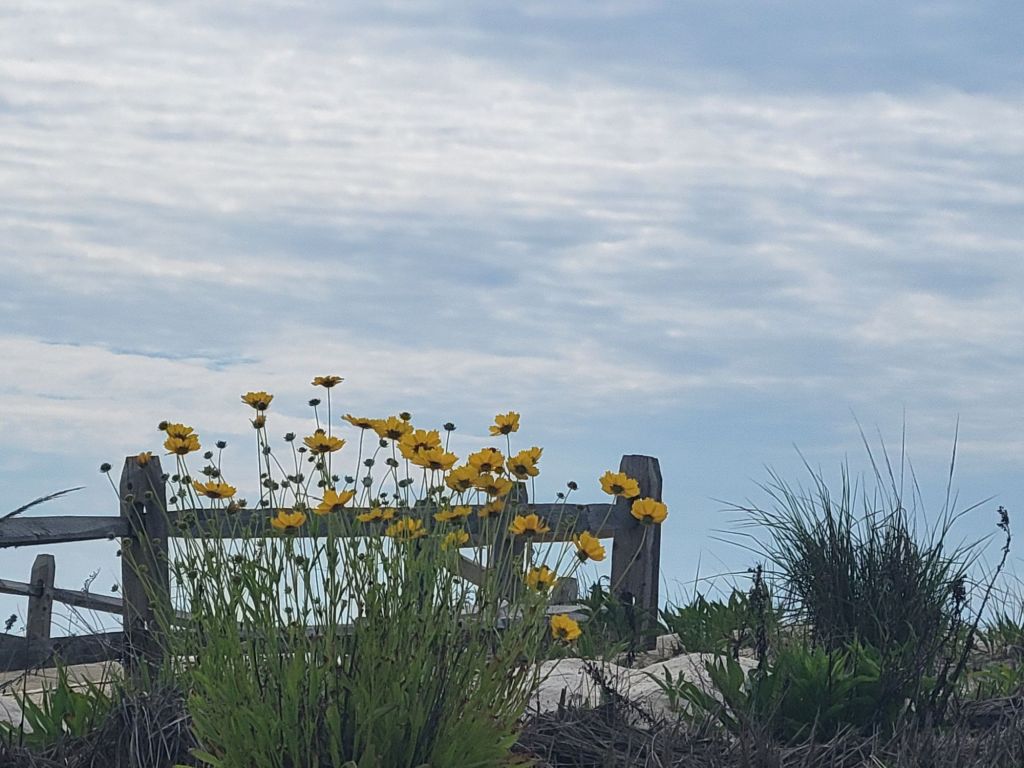
Graced with time by the ocean, going on long walks and just sitting by the sea, I have been so aware of the gifts of creation given freely by the One who loved us into being, the healing power of Christ who became one of us, and the persistent presence of the Spirit nudging us into wholeness.
God is so good, and so are we. May we remember that in good times as well as the more challenging times. May we be people of peace and reflect God’s love, mercy, and care for all of God’s creation. Amen.

















 At the Corner of Susan and St. Joseph