Tag Archives: immigration

Inhumane Profits

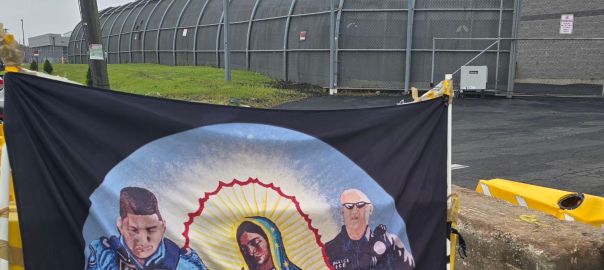
Imagine this scenario. Your daughter is a newlywed. While she is not a US citizen, her husband is, and she is trying to navigate the legal system to adjust her own status. She shows up at the immigration office for her regularly scheduled appointment, from which she does not return home. You finally make contact to learn that she is being held in immigration detention at Delaney Hall, a private for-profit prison run by GEO Group under a 15 year contract granted by the Trump Administration in February worth $1 Billion. You call the detention center to learn about visiting hours, yet the phone number listed on the website is disconnected. The GEO website and the ICE website both say that there are daily visiting hours, but when you make your way to the warehouse-like building where your daughter is detained, located on a highway with a nearby sewage plant and industrial estates spewing toxic smells while tractor trailers barrel by, you learn that daily visitation has been cancelled and you can only visit now on Saturday and Sunday. So you manage to come back on Saturday morning, only to be barred entry again because you are wearing open toe shoes on this summer day.

This is not a made up scenario, but the story I cobbled together this morning after greeting this mother outside the gates of Delaney Hall after she had been denied entry. In the end she was able to visit her daughter because I lent her a pair of shoes that Sister Sheena and I had brought with us for this very situation. The guards are able to bar visitors if they judge that they don’t meet the dress code, which in addition to open toe shoes can include sleeveless tops or shorts/skirts that are deemed to be too short. Other visitors who lined up outside the gates this morning to lay eyes on their loved ones were turned away for other reasons. Some thankfully were able to enter the facility to see their loved ones. About an hour later I saw these folks leave the facility, their faces showing a mix of emotion as they rushed back to their cars. I held each of them in prayer as they walked by.

I was able to greet the woman whose story I tell above to return her shoes. She and her son-in-law told us that her daughter is doing ok. They were holding back tears as they thanked us for the loan of shoes and more importantly for our kindness. They told us how much it meant to them that those detained at Delaney hall are not forgotten. I promised to pray for both of them and her daughter.

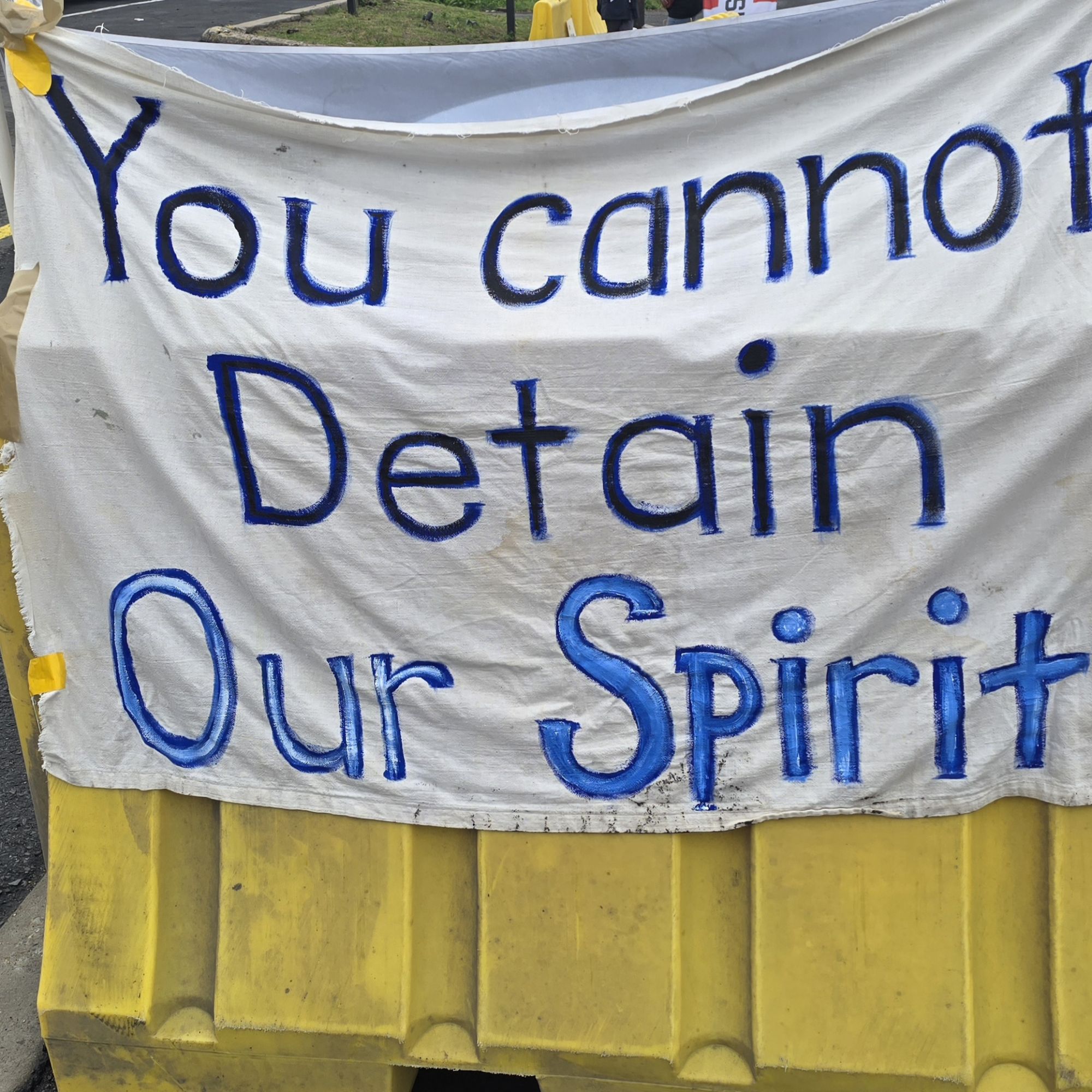
My friends, horrible things are not only happening in our name, but corporations are making a profit, paid by our tax dollars, on this inhuman treatment of our immigrant brothers and sisters. This attack on human dignity is incentivized. We cannot be silent. We must pay attention. We must listen to and tell the story. That is why I held aloft a sign that I made during my prayer time this morning – “History has its eyes on you.” Sheena held a sign that said “For Profit Prisons are Immoral.”
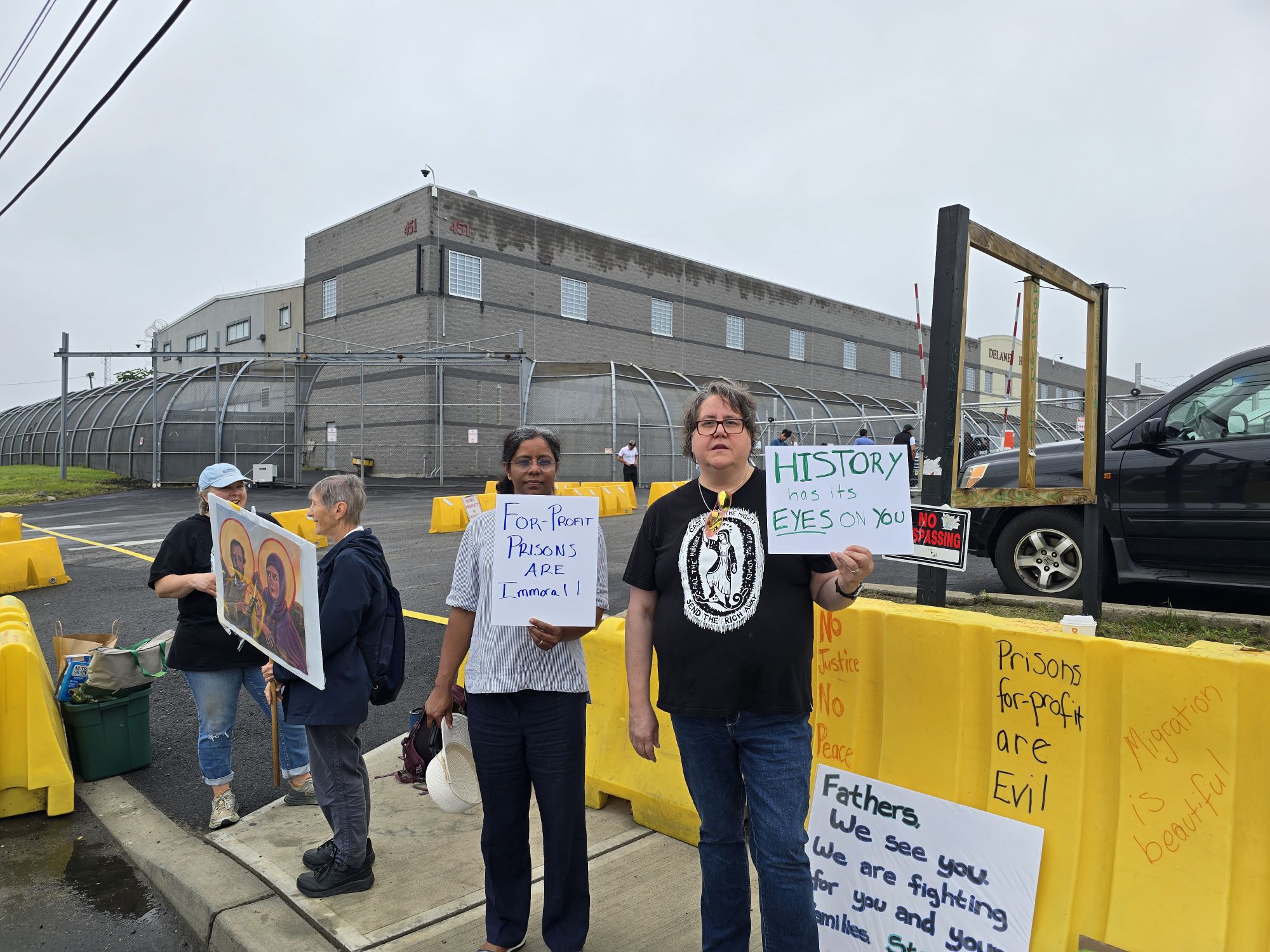
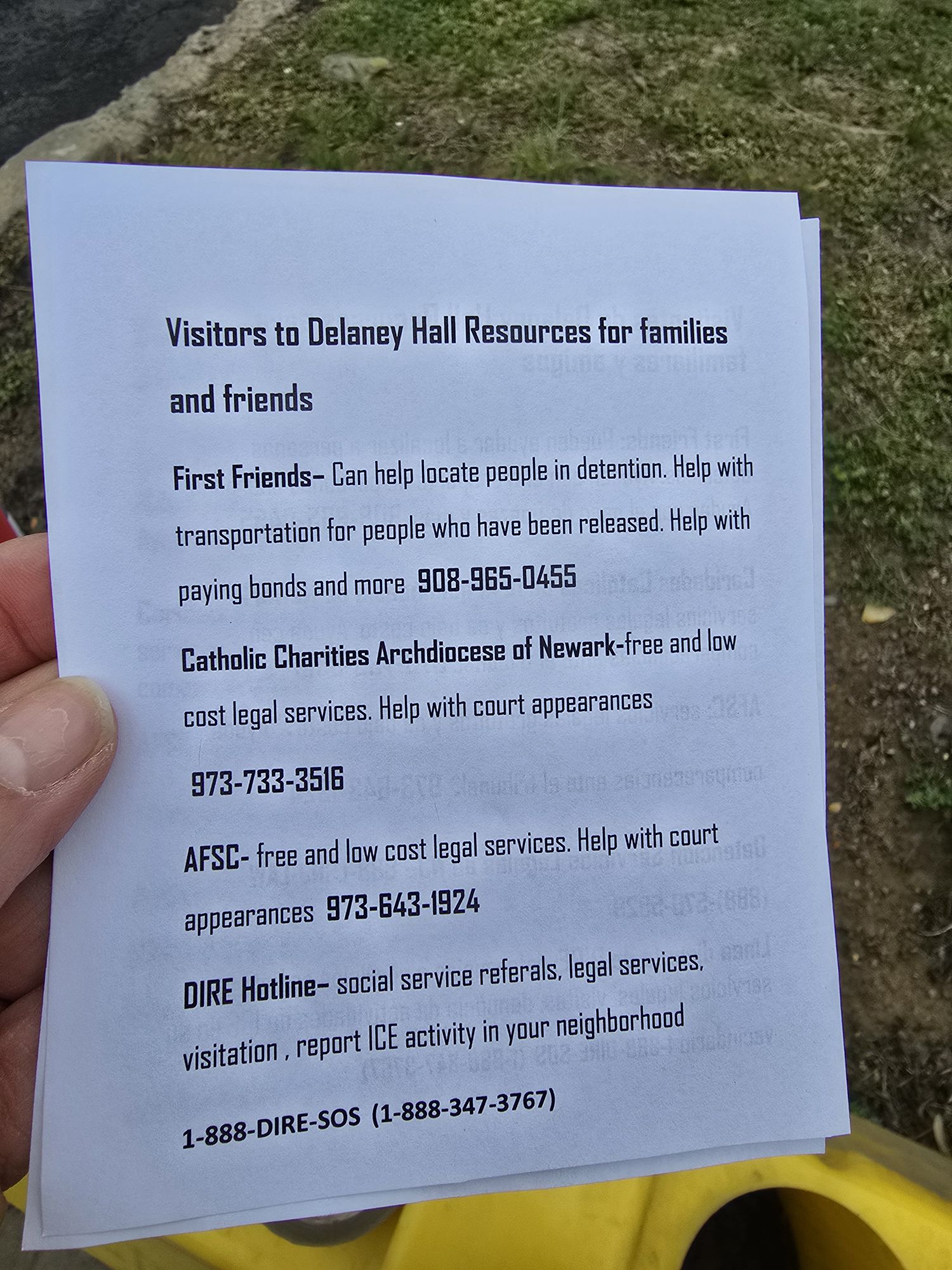
For the past ten weeks a faithful group of ordinary folks, including Pax Christi New Jersey, have been standing witness outside Delaney Hall to keep “Eyes on ICE” and provide support to the families attempting to visit their loved ones. They offer clothing when needed to pass the dress code, water and snacks for those who have travelled far to stand in line outside in the heat, and information sheets with helpline numbers for immigrant aid organizations. Perhaps most importantly they show that there are good people who are watching, standing witness, and calling out this social sin with real life consequences and who want to offer support. I hope to join them whenever I can. Sadly, this inhumanity for profit is happening just a twenty minute drive from my home.

This for profit prison is convenient for the immigration industrial complex because of its proximity to Newark Airport. “The location near an international airport streamlines logistics, and helps facilitate the timely processing of individuals in our custody as we pursue President Trump’s mandate to arrest, detain and remove illegal aliens from our communities,” said acting ICE Director Caleb Vitello when GEO was awarded the contract in February.

While we were there this morning, we witnessed a van full of immigrants leave the facility, escorted by unmarked vehicles, presumably on their way to a deportation flight at the airport. We were able to just see the men inside through the tinted windows. Hopefully they could see us outside as I held up a sign saying: “Fathers, we see you. We are fighting for you and your families. Stay strong!”

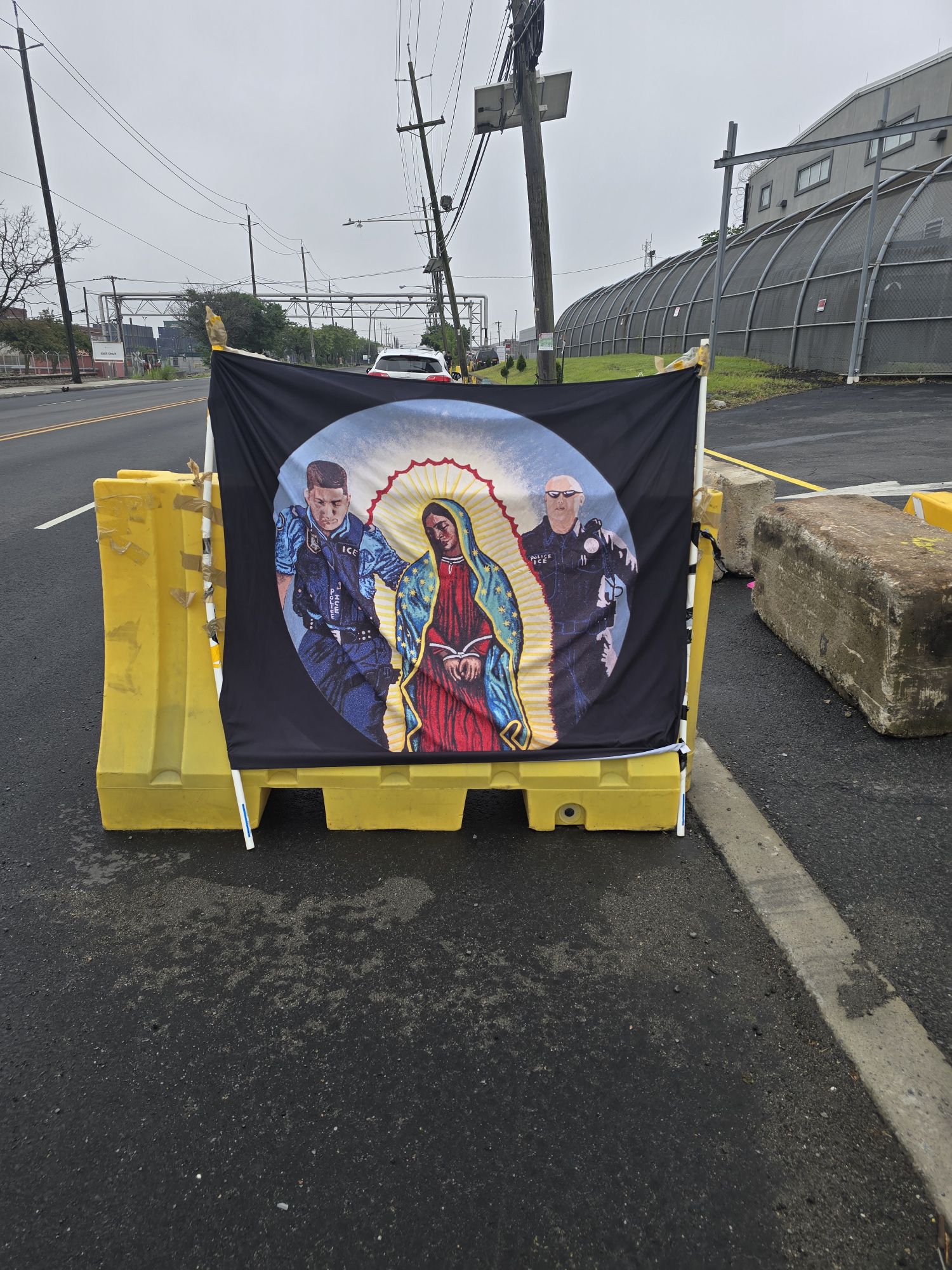
St. Edith Stein, pray for us … a Saint for these times

I have long been haunted by a quote by Edith Stein, St. Teresa Benedicta of the Cross, Carmelite nun, Jewish daughter and sister, philosopher, one time atheist, convert, contemplative, martyr of Auschwitz .

“Nowadays I always feel transported into Napoleonic times, and I can imagine in what tension people lived then everywhere in Europe. I wonder: will we live to see the events of our days become ‘history’? I have a great desire to see all this sometime in the light of eternity. For one realizes ever more clearly how blind we are toward everything. One marvels at how mistakenly one viewed a lot of things before, and yet the very next moment one commits the blunder again of forming an opinion without having the necessary basis for it.” Edith Stein: A Self-Portrait in Letters, quoted in the People’s Companion to the Breviary.

This quote is included in the office book published by the Carmelites of Indianapolis. It is the reading for Week IV, Friday, evening prayer. The first time I heard this read during community prayer when I was a candidate back in 2005, my heart stopped. I didn’t know much about Edith Stein, except that she had been killed in a concentration camp. But it led me to learn more about her, which only made the quote that much more powerful.

When she was a professor of philosophy she studied the problem of empathy. Writing in 1925–the same year that Adolf Hitler’s Mein Kampf was published–she proposed that the capacity for empathy ensures “openness among human beings” rather than separation or alienation. She engaged in her philosophical study of this capacity for empathy because she believed it “to be descriptive of human reality and the foundation needed for productive action” for life in the human community.

Now, on this sad day almost 100 years later, a day which our nation’s present leader has chosen to round up children, women and men–largely of one ethnic group–transporting them to camps, separating families and causing terror to thousands of people, I cannot help but ask for her intercession.

Nowadays, I sometimes feel transported to her times. And it is a scary time to be, one that rocks one’s faith in humanity and causes one to cry out to the heavens. What tension we live in today. Are we complicit? Are we bystanders? Or do we stand on the right side of history, crying out “Not in My Name,” and acting on behalf of human dignity?

And then of course there is today’s Gospel reading, the Good Samaritan, which makes it crystal clear what we are to do. What sad twisted irony that the raids against our immigrant brothers and sisters are set to begin today when this Gospel is proclaimed in churches across our nation. Of course, no doubt, many families are staying away from church today, afraid that they might be swept up, no matter what their legal status. And others listen with deaf ears.

Today, the Carmelite Nuns of Great Britain shared a quote from Edith Stein on their Twitter account in which she reflects on today’s Gospel reading.

“‘You shall love your neighbour as yourself.’ This commandment is valid unconditionally and without qualification. The neighbour is not the one whom I ‘like’ but any and every human being with whom I come into contact, without exception.”

Without exception. Unconditional. Without qualification.

When Edith Stein was arrested by the Gestapo in 1942 in the chapel of her monastery in the Netherlands and taken to a transit camp for deportation, eventually to Auschwitz, she commented: “I never knew that people could be like this, neither did I know that my brothers and sisters would have to suffer like this. … I pray for them every hour. Will God hear my prayers? He will certainly hear them in their distress.” 

When she arrived at Auschwitz, she ministered to God’s people in distress, even as she was one among them.

“It was Edith Stein’s complete calm and self-possession that marked her out from the rest of the prisoners. There was a spirit of indescribable misery in the camp; the new prisoners, especially suffered from extreme anxiety. Edith Stein went among the women like an angel, comforting, helping, and consoling them. Many of the mothers were on the brink of insanity and had sat moaning for days, without giving any thought to their children. She immediately set about taking care of these little ones. She washed them, combed their hair, and tried to make sure they were fed and cared for.” –Edith Stein,  A Biography, quoted on Carmelites of Boston website.

And so I pray.

St. Edith Stein, Teresa Benedicta of the Cross, you who studied empathy, lived a life of compassionate love, pray for us. Inspire empathy, respect for human dignity, and action for justice. Lead those of us who might become bystanders instead to solidarity and compassionate love. Help us to pray for conversion of heart in those who wield their power without enough apparent capacity for empathy or neighborliness. Most of all, be with those who suffer. Comfort the mothers, fathers and children facing inhumanity in these dark times. Pray for us all, that our hearts may become wider, wide enough to encompass all our neighbors, unconditionally and without exception. Amen.

DISPLACEMENT LESSONS

Watching the news of massive flooding in Texas and South Asia, I cannot help but be touched by the humanness of the experience. After all, as the mass migration and refugee crisis show us every day, displacement is something millions of women, men and children experience each day as a result of poverty, violence, war, and environmental disasters.

I am touched deeply by the look on the face of a Bangladeshi mother as she carries her child through water waste deep … pure determination mixed with despair. I am heartened by a comment by two young men in Texas who were helping strangers evacuate, “We’re not heroes, we’re ordinary people doing what we can do.”

I also cannot help but reflect on my own time of displacement last fall. One October morning I woke up to a fire outside our motherhouse. Everyone was safe, but the main building is still not occupiable. I spent about four months living out of boxes away from home. I was safe, I had everything I needed, I was cared for … and yet I was discombobulated constantly. I kept losing things and was off kilter even as life settled into a new normal.

We have been back home since January, but I am still finding things and sorting them. Just today I found a favorite mug I thought had been lost and found some important papers that had been oddly mixed in with some trivial stuff in the packing and unpacking.

I hold in prayer all those who have lost their homes, their livelihoods, their mementos. I pray for all those relying on the kindness of strangers, and those strangers who see a neighbor in need and respond even though they have never met them before.

I hope and pray that all will be safe, and just maybe hearts will be broken open enough to widen our circle of relationship. 

Maybe those sharing a shelter with an undocumented family will be able to see them as friend and neighbor rather than other to be feared or vilified. Perhaps stereotypes and bias towards racial or ethnic groups will be tested through a shared human experience. 

I pray that in our gratitude for safety and securury and prosperity we recognize the vulnerability we all share.

I pray that our common experience of compassion and care for those facing unimaginable suffering brings us closer, makes us stronger, and teaches us what really matters in life.

Connection not division.

Little acts of kindness and love that can break through even the worst suffering and despair.

Hope not fear.

AMEN

Infographics: Feminization of Migration

As I prepare for my oral comprehensive exams for my MA in Theology which are in three weeks, I am revisiting much of my research and writing from my courses these past two years in ethics and spirituality. Last year, I researched the phenomenon of the feminization of migration for my course on Women, Poverty, and Global Justice. Right now I’m engaging with the ethical reflection work I did on this reality, focused primarily on kinship and solidarity as ethical responses and ways toward immigration justice.

I was also reminded last night, re-reading the work of Gustavo Gutiérrez: “From the perspective of the option for the poor, theology is done not only about the migrants and their situation, but from their situation.”  So what is the situation of the feminization of migration? What can we learn from the experiences of women migrants themselves?  I am sharing below two infographics I made last semester as part of my own research and ethical reflection on this reality. If you find them helpful or engaging, please feel free to use them. My nerdiness is at your service, or really, in the service of justice for all God’s children.  If you do end up using them, please let me know.

[Here is a link to download my Feminization of Migration Infographic]

Infographic on the feminization of migration

Infographic on women's experience of migration
Infographic on women’s experience of migration

No Longer Strangers … a Scripture reflection

ephesiansI was invited to give a reflection on Ephesians 2:12-22 today at an all school mid-day prayer service held in our chapel at Catholic Theological Union.  It was a wonderful opportunity to ponder the word of God in the context of our community. Here’s what I shared:

As a Sister of St. Joseph of Peace, I was delighted when I was invited to offer a short reflection on this reading from Ephesians, in which the theme of peace is so strong.

“For he is our peace … He came and preached peace to you who were far off and peace to those who were near.”

I can’t help but hear echoes of my religious community’s Constitutions, where we say:

“Christ is our peace, the source of our power. United with him we engage in the struggle against the reality of evil and continue the work of establishing God’s reign of justice and peace.”

Christ is our peace, calling us to unity. But if we look around, so much divides us. Dividing walls abound, some of them quite literal like the ones we build on our borders.

Christ is our peace, but WE must make that peace known in our world. In the words of Paul VI who was beatified in Rome just this past weekend: “If you want peace, work for justice.”

As I have been sitting with this reading these past few days, I have been struck by another line from Ephesians:

“So then you are no longer strangers and sojourners…”

In 2003, the Bishops of the United States and Mexico crossed the dividing wall between our nations, united as one Church, to reflect on the reality of immigration and the need for immigration justice.

They called their joint pastoral letter: “Strangers No Longer: Together on the Journey of Hope.”

In the letter, the Bishops reflect on themes of migration and hospitality in Scripture:

  • From Abraham and Sarah offering hospitality to three strangers, who were actually a manifestation of God
  • To the edict to welcome the stranger, remembering Israel’s own exile in Egypt
  • To the Holy Family’s own flight into Egypt
  • To the reading we have today, of which the Bishops say:
    “The triumph of grace in the Resurrection of Christ plants hope in the hearts of all believers and the Spirit works in the Church to unite all peoples of all races and cultures into the one family of God.”

Just look around our community here at CTU. Our students come from places that are far and places that are near.  We come from places of relative peace and prosperity and places that have experienced deep division and heart wrenching violence.

We come to learn to be unifiers, reconcilers, bearers of mercy and builders of peace.

CTU is now even a place of hospitality, welcoming immigrant women and families in the Marie Joseph House of Hospitality across the street.

We have also been invited to participate in a practical work of mercy this week through a winter clothing drive for our immigrant brothers and sisters.

As the CTU community, we are no longer strangers and sojourners, but fellow citizens with the holy ones and members of the household of God.

May we be reconcilers in our families and communities.

May we welcome the stranger and work for justice.

May we seek, build, live, and bring peace.

Amen.