Tag Archives: liturgy

Souls of the Just and Hope

Today is the Feast of All Souls, also known as the Day of the Dead.

This morning I celebrated this Feast with immigrant families waiting to visit their detained loved ones outside Delaney Hall, the private for-profit immigrant prison in Newark, NJ. Despite the estimated $60 million annual profit GEO Corporation makes on the operation, they force families to wait outside for hours on an active driveway for a chance to see their loved ones. Thankfully a group of dedicated volunteers are there each visiting day to provide practical support with beverages, food, chairs, blankets, hats, gloves and perhaps most importantly compassion.

In the first reading for today from the Book of Wisdom we hear: “The souls of the just are in the hand of God.” And in the second reading from Romans: “Hope does not disappoint, because the love of God has been poured out into our hearts through the Holy Spirit that has been given to us.” Every time I am at Delaney Hall I leave with more hope, even in the face of the intentional cruelty done in the name of my country, because of the goodness of people.

Today one of the families woke up at 5 am to make tamales and Mexican hot chocolate which they brought to share with others families and the faithful volunteers who are there during visiting hours to support the visitors. The family told us they wanted to give to us like we give to them. I will admit this brought tears to my eyes. And I was not the only one. (Plus the tamales and hot chocolate were delicious)
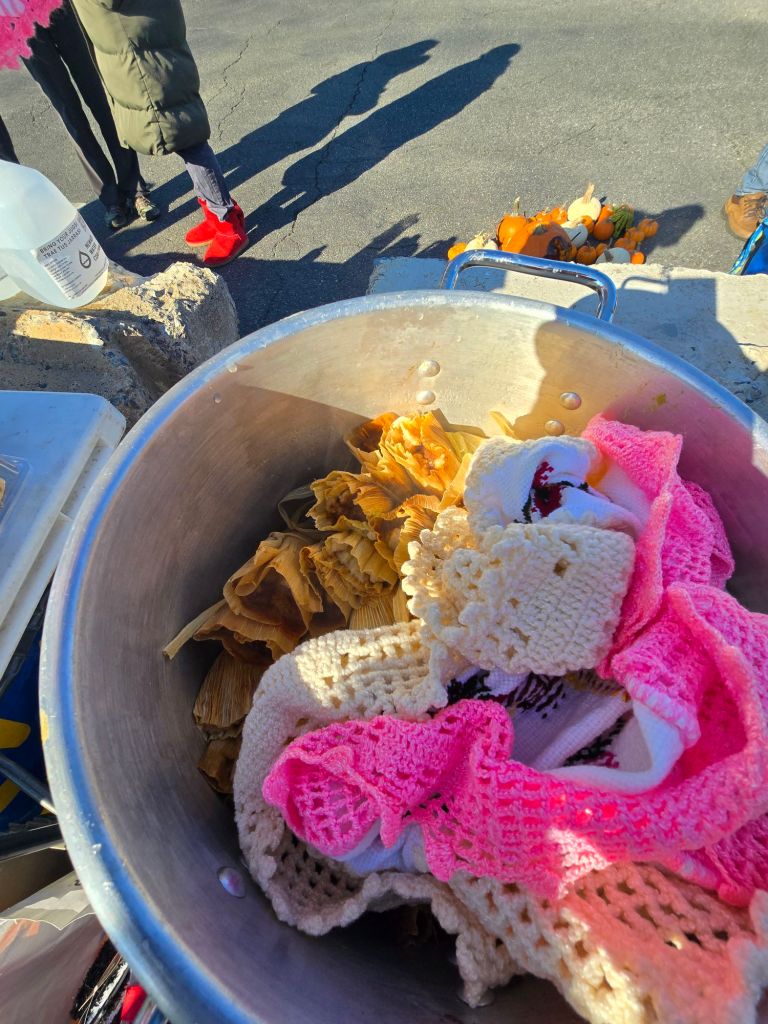
Homemade tamales!

Other volunteers brought toys and art supplies for the kids. And there was even a face painting station. For children whose families have been torn apart and who wait for hours outside a chain link fence topped with concertina wire for a chance to see their detained mom or dad, these simple gestures also give them a chance to be a kid and have some good memories to see them through.
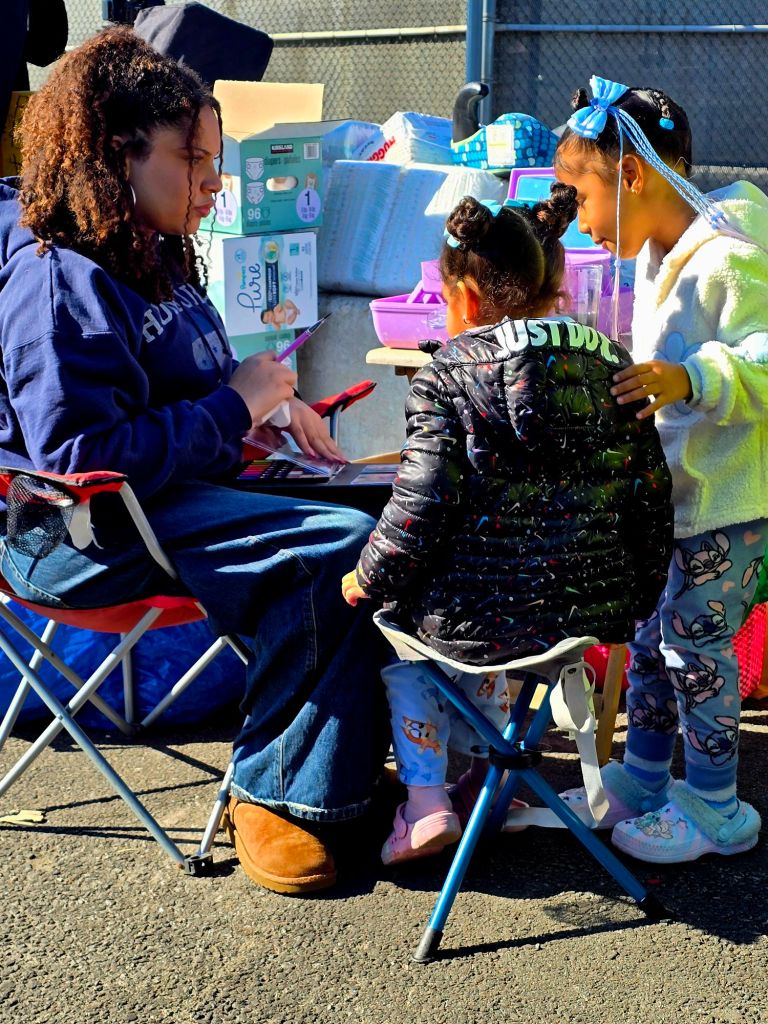
Face painting

Other volunteers set up a colorful altar, an ofrenda, for the Day of the Dead. We remember our loved ones who have gone before, so fitting as an emotional and spiritual support for the families visiting their detained loved ones.
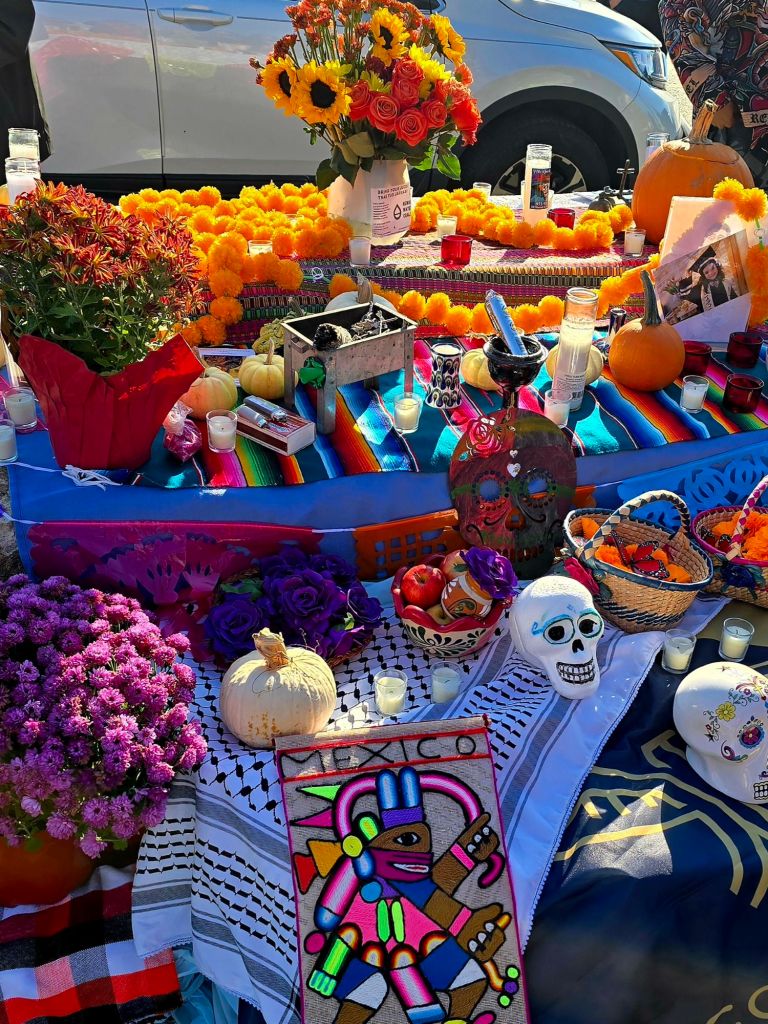
Indeed hope does not disappoint because God’s love is poured out freely into our hearts. We in turn pour this love into the world, especially places and spaces of suffering and oppression.

In the words of the collect from today’s liturgy:

Listen kindly to our prayers, O Lord,

and, as our faith in your Son,

raised from the dead, is deepened,

so may our hope of resurrection for your departed servants

also find new strength.

Through our Lord Jesus Christ, your Son,

who lives and reigns with you in the unity of the Holy Spirit,

God, for ever and ever.

Amen

Sense of Place

This Sunday morning, as I listened to public radio and live streamed mass, I thought about the importance and influence of our sense of place. In our digital age, we can live stream news and even liturgy from anywhere in the world. Yet what did I chose to do? I live streamed the local public radio station and the local Sunday liturgy.

Now, were I at home in New Jersey, this would be unremarkable. As it happens, however, I am spending the month of October as a short term resident scholar at the Collegeville Institue at St. John’s University in Minnesota. When I applied for, and received, this residency opportunity, it was in a pre-pandemic world. I researched the local area. Looked forward to attending mass and prayers with the monks at the abbey and the sisters at the nearby monastery, both Benedctine. I was excited to participate in all the public lectures and other opportunities a university environment provides, especially having access to a library, as well as interacting with the other resident scholars.

Then of course, the pandemic happened. I was so grateful that the Collegeville Institute and university decided to stay open and welcome scholars, even though of course things had to be adapted for public health reasons. It has been a graced opportunity to have the time and space to read, write, and reflect. I have certainly taken advantage of the wonderful grounds, which are designated as an arboretum. The library is open, and thanks to the wonder of electronic databases I’ve been able to reserve and pick up books. Sadly, the St. John’s Bible display is closed, but I looked through the books on display in the bookstore. As to the other scholars, we’ve waved to each other on our solitary walks and had some socially distanced interactions. A different experience than the one I’d envisioned, but a blessed one nonetheless.

As I finish my month here, I feel grounded in and gifted by this place. The Collegeville Institute is nestled in the woods upon a lake. It is no surprise that I have a sense of place here, because as it happens that was intentional.

The monks insisted on the graceful architecture of Marcel Breuer, who conceived of apartments walled with windows to maximize the sense of place, in the midst of natural beauty.

History of the collegeville institute

My work space looks out at the trees and the water and my squirrel friends. As I’ve worked and prayed, I’ve watched the seasons change and walked the trails through the woods and fields, which are just outside my door!

But back to my morning realization. Why did I go to the effort, shortly after I arrived, to download the Minnesota Public Radio app to my phone? After all, I already had the WNYC app downloaded, which has essentially the same NPR programs that I am accustomed to, although one hour earlier. Partly I suppose it’s an adaptation of habit. Back in the day when you actually listened to the radio at home ON a radio, which I now only do in the car, of course I’d listen to the local public radio station. Here in the 21st Century, I made a concious choice to download the app for the local public radio station to help me tap into the local, if just a bit.

This morning I reflected that this has to do with the importance and influence of my sense of place on my imagination and being. In away, during this weird covid time, it’s more important to make these concious choices to get the lay of the land and to BE in the land, even if virtually. Otherwise, with little social interaction and most time spent safely inside, wherever we are, we can settle into a kind of no land.

It is also important for me to recognize that I am on the land of the Mdewakanton, Anishinabewaki ᐊᓂᔑᓈᐯᐗᑭ, and Očhéthi Šakówiŋ. (If you want to know the native peoples of the land where you are, go to https://native-land.ca/).

My first two weeks here were an official quarantine, after my travel from New Jersey. Since then I’ve had more time to walk on the grounds of the unviersity and even did some early Christmas shopping at the bookstore–masked and following social distance guidelines of course. But I’ve not yet made it into the Abbey Church.

Instead, each Sunday I have live streamed mass from the Abbey. Is it the same as physically being there? Of course not, and I do plan to go to daily mass before I leave, when there will presumably be less people present. Yet even participating in the Abbey Sunday Liturgy from my couch, looking out at the tranquil scene outside my window and then back to the screen, I feel connected. Connected to the monks and the other people there, in their masks, socially distanced, praying in this space, from this place, for the needs of the world.