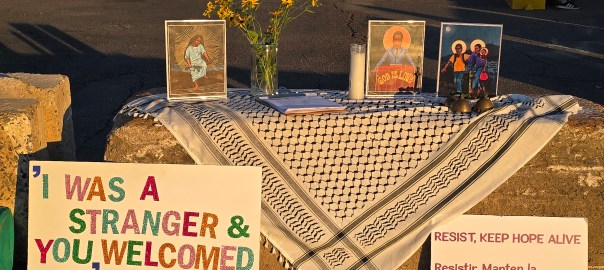
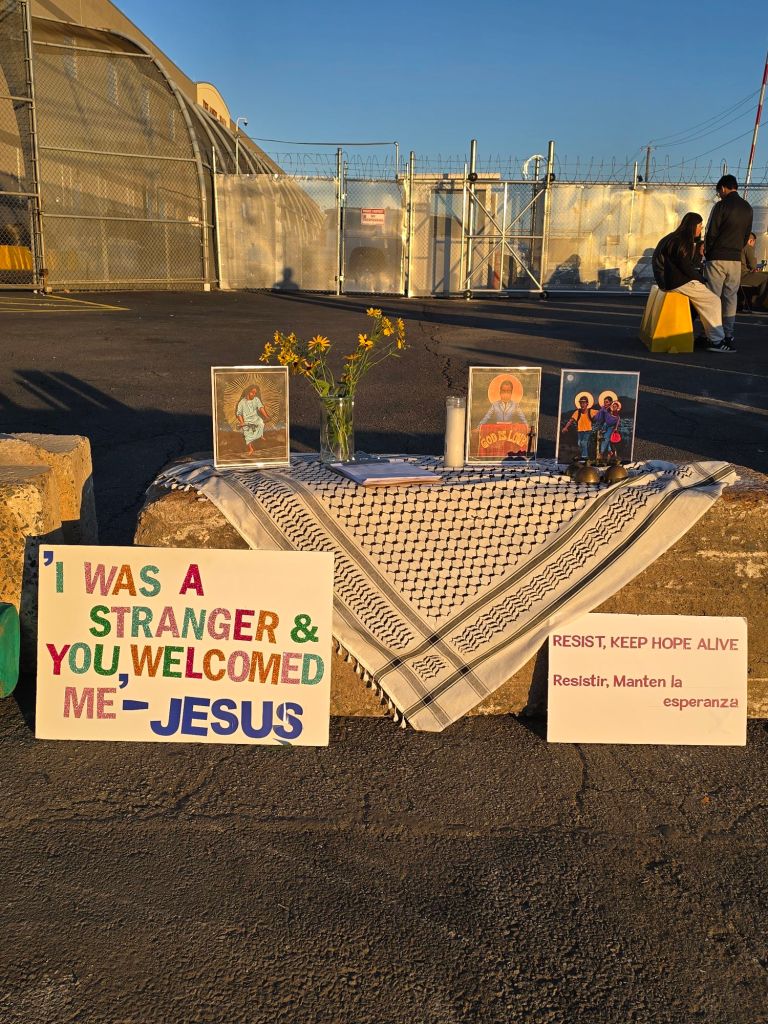
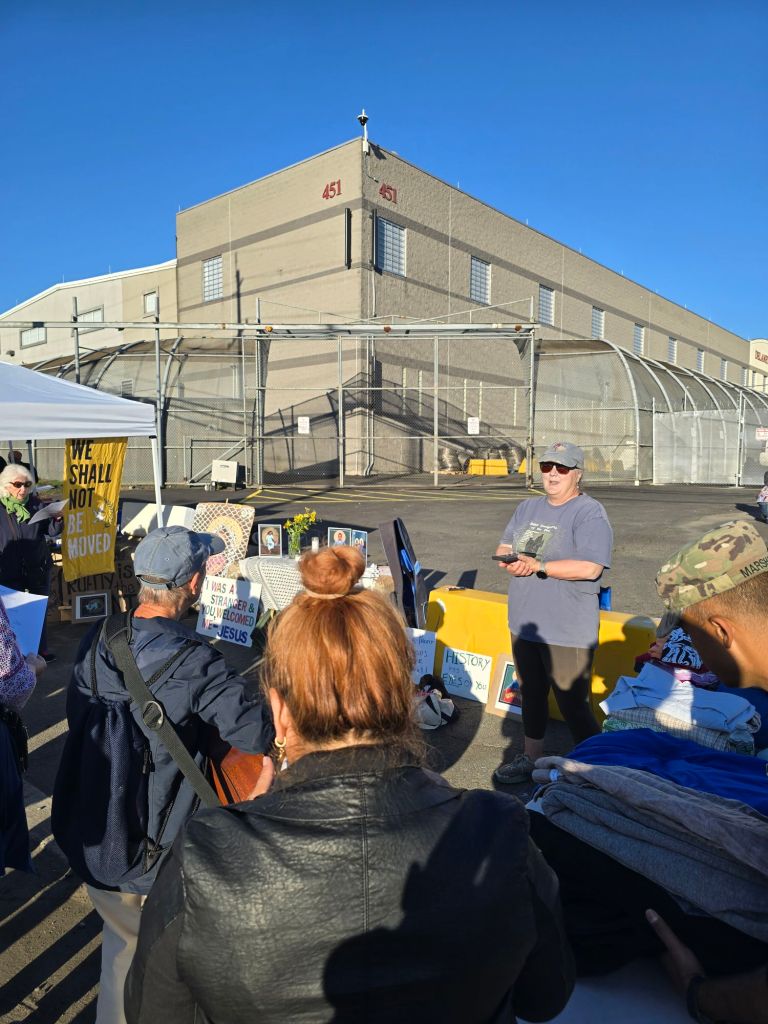
This morning a small group of us prayed outside the gates of Delaney Hall, the for-profit immigrant prison operated by GEO Group in our name. We gathered outside for a simple prayer service while the first group of families were forced to wait on an active driveway outside the gates for the chance to visit their loved ones detained in this 1,100 bed facility. This was the second week of the Let Us Pray Sunday morning prayer service outside Delaney Hall. Different faith traditions will be leading prayer each week. This week’s prayer was in the Christian Tradition and organized by Pax Christi NJ.
We began singing the song, Please Prepare Me, praying that we might be a sanctuary for the families and their detained loved ones.
We then listened to the word of God: Jeremiah 17: 5-11, Romans 12: 1-12, and Matthew 11:28-30. I was then honored to offer a brief reflection on the scripture readings, which is copied below. It was a beautiful experience of church with friends and strangers praying together that we may find refuge in God and be rooted in love.
Reflection by Susan Francois, CSJP – Delaney Hall (August 31, 2025)
Scripture: Jeremiah 17:5-11, Romans 12:1-2, Matthew 11:28-30
Chances are, right now, you have a piece of paper or a coin in your pocket with the words “In God We Trust” written on it. Our currency has carried these words since President Dwight D. Eisenhower signed a law making “In God We Trust” our official national motto in 1956. The context of this law, of course, was the Cold War. The inclusion of the motto on our nation’s money was seen as a response to the anti-religious stance of the Soviet Union.
We just heard proclaimed words from the prophet Jeremiah, in which he reminded his community to trust in God, not people and not money. His preaching was in a different context. He was worried that the people were placing their trust in the wrong things and turning their hearts from God. He wanted them to understand that actions have consequences. He predicted (correctly as it turns out) that they would be exiled to Babylon.
I can’t help but wonder what he’d make of our context today. Take the last line from the passage from Jeremiah, where he compares a partridge that broods but does not hatch to those who acquire wealth unjustly. In the end, they are just fools. Unjust fools.
The building behind me is operated by GEO Corp under tax-payer funded 15-year $1 Billion contract. GEO’s own press release announcing the deal in February proudly predicted that the “contract is expected to generate in excess of $60 million in annualized revenues for GEO in the first full year of operations.”
And yet, even with all this profit, families with small children, pregnant mothers, and elderly relatives of persons detained behind these walls are not provided with a safe place to wait for the chance to see their loved ones before they are deported. They are required to wait hours in the hot sun—and with this being Labor Day weekend, we know colder and wetter weather is around the corner—without shelter, without access to a bathroom even. I suspect that the prophet Jeremiah would have looked at this private-for-profit prison operation and declared that the GEO shareholders are earning their wealth unjustly.
Let’s shift Jeremiah’s focus from those detaining our migrant brothers and sisters to their faithful loved ones who come to stand at the foot of these gates today. Despite the odds, despite the difficulties, no doubt even in despair, they come each weekend in hope to spend a few moments with their loved ones. “They are like a tree planted beside the waters that stretches out its roots to the stream. It does not fear heat when it comes, its leaves stay green.”
The leaves that sustain them, I suspect, are rooted in love. Love for their husband or wife, son or daughter, mother or father, brother, sister, or friend who are inside these walls. Love for each other. Those of us who have been privileged to volunteer here these past few months have seen so many actions of kindness and love between strangers on this driveway. Volunteer to visitor. Visitor to visitor. Visitor to volunteer.
By our very presence—as visitors, as volunteers—we are refusing to conform to this age of inhumanity where cruelty seems to be the point. We trust in love, and my Christian tradition teaches that God is love. Jesus, God-with-us, love incarnate, invites us in the passage we heard from Matthew’s Gospel to find sanctuary in his love, where we will find rest.
May we be love. May we be loved. May we be sanctuary for one another. May we trust not in the unjust laws of men or the unjust pursuit of profit through human suffering, but in the love of God.
Friends some seriously (and apparently intentionally) inhumane actions are being perpetrated in our name and funded by our tax dollars. This is true on many levels and across the country, but this particular story is local and takes place a 20 minute drive from my house at Delaney Hall, a private for profit prison in an industrial area of Newark, New Jersey where immigrants are detained on behalf of our federal government.
There are many issues with the lack of due process, lies and deception by ICE officials, and violations of established legal protections that have led to up to 1,000 of our immigrant brothers and sisters being detained at Delaney Hall on any given day. Then there are the questions about how these human beings are being treated while in detention. Those are topics for another post.
This story is simply about the arbitrary and constantly changing rules for visitors, rules that are cruel and inhumane. Inhumanity seems to be the point and motivating factor. There is no other explanation to what is happening to the families desperate to see their loved ones one more time before they are deported.
Like the 14 year old US citizen child who was in tears today, trying to get into the detention center with her Aunt. Her mom and dad are both detained at Delaney Hall. They heard that her father might be deported tonight. They were desperate for accurate information regarding the fate of her parents. They could not afford legal assistance. Listening to her story was simply heart breaking.
Or like Bella who was denied the right to visit her daughter Mary during the scheduled 7:30 am visitation time allotted for just 15 visitors each Saturday for the up to 100 female detainees in Mary’s ward. Bella made an early morning trip from her home across the Hudson in New York to get there in time, at great expense. The published visitation rules signed by the Delaney Hall security chief say you may be denied entry if you arrive after the start of visitation hours. She arrived by 7:20 but the guard decided she was too late and told her to come back tomorrow. I tried to advocate for her but to no avail. He kept just saying she should have come earlier and he was within her rights to deny her visitation. Even though they had not yet let the 7:30 visitors inside, and they had not met the limit on the number of allowed visitors. I asked to speak to a supervisor, after identifying myself as a Catholic Sister/clergy, but he refused and again just said he was within his rights to deny her entry.
Bella literally dropped to her knees and opened her arms wide in supplication, calling out to God for mercy. She was in tears, as was I. Powerless in the face of inhumanity and injustice.
These are just two stories of many, just from today during the morning hours at this one detention center. Visitation is no longer allowed during the week at Delaney Hall, only on the weekends and during very limited hours. Family members line up hours early, waiting in the hot sun, often after driving hours to visit, without any guarantee they will be allowed inside. The visitation hours and rules published on the Delaney Hall and ICE websites are incorrect and out-of-date at best, if not intentional misinformation. Each week the guards seem to change the rules or at least apply them inconsistently. The families suffer, as do their loved ones who are waiting for a visit that never comes. Why? I can’t help but think it is by design.
And then this afternoon, after navigating this whole ordeal to set eyes on their loved one for a few minutes, a group of visitors came out to find their vehicles had been ticketed or towed by the Newark Police Department. Because, you see, not only is there not a visitor parking lot at this detention center (operated by tax dollars under a $1 Billion 5 year contract with ICE), there is also not any legal parking on the public city street outside the detention center. There is a public parking lot next door at the Essex County Detention Center, but visitors to the private prison next door are not allowed to park there, although staff apparently are. Again, why? I can’t help but think this inhumanity is by design.
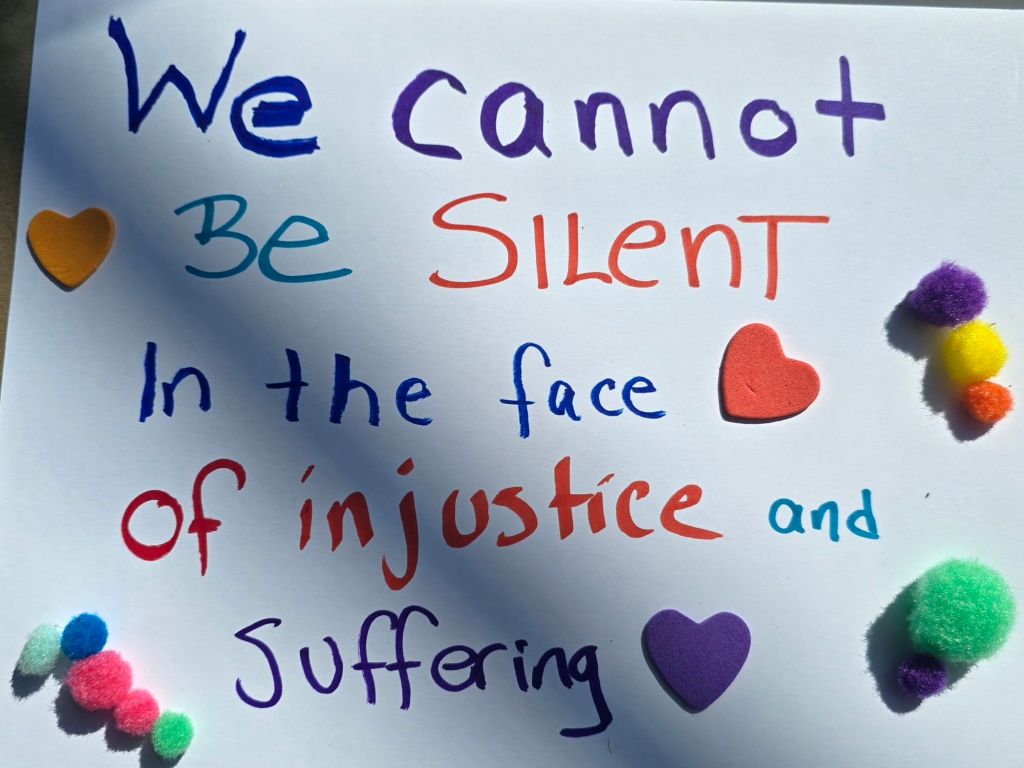
This is not ok. We cannot be silent.
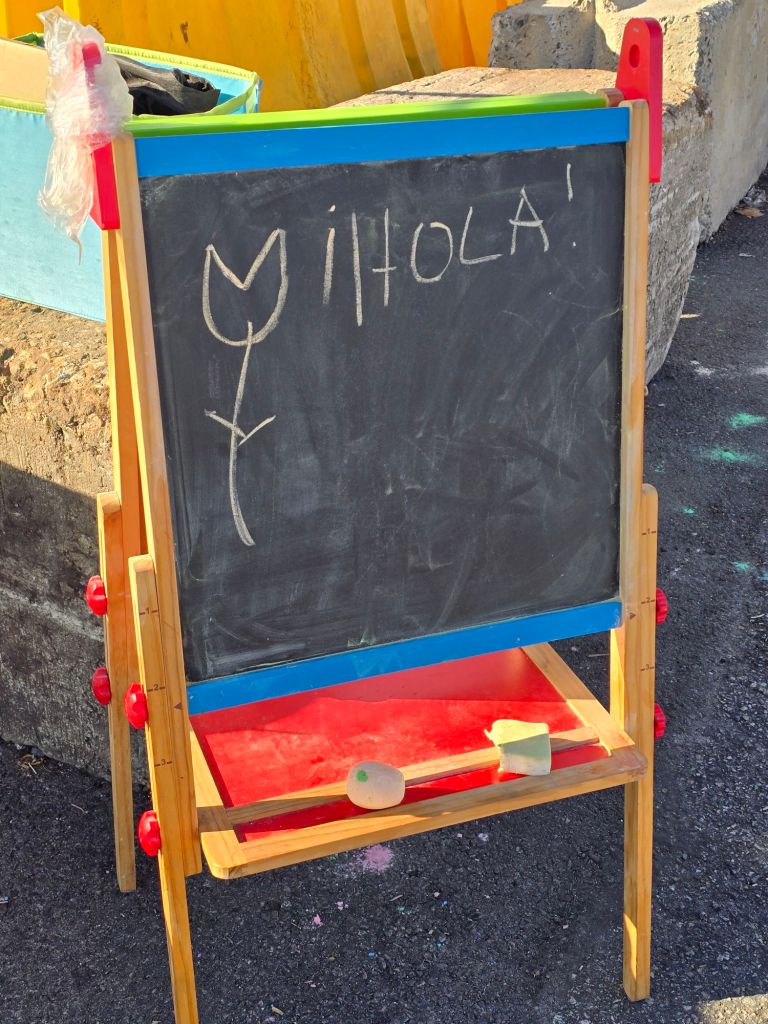
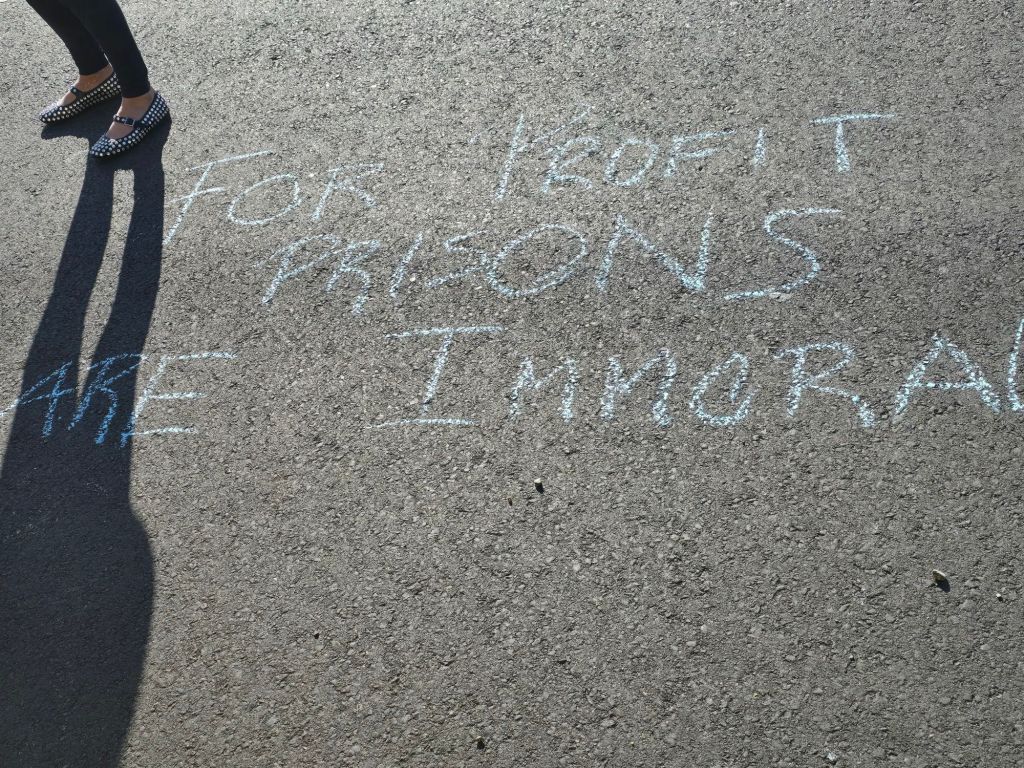
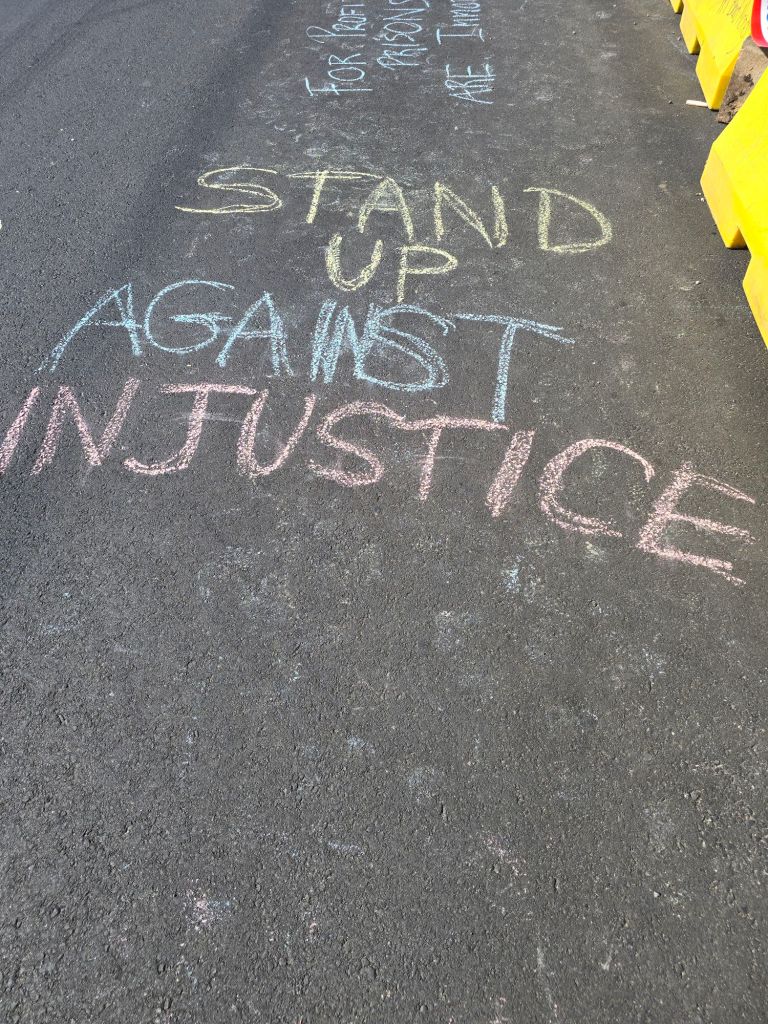
Now for good news. A group of folks organized in mutual aid swiftly organized to help the visitors get their cars out of the impound lot. Others are strategizing how to work with elected officials on a long-term parking solution. Many folks spent time outside Delaney Hall today in solidarity and support of the visitors, providing umbrellas and tents to protect them from the sun while they waited hours outside the gate. Offering coffee and donuts and water. Creating a play area for the children. Making and holding up signs as public witness to say that profiting off of human misery is immoral, that no human being is illegal, and that we are called to love our neighbors. Some of the visitors even brought toys and snacks themselves to share with others. Community at its organic best.
Goodness, in other words, was present even amidst the inhumanity. Love is always stronger than hate.
Today’s Gospel reading is one of my favorites, and so timely. From Matthew:
“As Jesus got into a boat, his disciples followed him. Suddenly a violent storm came up on the sea, so that the boat was being swamped by waves; but he was asleep. They came and woke him, saying, ‘Lord, save us! We are perishing!’ He said to them, ‘Why are you terrified, O you of little faith?’ Then he got up, rebuked the winds and the sea, and there was great calm. The men were amazed and said, ‘What sort of man is this, whom even the winds and the sea obey?’”
There is a beautiful song reflecting on this story by The Porter’s Gate, “Wake up Jesus,” in which the singer Liz Vice laments soulfully at the end: “How can you sleep when we’re in need. Won’t you rise up? Won’t you rise up?”
This morning in prayer it dawned on me … I need to be the one to rise up. You need to be the one to rise up. We need to be the ones to rise up. That’s how this whole Christianity thing works. They will know we are Christians by our love.
Our love for families who are separated by inhumane immigrant detention efforts.
Our love for the children and families who will lose food assistance if the budget bill goes through. Even Fox News admits 3 million people could lose benefits to combat hunger.
Our love for the estimated 12 million people who will no longer be covered by health insurance with cuts to Medicaid to pay for tax cuts for the wealthiest among us.
The storms keep coming and lives are literally at stake.
Will we rise up as our lawmakers prioritize greed and misguided ideology over life and human dignity?
Will we be Christ and use our God given agency to calm the raging seas, each doing our bit, contributing to the common good?
Will we be awake to the suffering of human beings, present to their pain and ready to act to rebuild our social fabric?
My prayer this morning is for Christ to guide me/us, to sustain me/us, and to inspire me/us to action.
On Tuesday, June 24, Catholic Sisters and their partners and friends will gather on the steps of the US Capitol, and in echo events across the country, for prayer and public witness in support of immigrants and a just economy. My Congregation, the Sisters of St. Joseph of Peace, is one of the sponsoring organizations of Sisters Speak Out. It does my heart good to see how the network has grown as evidenced by this graphic.
We will have representation at the DC event and our CSJP sisters and associates will also gather in Englewood Cliffs, New Jersey and Bellevue, Washington for echo events. The Bellevue prayer and witness is open to the public and will be live streamed. Click here for details and to register.
This is our moral moment. We must hold fast to Gospel values and stand together in support of human dignity. Speaking out is a requirement of justice even as we are overwhelmed by the inhumanity and unfathomability of actions undertaken in our name. It is a requirement of our faith precisely because these inhumane actions are being taken in our name. Catholic Social Teaching calls us to have a preferential option for those who are poor, to protect life and human dignity at all stages, to defend the rights of workers and migrants, to care for creation. All of these are presently under attack.
Yesterday, World Refugee Day, San Diego Bishop Elect Michael Pham visited the federal building to stand in solidarity with individuals making appearances in immigration court who were afraid of being summarily detained and held in private for profit immigration prisons. (Yes not only is this becoming routine, but these immigrants seeking to follow legal systems are being swept up by men in masks in 2025 in the United States!). This did not happen yesterday in the presence of the Bishop and his fellow clergy.
Per a news story: “masked immigration agents weren’t leaning against the off-white walls, waiting to grab people. They scattered Friday after seeing a clergy delegation led by Bishop Pham.
‘Like the story of Moses and Exodus, the Red Sea parted,’ said observer Scott Reid of the immigrant-aiding San Diego Organizing Project.
Said another observer: ‘We’ve never seen the hallways cleared out so quickly.’
The result: Nobody was detained as immigration lawyers said would happen.”
I will still be out of the country on June 24, visiting our sisters in the UK. It has been an interesting few weeks to be out of the country, that is for sure. And when I tell people the scale and scope of what is happening at home, they look at me with unbelief and a sort of pity.
Wherever you are on June 24 please join us in solidarity. And know that we are in this for the long haul, following in the footsteps of Jesus who always stood with those who were oppressed.
As we say in our CSJP Constitutions:
“Christ is our peace, the source of our power. United with him we engage in the struggle against the reality of evil and continue the work of establishing God’s reign of justice and peace.”
This week I finally had a chance to visit the Roman Colosseum, something that has been on my bucket list ever since my high school Latin days. It is certainly a magnificent sight and a colossal site to behold, even filled with hordes of tourists like myself during a June heatwave.
Walking through the remains of this stone structure, echoes of the countless human lives lost in the name of empire and entertainment sounded in my heart. As I stood at the cross overlooking the sight of their torture in the arena, I prayed with and for them. I prayed too with the memories of those who watched, jeered, and cheered, and for the political leaders who orchestrated it all for propaganda and ideological purposes.
I couldn’t help but make connections to what is happening at home in my own country even as I stood there in Rome. Today’s people on the margins are being sacrificed for political purposes, whether through the siphoning off of life-saving food and medicine at home and abroad, or deporting and detaining our immigrant brothers and sisters while ignoring the constitutional right to due process. Tears are being shed and lives disrupted and even taken. And for what? Political ideology at best and nefarious intention at worse, with real human impacts at a scale that only history will truly measure.
I for one feel the need to speak out, to pray, and to act. I am in solidarity with the people in peaceful protest on the streets in Los Angeles and across the country. Although I will still be out of the country, my Congregation is one of many that will be represented on June 24 in Washington, DC and in echo events in New Jersey and Washington State for the Sisters Speak Out event, a prayer and public witness for immigrants and a just economy. https://sistersspeakout.my.canva.site/
Finally, as events unfold in my nation this weekend, I am proud to be part of the elected leadership team of the Sisters of St. Joseph of Peace as we have issued a public statement in support of nonviolent action. We also express our profound concern about unjust action against immigrants, the deployment of military forces in our own nation, and the display today in our nation’s capital.
“Consistent with our mission as agents of peace through justice, we reject the false belief that national strength derives from military power and reject the militarization being used to quell domestic demonstrations.”
Persecution and human suffering in the name of political theater is social sin, pure and simple. I say not in my name. I resist and reject it. And I pray for the heart and soul of my nation and all those whose lives are being disrupted and lost.
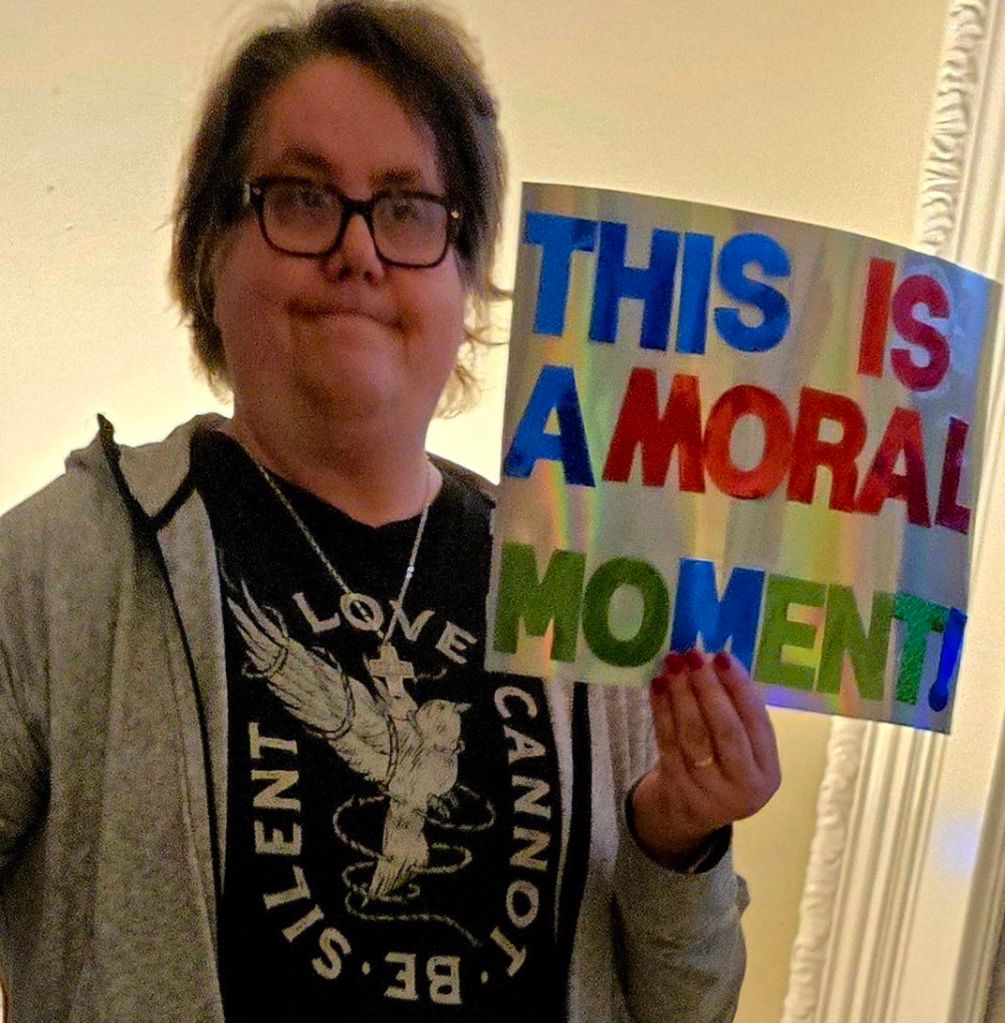
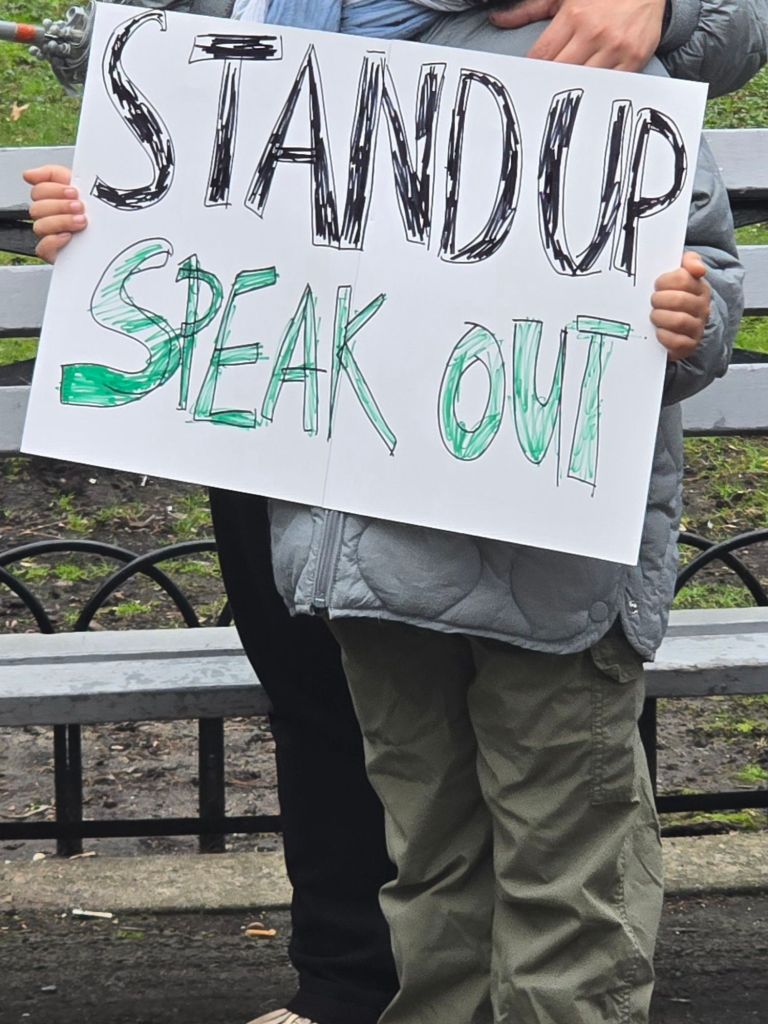
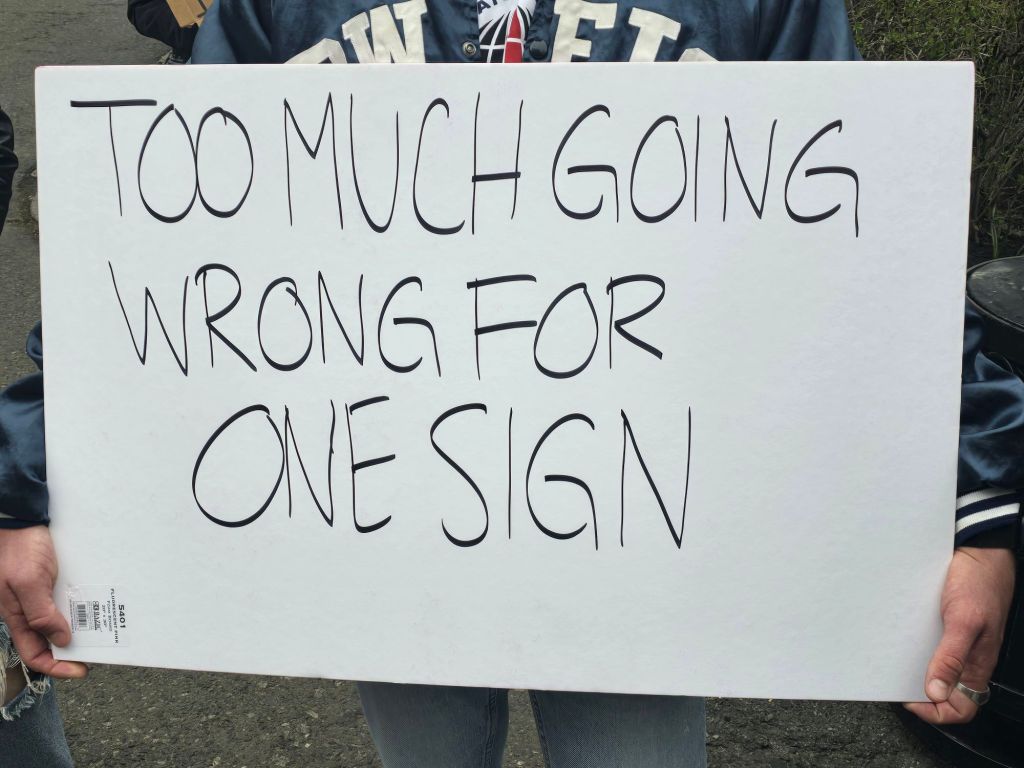
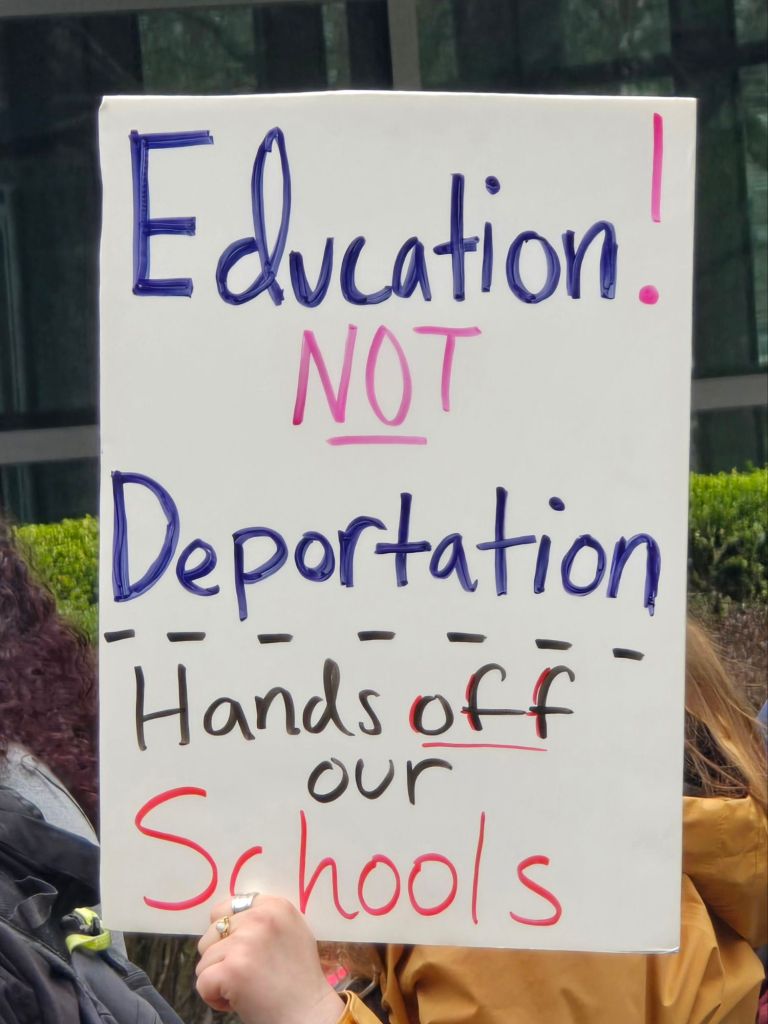
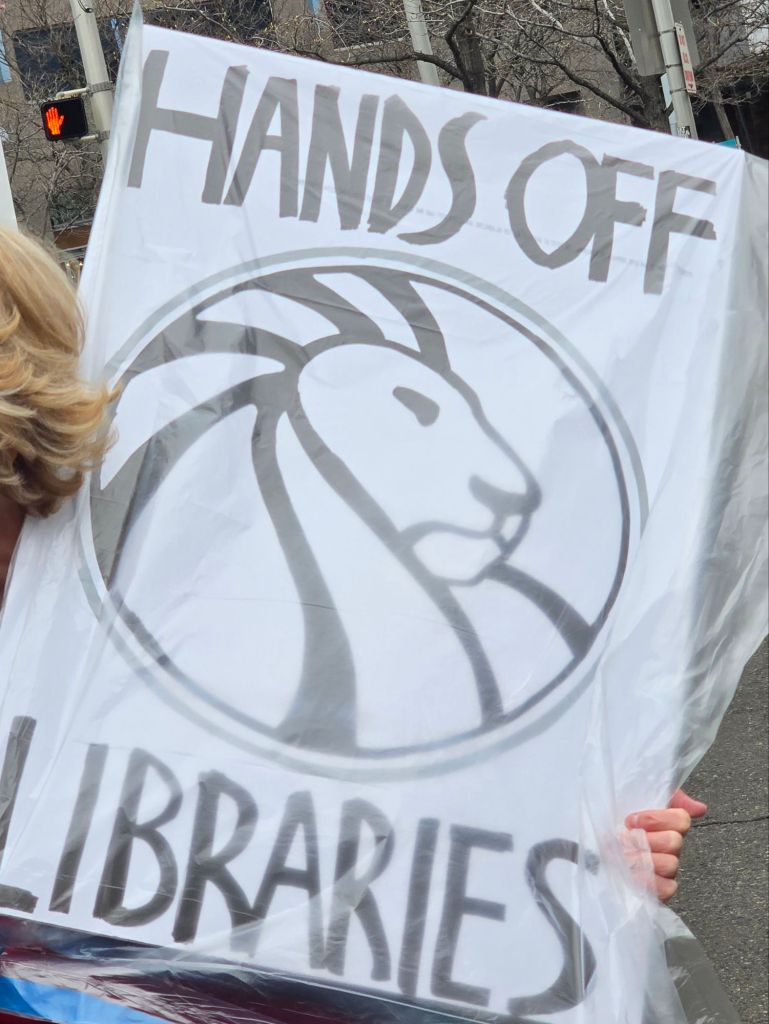
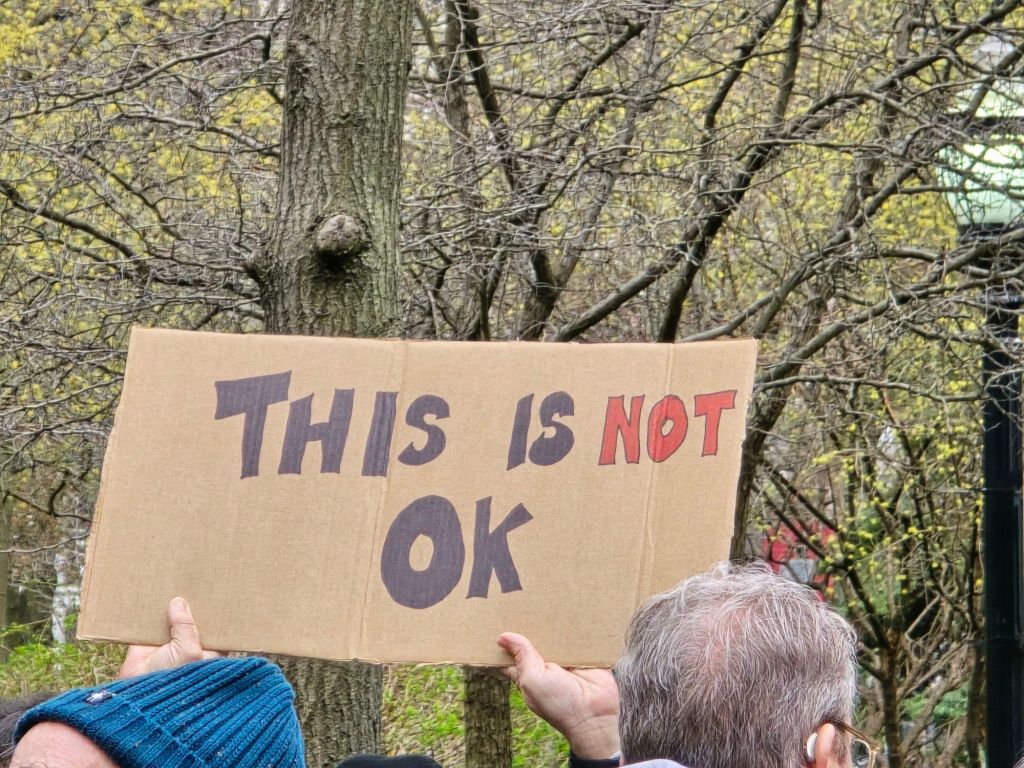
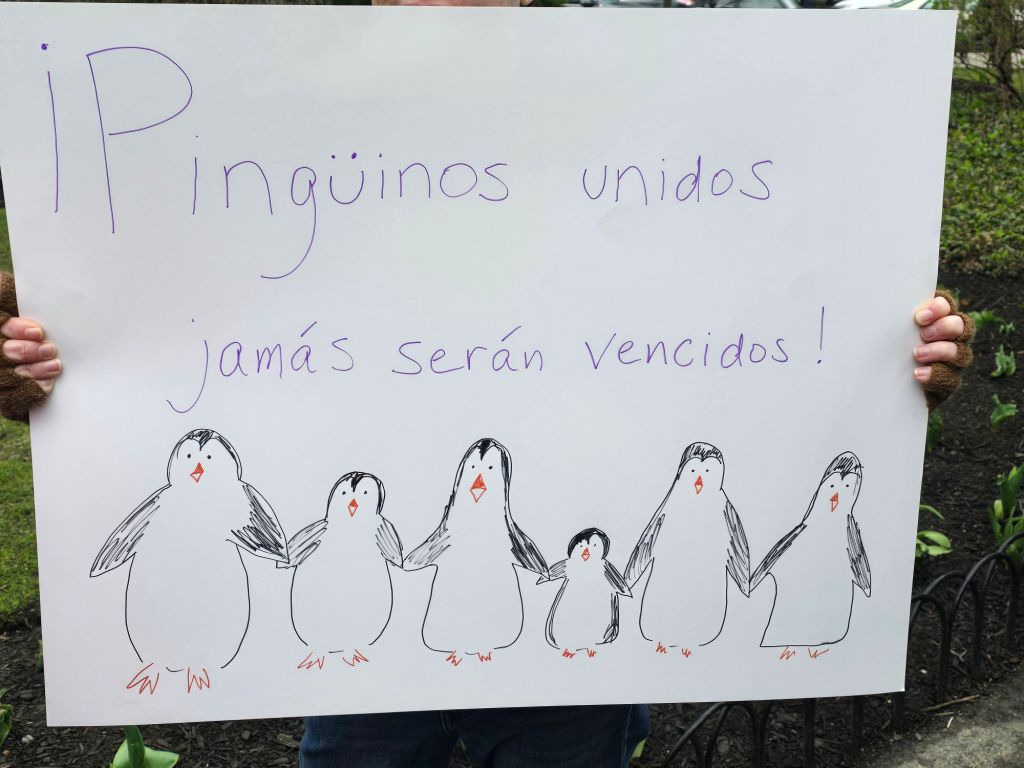
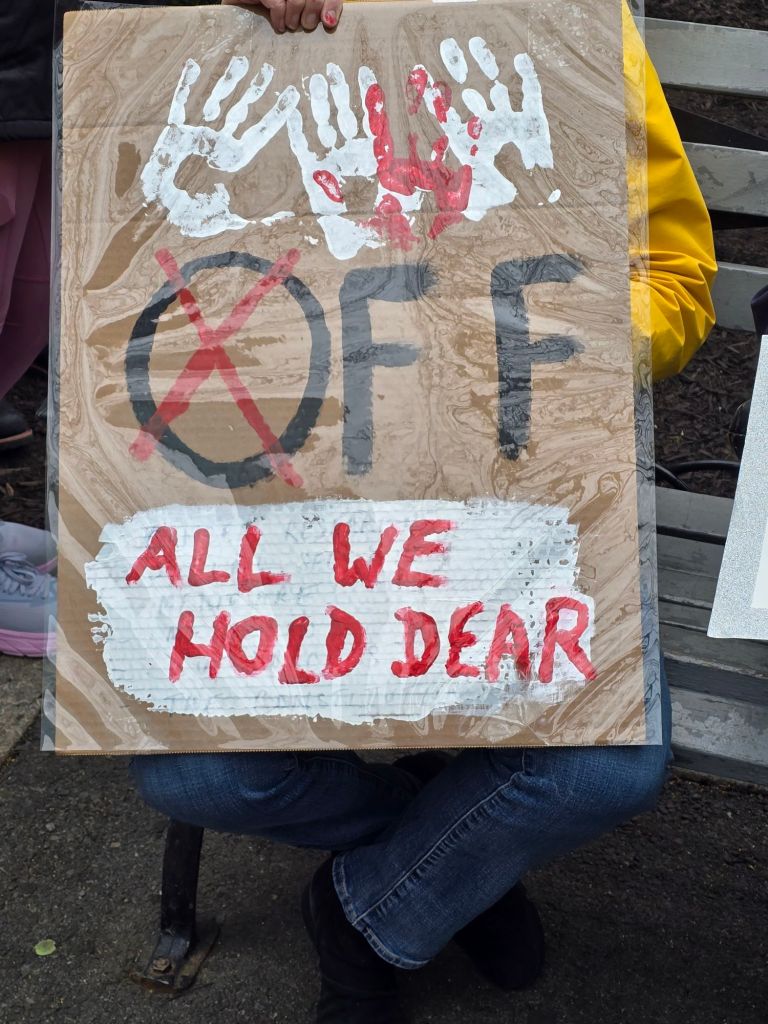
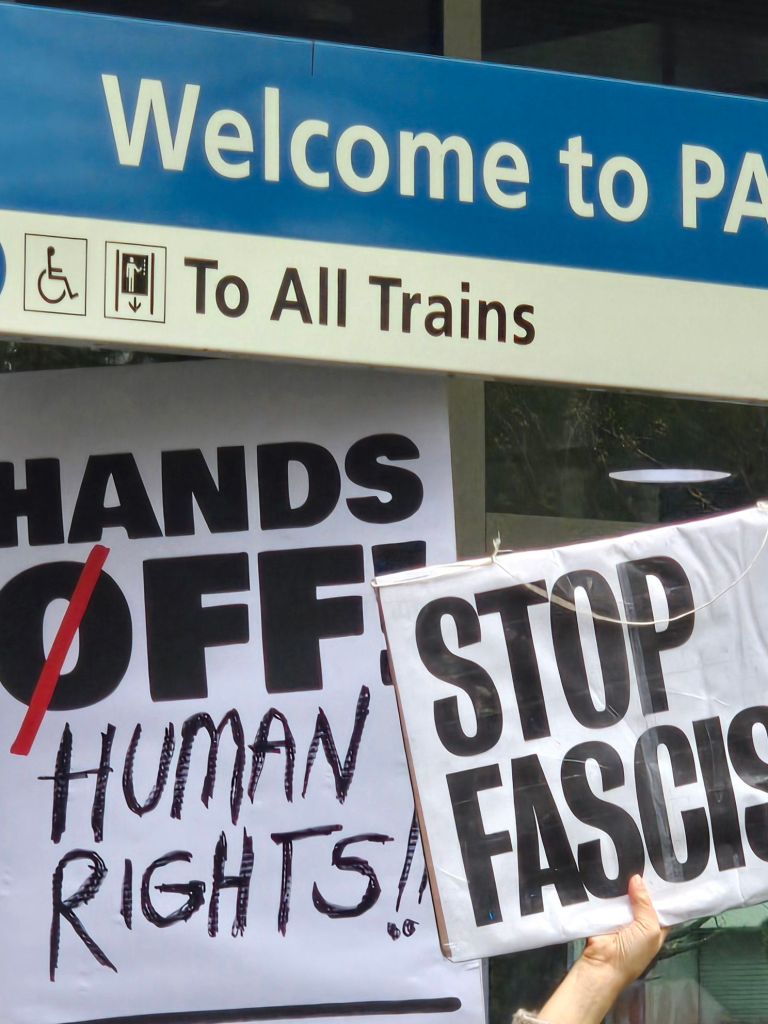
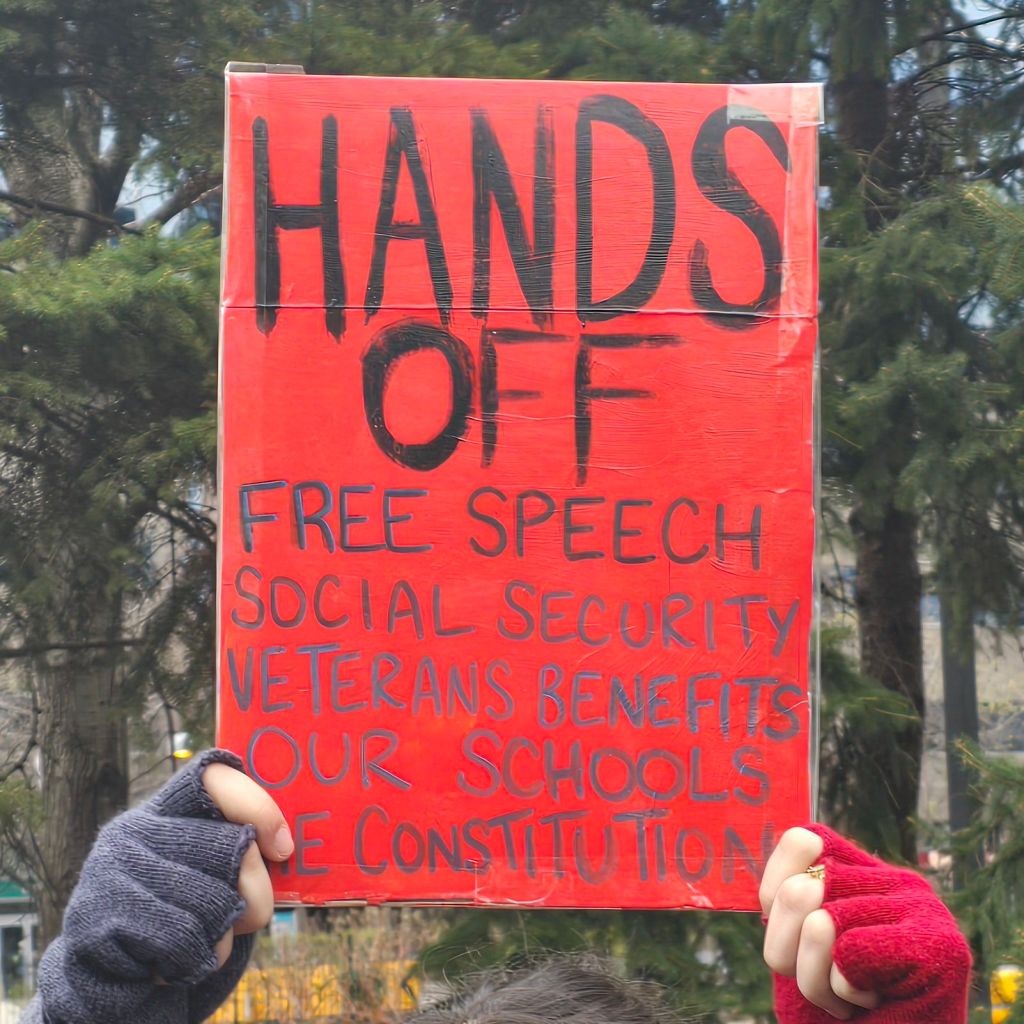
I started my day with a community of strangers outside a downtown subway station in Jersey City this morning, standing up and speaking out for our democracy, the common good, and human rights (among other things). This was one of over 1,300 events organized for today across the country under the unifying theme of #HandsOff. I carried my homemade sign which said on one side, “This is a moral moment” (quoting my Senator Cory Booker), and “Time 4 Good Trouble” (quoting John Lewis) onthe other. Under my raincoat I wore my “Love cannot be silent” t-shirt. (Before I left the house I prayed with St. Joseph and showed him my signs, because, well, I am me!)
Some reflections …
People of all ages showed up, even with the forecasted rainy weather. From families with toddlers in tow and even a mom-to-be with a very visible baby bump to grandparents and retirees and every generation in between. They even stayed when it rained, although thankfully the organizers had premptively shifted to a location that provided some shelter. Good organizing is appreciated and important and Knitty Gritty JC, a new to me local organization, did a great job planning this event.
For the most part these were not your standard protest goers (although some of us were there to be sure) but ordinary folks who answered the call to do something! They quickly went from standing around awkwardly to learning and loudly joining the chants, from the oldie but goodies (Tell me what democracy looks like, this is what democracy looks like) to hot off the news cycle ones (Ho ho, hey hey, Donald Trump crashed your 401k). Moreover, they held their signs high and joined in boisterously. I particularly loved seeing the toddlers dancing to the chants.
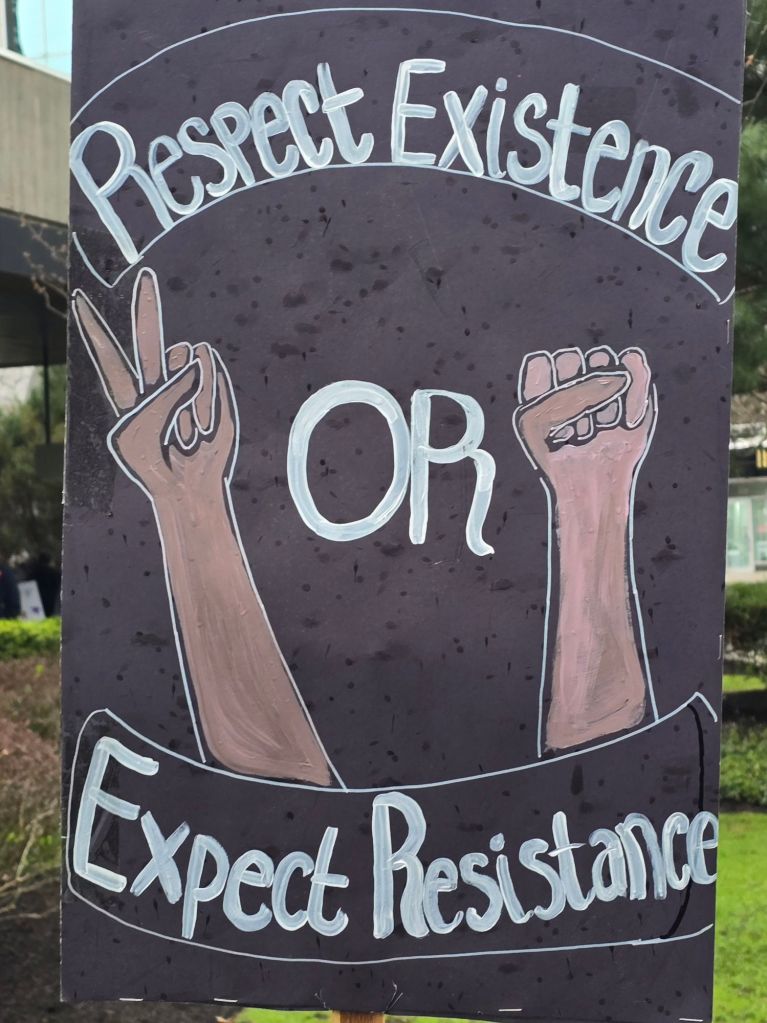
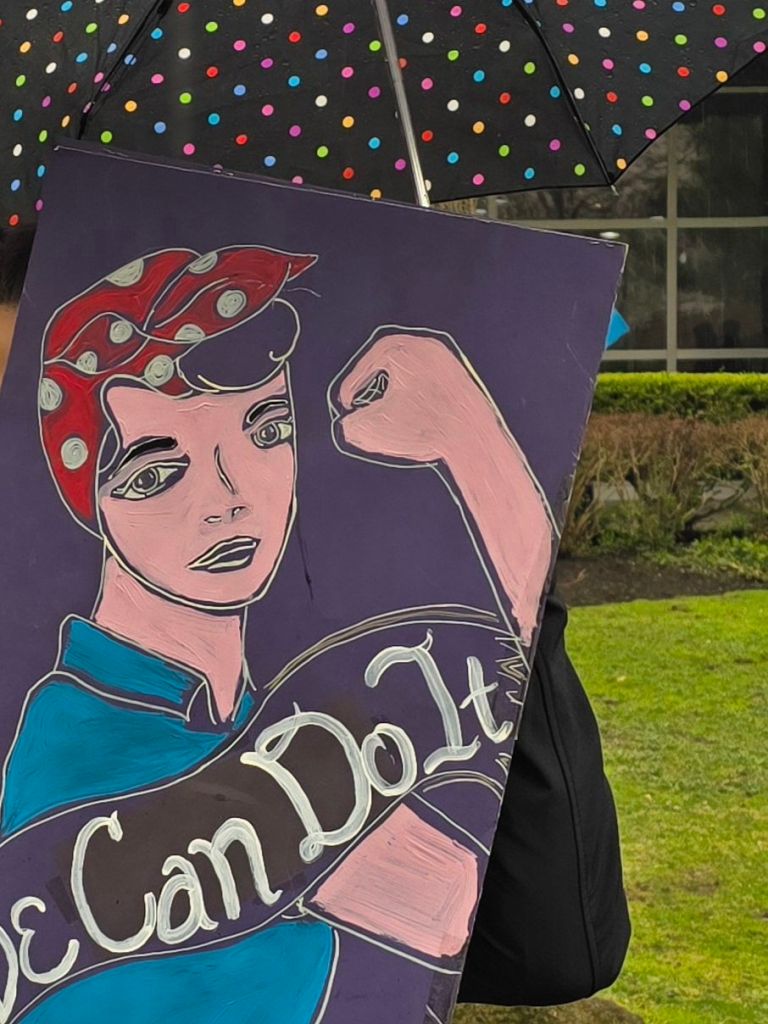
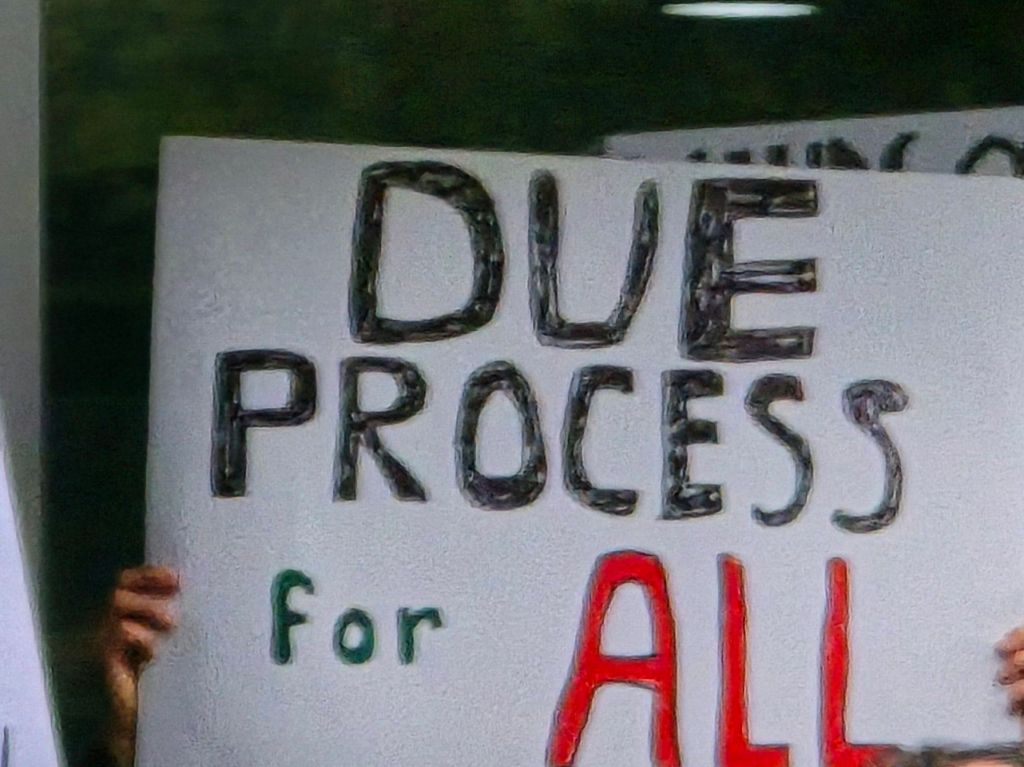
Speaking of signs … such creativity! Careful thought and consideration clearly went into these signs, messages of extreme concern for things we have been used to taking for granted like due process, libraries, and social security. There was a laundry list, but that is only because everything that serves the common good seems to be on the chopping block under the current regime. And yes, it feels more like a regime than an administration, if I am honest, just three months in.
A personal observation. This was not my first protest. I always come with my id and a form of payment just in case my right to protest is challenged by law enforcement or things go south. However, this was the first time that I decided it was prudent to bring my Global Entry card, which is government issued ID that declares my US citizenship. I am a US born white woman, yet current events led me to this precaution in these extraordinary times when our human and civil rights are under attack like never before in my lifetime. I will say that the Jersey City police were polite and just asked us to make sure we were not blocking pedestrian access to the PATH station.
Having been to many protests over the years, standing up for peace and justice from the Gulf War under Bush Senior to Title 42 under Biden, this moment feels different. As Senator Booker named it on the Senate floor this week, this is not a right or left moment but a right and wrong moment. The general vibe of today carried a particular unifying ethos and for lack of a better word, simply felt different, even from the President’s Day event I attended earlier this year. This morning’s energy was a mix of joy and anger. It felt like a community, people showing up when a family member is sick. It felt like an all hands on deck moment. And it gave me hope. Indeed, as we chanted: The people united will never be defeated.
I find myself reminded of and praying with these words from Gaudium et Spes, the Pastoral Constitution of the Second Vatican Council:
“The joys and the hopes, the griefs and the anxieties of the people of this age, especially those who are poor or in any way afflicted, these are the joys and hopes, the griefs and anxieties of the followers of Christ. Indeed, nothing genuinely human fails to raise an echo in their hearts. .. That is why this community realizes that it is truly linked with humankind and its history by the deepest of bonds.”
May we, people of all and no faiths, be bound together in hope and loving action for all that is good. May we resist joyfully. Amen
In the first three episodes of this series, I have been publishing research from my 2015 MA theology Thesis on resistance to social sin. Today I am sharing the Layers of Resistance model I developed, with some updated thinking from a recent presentation I gave to a community of Catholic Sisters last autumn.
Drawing from the Church’s understanding of social sin and insights from feminist theology, the model urges us to resist the supposed impossibility of changing the world. We can resist the globalization of indifference by acts of resistance, big or small, that seek to heal distorted relationships. Our individual actions can and will influence our the collective – in fact we can coordinate our individual actions into collective ones. Resistance is not futile. It is the way of love.
Unpacking Social Sin
First of all, before we talk about how to resist social sin , it’s important to have some common understanding of what we mean by social sin in the first place. Social sin is a relative late comer to the field of Catholic moral theology, reflecting a major shift in understanding in later part of the 20th Century. Two major influences were the renewed inter-religious dialogue during and after the Second Vatican Council on questions of racism, poverty, war and peace and Latin American liberation theology.
This category of social sin was picked up by global church in 1971 synod of bishops – Justice in the World. The Synod recognized that we are indissolubly linked and responsible. The Bishops also recognized the inability to overcome social sin by our own strength and the need to forge new paths towards action in the cause of justice in the world. This document was instrumental in my own congregation’s reclaiming of our charism of peace through justice during the renewal period.
Social sin is a broad term that “encompasses the unjust structures, distorted consciousness, and collective actions and inaction that facilitate injustice and dehumanization.” (Heyer, 415) The Church understand social sin to be both personal and collective in its source, which implies that resisting social sin must also be personal and collective. “Every sin is personal under a certain aspect; under another, every sin is social, insofar as and because it also has social consequences.” (Compendium of the Social Doctrine of the Church, 117) It is a both/and reality, and this understanding must frame our response.
In his 1987 social encyclical Sollicitudo Rei Socialis, Pope John Paul II* boldly claimed that “one cannot easily gain a profound understanding of the reality that confronts us unless we give a name to the roots of the evils which afflict us,” that is, structural sin. Over time, these structures of sin “grow stronger, spread, and become the source of other sins, and so influence people’s behavior.” (36)
Three years earlier, in his 1984 apostolic exhortation, Reconciliatio et paenitentia, Pope John Paul IIreflected on the role of the individual in social sin and the relationship to the structural elements. I find this passage especially challenging:
“It is a case of the very personal sins of those who cause and support social evil or who exploit it, of those who are in a position to avoid, eliminate, or at least limit certain social evils but who fail to do so out of laziness, fear, or the conspiracy of silence, through secret complicity or indifference, of those who take refuge in the supposed impossibility of changing the world, and also of those who sidestep the effort and sacrifice required, producing specious reasons of a higher order.”
Pope Francis adds another element to the dynamic of social sin, which I think is critical in the present (mis)information age to understand and engage, namely the Globalization of Indifference which is playing out hourly on our current geopolitical stage.
“In today’s world, the sense of belonging to a single human family is fading, and the dream of working together for justice and peace seems an outdated utopia. What reigns instead is a cool, comfortable and globalized indifference, born of deep disillusionment concealed behind a deceptive illusion: thinking that we are all-powerful, while failing to realize that we are all in the same boat. This illusion, unmindful of the great fraternal values, leads to a sort of cynicism. For that is the temptation we face if we go down the road of disenchantment and disappointment.” (Fratelli Tutti, 30)
So we need to resistthe temptation of taking refuge in the supposed impossibility of changing the world. We need to resist the illusion of isolation, the temptation of cynicsm, and being comfortable with the globalization of indifference. Reading the signs of our current times, lives depend on our ability to resist. How? That’s where I offer the Layers of Resistance Model for your reflection and action.
Layers of Resistance
Social sin is inherently relational – the sum of individual and collective acts. Therefore, our resistance to social sin must also be relational.
Layer 1 – Responsibility and Consciousness
Each of us is born into and lives in a social context. We are enmeshed in unjust structures beyond our control, some of which we derive benefit from, others which might burden us. The first layer of resistance calls us to develop a critical conciousness of our own connections to social sin, and to raise the awareness of others.
In the Latin American theological understanding of social sin, this is called conscientization. In order to accept responsibility for social sin, we must be awake to sin embodied in structures which affront human dignity/creation. Salvadoran theologian Jon Sobrino notes that “[e]vil has its own dynamic and requires concealment and lying.” He observes that “the problem is not ‘seeing,’ but ‘wanting to see.’ If people do not want to see the reality in front of them, there is no solution.” (Sobrino 38, 41)
Layer 2 – Lamentation
Note, THIS IS NOT GUILT. “Guilt,” writes Gregory Baum, “is not a useful theological concept for understanding the situation of the great majority of persons, caught as they are in the inherited structures and in the corresponding legitimating ideologies.” (Baum 119) Instead, he points us to the power of the biblical tradition of lament.
Bryan Massingale also calls us to lament our connection to social sin. Lament “entails a hard acknowledgement that one has benefited from another’s burden and that one’s social advantages have been purchased at a high cost to others. Here lament takes the form of a forthright confession of human wrongdoing in the light of God’s mercy. It is a form of truth-telling and contrition that acknowledges both the harms that have been done to others and one’s personal and communal culpability for them.” (Massingale 111)
One of Massingale’s key insights is that this lament feels visceral. We feel it in our gut. It makes us comfortable, and this is as it should be. This compels us forward to action.
Layer 3 – Healing Distorted Relationships
The third step draws from the wisdom of both magisterial teaching (see discussion of Popes John Paull II and Francis above) and feminist theology. Because social sin is just that, social or relational, then the path towards resistance must heal the relationships that have been distorted by the social sin. Indeed, feminist theologian Rosemary Radford Ruether asserts that “there is no evil that is not relational.” The historical or systemic nature of sin does not absolve us of personal responsibility. (Ruether 181)
Looking specifically at the social sin of sexism, Ruether notes that on the one hand, the system of sexism was started by human beings and continues today through the cooperative actions of human beings of both genders. Yet, she believes that if we were to stop our “many sided cooperation with it, it could not continue to stand.” (182)
Just as the social sin of sexism had its beginning in the actions and choices of human persons, we can also choose to “make a beginning” toward conversion. “In making a beginning, we can discover that the power of sexism has already been disenchanted. It has begun to be defeated ‘spiritually’, that is, it has lost its authority over our lives.” (183) This beginning is situated in our own relationships and spheres of influence.
As we seek to heal relationships distorted by social sin, Pope Francis reminds us to look at the perfect model of relationship: the Trinity – a model of communion. “If we go to the ultimate source of that love which is the very life of the triune God, we encounter the community of three divine persons, the origin and perfect model of all life in society.” (Fratelli Tutti 85)
The model of divine love embodied in the Trinity–the root of our faith–calls us to recognize that we are all made in the image and likeness of God with inherent dignity. This truth of Trinitarian love challenges us to stand up for human dignity and to seek right relationship and heal distorted ones. These are the radical roots of our faith which ground us and bring forth life and goodness.
In his new encyclical, Dilexit Nos, Pope Francis tells us: “All our actions need to be put under the ‘political rule’ of the heart. In this way, our aggressiveness and obsessive desires will find rest in the greater good that the heart proposes and in the power of the heart to resist evil.” (13)
Resistance is the moral response to social sin – individual and collective resistance. Resistance must not only be grounded in love, it must be centered in our own spheres of influence. Think back to the example of the rescuers discussed in Episode 2. Their acts of resistance, no matter how small, made a difference in their spheres of influence. Grounded in their belief that they were connected to all people, integrating the value of human life in their world view, and that they were not powerless but that they had agency, they acted. This enabled them to resist the supposed impossibility of changing the world.
We too can resist this temptation, and the globalization of indifference or feeling overwhelmed by the sheer scope of social sin if we first peel away the layers and take action to resist social sin in our own lives.
Applying the Layers of Resistance Model
Choose one aspect of social sin that you feel called to resist. Focusing on one aspect can help us to avoid feeling overwhelmed as we seek ways to resist. Some questions to consider:
1st Layer of Resistance
What do you already know about the focus area.
How are you/we linked to, accepting of, complicit in the social sin of this focus area?
How are you, might you raise the awareness of others?
2nd Layer of Resistance
What truths need to be told about your/our complicity with the social sin of this focus area?
What risks might you/we be called to take?
What is this telling you about you/our moral identity?
3rd Layer of Resistance
Who are the persons and ecosystems you are related to through this focus area?
What relationships are being distorted through this social sin?
What concrete act(s) might you take within your sphere of influence to heal these distorted relationships?
*It is not surprising that Pope John Paul II addressed the reality of social sin, given his personal history, as noted in this memorial page on the US Holocaust Museum website: “With the passing of Pope John Paul II, the world has lost a moral leader fervently committed to fighting the prejudice and hatred that led to the Holocaust. His own personal experience of Nazi oppression and the persecution of Jews, including the deaths of his childhood Jewish friends and their families in the concentration camps, strongly influenced his leadership in Jewish-Christian relations.”
Sources
Gregory Baum, “Structures of Sin,” in The Logic of Solidarity: Commentaries on Pope John Paul II’s Encyclical “On Social Sin,” eds. Gregory Baum and Robert Ellsberg (Maryknoll, NY: Orbis Books, 1989)
I am sharing excerpts from my theological research on the Ethics of Resistance to Social Sin. In Episode 3, I explore how to resist social sin in everyday actions. Ten years ago, when I wrote this, I looked at resistance to the social sin of human trafficking. Re-reading what I wrote then, I see potential insights that might be helpful as we seek in 2025 to resist other social sins, including those that seek to undermine democracy and consolidate power through oligarchy and autocracy. We are all enmeshed in a complex web of unjust structures and distorted consciousness in the best of times. In these times, you might be forgiven for feeling overwhelmed. The primary locus for resistance to social sin is in our connections in our own lives, areas where we have influence and can take actions, no matter how small, grounded in love and right relationship. Resistance is not futile. Each and every act of resistance, no matter how small, can serve to affirm inherent human dignity and the integrity of God’s creation, even if it does not actually serve, by itself, to end the social sin.
CONTEMPORARY RESISTANCE IN EVERYDAY ACTIONS Most people are not likely to face the dramatic life and death choices that were almost an everyday occurrence under the Nazi regime. Yet, as discussed in chapters Episodes One and Two, social sin enmeshes ordinary people in a web of “unjust structures, distorted consciousness, and collective actions and inaction that facilitate injustice and dehumanization.” (Heyer, 415) Most often, this web manifests itself in daily lives and choices in an increasingly globalized social, political, and economic system. It follows then that contemporary Christians seeking to resist social sin must look first at their connections to social sin in their everyday lives and choices. This is their primary locus for change.
The Second Vatican Council recognized the moral importance of everyday ordinary actions. Gaudium et Spes claims that human beings, created in God’s image, have a mandate to “rule the world in justice and holiness.” We do this through “the massive endeavor of humanity,” both at the individual and collective level. Yet, as the Council reminds us, this mandate “also applies to everyday activities.” (Gaudium et Spes, 34) Hence, it should govern our actions in every sphere of life, not just dramatic choices. Evoking the memory of Jesus, the Council asserts that “the way of love is open to all people and that … this love is to be pursued not just in great matters but above all in the ordinary circumstances of life.” (GS, 38) Facing the life-threatening and life-diminishing realities of contemporary forms of social sin, by extension this mandate also extends to actions for justice, both in extraordinary and ordinary circumstances.
In his introduction to Resist! Christian Dissent for the 21st Century, Michael G. Long asserts that resistance is a call for “everyday Christians, ordinary Christians.” 1 He also ponders “what it means to be Christian resisters” in the dominant US culture today. (Long, xxviii, xxx)
“What exactly should we resist as we make our way through this new century? Should we restrict ourselves to the evils identified in the Bible? Or are there new targets of Christian resistance? Should we resist just the governing authorities? Or are there additional forces that demand our resistance?” (Long, xxxi)
German Theologian Dorothee Sölle also ponders exactly what it is we are to resist today. Given that she was fifteen years old when the second world war ended, she was of course intimately familiar with the context of resistance discussed in the previous section. She contends that while it is important to remember that resistance carries “the memory of the dead, such as Sophie Scholl,” it cannot be reduced to the mere veneration of heroes. Rather, today’s realities require us to “offer resistance actively and deliberately and in very diverse situations, against becoming habituated to death, something that is one of the spiritual foundations of the culture of the First World.” (Sölle, Silent Cry, 4)
Sölle suggests that resistance is the “adequate form of struggle for those Christians” who are part of the dominant culture, such as “members of the white bourgeoisie—those who normally participate in the oppression and profit from exploitation.” Such resistance is a “form of liberation theology” from their social location of privilege. It is a “radical NO to the capitalist murder machine.” (Sölle, Resistance, 178-179) This “no” may take a variety of forms, such as “evasion, dissent, abstinence, refusal, boycott or strike, reform or counterproposal, dialogue or mediation.” There are echoes of Wink’s list of creative alternatives for those who follow the third way of Jesus. Sölle believes that these acts of resistance, from within the dominant culture, require a “radically mystical consciousness” which maintains connection to “those who think otherwise … No one is excluded or eliminated.” (Sölle, Silent Cry, 198) Here, Monroe’s research finding comes to mind— that only the rescuer group was able to include everyone in their worldview, and thus find the strength to advocate for the powerless at great personal risk.
Cynthia Moe-Lobeda also reflects from within the dominant culture on resistance to the life-threatening and life-diminishing reality of social sin. “‘Resistance’ means refusing to participate in some aspects of an economic system that is in fact destroying earth’s atmosphere and countless livelihoods, communities, and lives.” (Moe-Lobeda, 242) This resistance can, and must, occur at various levels: individuals and households, civil society, business, and government. “The actions of each reinforce the work of the others.” (Moe-Lobeda, 246) Moe-Lobeda’s multi-level understanding of resistance recognizes the complex structural reality of social sin. “While structural sin transcends individual moral agency, it does not transcend collective agency. … Social movements demonstrate that people, working together, can indeed counter structural sin.” (Moe-Lobeda, 63)
Moe-Lobeda outlines a three-tiered schema for practices of resistance by individuals, civil society, business, and government. The first level is direct action against the impact of the social sin, such as buying goods which are certified as fair trade, meaning the producers received a just wage. The second level is aimed at changes in public policy, such as legislative advocacy. The third level forms people “capable of making choices” against the social sin. (Moe-Lobeda, 252)
It is important to remember that actions of resistance from within the dominant culture, whether undertaken by individual actors or larger social groups, take place within a “paradox of privilege. … Even when a person does recognize and repent of structural sin, it is not possible to divest oneself from the impact of the social structures into which our lives are woven.” (Moe-Lobeda, 61)
Christian resistance to evil has always taken place within a particular social context and requires navigating a web of social, political, and economic relationships. When ethical reflection on the social problem of human trafficking begins from the experience of trafficked persons, resistance emerges as an appropriate moral response which holds fast to the truth of human dignity.2
The goal of the above discussion of resistance—from the Christian tradition, to the example of resistance to extreme social sin in the Nazi holocaust, to reflection on contemporary resistance from within the dominant culture—has been to set the stage for the development of an ethic of resistance to the social sin. It should be clear that even in the face of extreme social sin, resistance is possible and serves to affirm inherent human dignity, even if it does not actually serve, by itself, to end the social sin. Furthermore, given that identity constrains moral choice, it is important to consider how acts of resistance might help transform the social context in ways which “move us beyond generalized feelings of sympathy, sorrow, or even outrage to a sense of moral imperative.” (Monroe, 231)
Next Up: Episode 4 – Layers of Resistance Model
1 Emphasis in original text.
2 While my Masters Thesis looked at the social sin of human trafficking, I believe this theological reflection and analysis can be useful for ordinary persons seeking an ethical response to other social sins, including those that seek to undermine democracy and consolidate power through oligarchy and autocracy.
Sources
Kristin E. Heyer, “Social Sin and Immigration: Good Fences Make Bad Neighbors.” Theological Studies 71, no 2. (Summer 2010)
Michael G. Long, ed, Resist! Christian Dissent for the 21st Century (Maryknoll, NY: Orbis Books, 2008)
Moe-Lobeda, Cynthia D. Resisting Structural Evil: Love as Ecological Economic Vocation. Minneapolis, MN: Fortress Press, 2013.
Kristen Renwick Monroe, Ethics in an Age of Terror and Genocide: Identity and Moral Choice (Princeton: Princeton University Press, 2012)
Dorothy Sölle, “Resistance: Toward a First World Theology,” Christianity and Crisis 30, no. 12 (July 1979)
Dorothy Sölle, The Silent Cry: Mysticism and Resistance (Minneapolis, MN, Fortress Press 2001)
Excerpt from: “Human Trafficking as Social Sin: An Ethic of Resistance,” by Susan Rose Francois, CSJP. Submitted to the Faculty of The Catholic Theological Union at Chicago in partial fulfillment of the requirement for the degree of Masters of Arts in Theology, March 2015.
I have been pondering what, if anything, to share regarding my post election thoughts. It hasn’t quite been a week, but I have been reading the national temperature and preparing for this result for a while now. So here goes…
First, before you ask, I have already discerned that this time around, I will not be reviving my daily practice of posting a prayer for President Trump.
Why?
For one thing, the platform itself has changed from Twitter to X, resulting in a significant change in ownership, philosophy, and audience. Somehow (the grace of God?), for the most part, I avoided being trolled or harassed last time. I suspect that may not be true this time around, and dealing with that possibility is not where I wish to place my energy.
This does not mean I stop praying. I pray for our elected leaders each and every day, and the 47th President and his administration will certainly be included in my daily prayers. As will the most vulnerable people and ecosystems who will be impacted by policy changes he proposes.
I have been posting short videos that share some simple messages about God’s love, goodness, the beauty of God’s creation, human dignity, the call to be still and grounded…
These are simple yet profound truths that seem to be lost or drowned out in the noise of the globalization of indifference and toxic nature of our (un)civil discourse that makes fertile ground for misinformation and the sowing of fear, hate and division. These posts seem to be finding an audience, if modest in size. More importantly, I believe this type of messaging is urgently needed in our public space. Let me explain.
When I was in graduate theological studies, my research focused on resistance to social sin. One of my key findings had to do with identity and moral choice.
Political psychologist Kristen Renwick Monroe analyzed first hand accounts of ordinary Germans during the Nazi regime and found that how they saw themselves directly impacted how they responded. I believe there are lessons to be learned for our present moment.
Those who supported the regime saw themselves as victims. They were willing to act preemptively against the other out of a desire for self-preservation.
Bystanders saw themselves as helpless, just one person alone against the Nazis. What could they do?
Rescuers saw themselves as connected with everyone and able to effect change. Notably, Monroe also discovered that they were the only group who “had integrated the value of human life into their worldview.”
She concludes that “identity constrains choice” across all three groups. In other words, one’s identity—in relation to self, other, world, and agency—radically influences one’s ethical response and actions. Monroe believes that her findings suggest that identity constitutes “the force that moves us beyond generalized feelings of sympathy, sorrow, or even outrage to a sense of moral imperative.”
So, in addition to getting ready to be a strong, vocal, and persistent advocate for the common good, human rights, peace, and the integrity of creation in the face of likely policy, legislative, and economic changes over the next four years, I also want to do my part to help (re)form our collective sense of identity and expand our menu of moral choice.
I see myself as connected to everyone. My worldview, informed and inspired by my parents and their/my Catholic faith, calls me to see human life and dignity and the goodness of all of God’s creation as central to my worldview and demanding of my action. My religious community strengthens and expands this understanding through our common life, prayer, mission, and charism.
I feel a deep sense of call to use my gifts, talents, and influence to spread that message in the belief that it will make a difference. Also, I am hoping it will help me stay grounded during the next four years.
Last night, I saw White Rose The Musical, a new off-Broadway production. I was intrigued to see how this story of resistance to the Nazi regime by ordinary Germans would be portrayed on stage, in particular in musical form. I enjoyed the production. Most critically, it expressed the importance of doing something in the face of evil, holding fast to what matters, and staying with the questions in messy times. Overall it was hopeful, something we need these days in the face of rising fascism and threats to democracy.
One reason I travelled across the Hudson last night to see the musical was this … My research topic for my MA Ethics thesis at Catholic Theological Union was the ethics of resistance. The students of the White Rose Society were one of the case studies I explored.
During WWII, a group of college students came together in Munich to resist what they knew in their core to be wrong, using the written word to encourage resistance to the Nazi regime among ordinary Germans by speaking plainly about the evil being perpetrated in their name. In six strongly worded leaflets, they sought to raise consciousness and conscience.
“Why do the German people behave so apathetically in the face of all these abominable crimes, crimes so unworthy of the human race? … For through his apathetic behavior he gives these evil men the opportunity to act as they do; he tolerates this ‘government’ which has taken upon itself such an infinitely great burden of guilt; indeed, he himself is to blame for the fact that it came about at all! Each man wants to be exonerated of a guilt of this kind, each one continues on his way with the most placid, the calmest conscience. But he cannot be exonerated; he is guilty, guilty, guilty!”
This second leaflet was written and distributed in 1942, shortly after the Wansee Conference and implementation of the “final solution.” The first four flyers were produced in the summer of 1942. The students suspended leafleting in late 1942, when three members, all medical students—Hans Scholl, Alexander Schmorell, and Willi Graf—were drafted to medical service on the Russian front. The students wrote the final two leaflets upon their return in early 1943.
The leaflets were distributed throughout Germany by post, apparently inspired by a mimeographed sermon by Catholic Bishop Clement von Galen, condemning the Nazi euthanasia of disabled persons, which was widely distributed in this fashion. Upon receiving a copy of the sermon in the mail, Hans Scholl is reported to have said: “Finally someone has the courage to speak, and all you need is a duplication machine.”
It was the choice of Hans Scholl and his sister Sophie Scholl to distribute copies of the sixth leaflet in person at the University of Munich that led to their arrest on February 18, 1943. While students and faculty were in class, the siblings placed copies on steps, windowsills, and ledges, throwing the last leaflets over a balcony. They were arrested. Four days later the two siblings and another student, Christopher Probst, were sentenced with high treason and executed. Other White Rose members were executed in later months. Due to their arrest and execution, the students were unable to keep an appointment they had scheduled for February 25th—with Dietrich Bonhoeffer—to discuss plans for a network of student resistance groups.
Inge Scholl, sister of Hans and Sophie, later observed: “They stood up for a simple matter, an elementary principle: the right of the individual to choose his manner of life and to live in freedom.” As a group, their motivations were of course varied. Some, such as Willi Graf, were deeply motivated by the central Christian theme of love of neighbor. Graf and the other two students sent to the Russian front were certainly motivated by personally witnessing horrific violence and dehumanization of the Jewish people in concentration camps.
Sophie and Hans Scholl were influenced by their devout Lutheran upbringing in a home where Scripture was central and current issues of justice and pacifism were engaged at the kitchen table. Sophie’s own diary indicates she was motivated by her faith: “My God … Oh, how far from you I am, and the best thing about me is the pain I feel on that account. But I’m often so torpid and apathetic. Help me to be singlehearted and remain with me.”
Guided by individual motivations, the White Rose Society creatively and collectively responded both to evil and bystanders. They exposed the injustice of the system. They found a creative alternative to violence. Finally, they sought the transformation of an oppressive regime and the German people, whose apathy gave the Nazi regime power and opportunity.
Sources:
Kidder, Annemarie S. Ultimate Price: Testimonies of Christians Who Resisted the Third Reich. Maryknoll, NY: Orbis Books, 2012.
Michalczyk, John J. and Franz J. Müller. “The White Rose Student Movement in Germany: It’s History and Relevance Today.” In Resisters, Rescuers, and Refugees: Historical and Ethical Issues, ed. John J. Michalczyk, 49-57. Kansas City: Sheed & Ward, 1997.
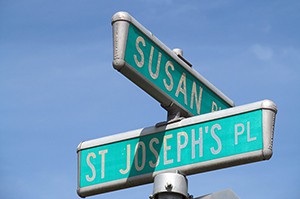






















 At the Corner of Susan and St. Joseph