The journey through Triduum is always a transformative one for me. Part of my love of the Triduum might be the fact that even though I was raised Catholic and went to 12 years of Catholic school, I never really experienced it until I came back to the Church as an adult in my 20s. My first Triduums were experienced as part of a parish faith community that took these days seriously and journeyed together in a meaningful way. In fact, when I reflect upon my own personal vocation discernment journey, I realize that Triduum played a key role.
My latest column has been posted on Global Sisters Report, in which I reflect on religious life through the lens of Downton Abbey, specifically comparing being a younger catholic sister in elected leadership to the experience of Matthew Crawley being the heir to the Earl of Grantham.
“There I was, sitting in the chapel with my Sister housemates, when I found myself thinking: ‘It’s almost as if I’m Matthew Crawley.’ … I am grateful for my random Matthew Crawley thought because it has helped me to come to grips with some of the responsibility I feel for the future. If I am honest, at times it is a heavy weight on my shoulders, as I suspect it is heavy on the shoulders of many younger members. How can we possibly follow in the footsteps of the women who answered the call of Vatican II so fearlessly? … “
Today is the Feast of St. Joseph! Margaret Anna Cusack (Mother Francis Clare) chose St. Joseph as the patron of my religious community, the Sisters of St. Joseph of Peace, because he was a model of peace. In the words of our original 1884 Constitutions:
A few years ago I made this video prayer reflection for St. Joseph’s Day (complete with a rather funny typo). I invite you to spend some time today with Joseph, model of peace.
As I prayed with today’s Scripture readings this morning, I was reminded of this video prayer reflection I created last summer as I was facing the possibility of major changes in my life. It is set to “If Not Now” by Tracy Chapman, a song that has had great meaning to me ever since I first heard it as a 16 year old (this album was constantly in the tape deck of my first car). It’s also a song with meaning that has grown for me over the years. Even now, in a new context, the meaning shifts and deepens.
I’m not quite sure why the story (John 4: 43-54) of the royal official who asked Jesus to heal his child made me think of this video prayer. Perhaps it had something to do with my suspicion that while the official did believe that Jesus could bring about healing, and he took the step to ask him to do so, he also wondered how it could be so.
So much in our life and in our world cries out for healing. In the words of Isaiah 65, may we too believe that God is about to create something new, something which will be the cause of great rejoicing and happiness.
Our job is to show up, here and now. The rest, my friends, is up to our loving and creating God.
Periodically on Fridays I will share some words of wisdom from the founder of the Sisters of St. Joseph of Peace. Known in religion as Mother Francis Clare, Margaret Anna Cusack was a prolific writer in her day. She wrote lives of the saints, spiritual works, histories, and social reform. I find great inspiration in her life’s word and work. Here’s a little tidbit from her 1876 book, Advice to Irish Girls in America.
The world gives us the example of pride; our dear Saviour Jesus Christ gives us the example of humility. My children, we must take our choice, we must follow the example which the world gives us of pride, or the example which Jesus gives us of humility.
The Lenten Scripture readings can sometimes be hard to wrap your head around, and yet, on another level, they are so very simple. Trust in God. Serve. Forgive. Love. Be merciful just as God is merciful.
I find consolation in that the disciples also seemed to have a hard time wrapping their head around the message of Jesus.
Two cases in point …
In Sunday’s Gospel from Mark (9:2-10) we have Peter wanting to set up tents and stay on the mountaintop with Jesus, Elijah, and Moses, almost missing the point that this was a new moment. In the end it required a voice from the heavens to snap him out of it!
Today we have the story of the mother of James and John (Matthew 20: 17-28) asking that “these two sons of mine sit, one at your right and the other at your left, in your kingdom.” The sons also did not get it, thinking they were up for what was ahead without stopping to think of the level of sacrifice following Jesus might entail.
I imagine that Jesus must have been just a little bit frustrated when, once again, his friends just did not get it. But he rolled up his sleeves, sat down, and tried another way of teaching lessons in paradox. His way was not business as usual, but something new centered on God’s way of love, justice, and mercy.
“You know that the rulers of the Gentiles lord it over them, and the great ones make their authority over them felt. But it shall not be so among you. Rather, whoever wishes to be great among you shall be your servant; whoever wishes to be first among you shall be your slave. Just so, the Son of Man did not come to be served but to serve and to give his life as a ransom for many.”
It shall not be so among you ….
What are the ways that we are called to live the paradox of the Gospels today? In our families? Communities? Ministry?
What is is that I just don’t get? My prayer this morning is for my heart and mind to be opened to Jesus’ never ending lessons in paradox this Lent.
Periodically on Fridays I will share some words of wisdom from the founder of the Sisters of St. Joseph of Peace. Known in religion as Mother Francis Clare, Margaret Anna Cusack was a prolific writer and advocate for women and children. She was very attuned to the social realities and situation of oppressed people in her day.
Her contemporary experience was the Irish famine. The common folks were starving, and the young and able bodied (men and women) were being forced to emigrate to make money to keep their family alive back home. Margaret Anna, then Sister Francis Clare Cusack of the Poor Clare Convent in Kenmare, County Kerry, experienced this first hand. Her Sisters fed the poor in the area district, and she funded a famine relief fund for the people of Ireland through the sale of her books. As an example of her impact, here’s a tidbit from a letter to the editor of the Dublin Free Press by a Mr. J. Sullivan:
The poor, starving people have to depend almost entirely on the funds obtained by that lady for relief. She has disbursed within a very short period, very little short of $10,000, to the poor of that district …
Serving the poor in need was not enough for her. She asked questions as to why they were poor, and looked at the social structures that perpetuated (and created) the problem. In terms of trafficking, she also looked at the situation where young women especially were made vulnerable to victimization. She saw that they were being forced to emigrate to seek work, in factories or most often as domestic servants, and she was worried for their safety–spiritually as well as physically.
“How many girls are driven to a life which they abhor simply to get bread, the bread which is denied to them by those who squander on folly what is due to justice!”
“I knew that the only way out of their victimization was to help them become economically and intellectually independent.”
She reflected on what her faith taught her, and was motivated to do as much as she could for those who Jesus had loved so well … poor and starving people.
And she acted.
I wish with all my heart that our girls were not obliged to leave their own country; but since they will do so, it is a most urgent duty of charity, and it would undoubtedly be a public benefit both to America and Ireland, to help them prepare for their future lives.
She founded St Joseph’s Sisters of Peace in 1884. Her aim was to prepare young Irish women before they emigrated, giving them skills that would help them both to survive and support their families. She also opened homes for “working girls”– meaning simply girls that worked. These homes were places of safety, rest, and renewal. Really, if you look at it through the lens of what we know today about human trafficking, she was seeking to support vulnerable women and prevent them from being trafficked.
So, what does she have to say to us today about human trafficking? Based on her own response in her day, I think she would encourage us today :
Meet the needs of vulnerable people (Charity)
Examine Root Causes (Social Analysis)
Make connections (Theological Reflection)
Act to change the systems where injustice thrives (Systemic Justice)
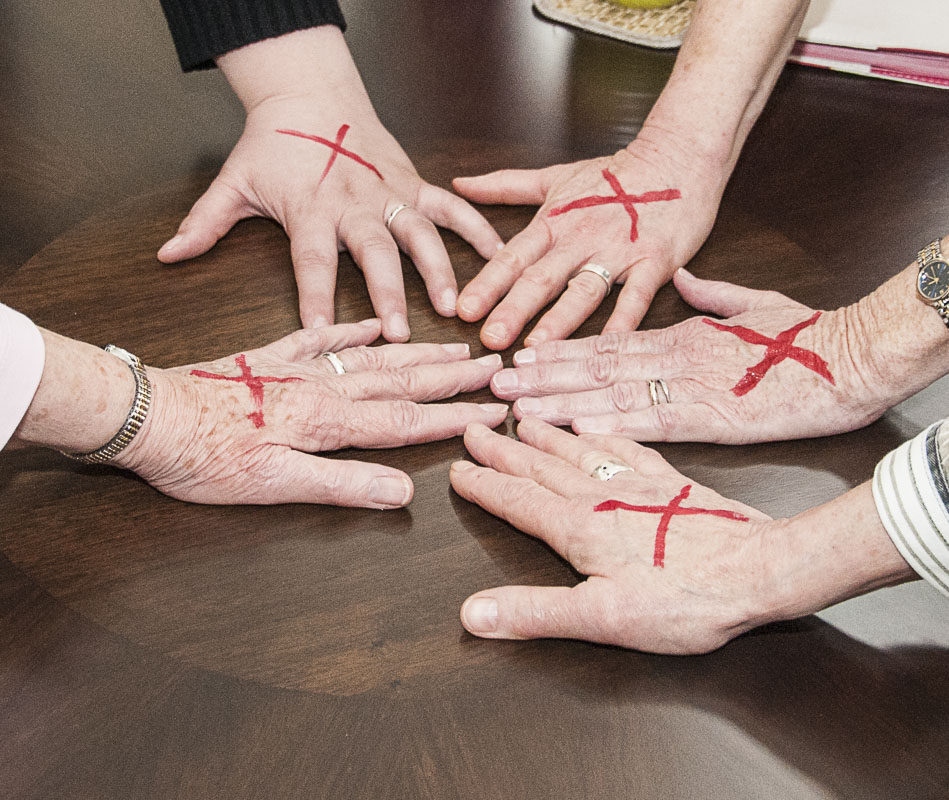
In light of all this, I am very proud of something our CSJP Leadership Team did yesterday – we approved a statement in support of the End Modern Slavery Initiative Act of 2015, an important piece of bipartisan legislation recently introduced in Congress. We also joined in Shine a Light on Slavery Day, which is today, by taking a picture of our hands with red x’s marked on them to show our commitment to end slavery.
There is a social media campaign today as part of Shine a Light on Slavery Today. If you blog, tweet, or use Facebook, consider writing on the issue of modern slavery/human trafficking and add the hashtags #EndItMovement and #EndSlaveryAct.
CSJP Leadership Team with red x’s marked on their hands to show support for the End Slavery Intiative
You know you run in certain nerdy church circles when your Facebook feed fills up with creative ways to observe the liturgical season of Lent. One meme that is making the rounds is a “Reverse Lent Challenge,” with the message that rather than giving something up (like the proverbial chocolate) you might consider taking something on, such as making a commitment to helping a family member or friend, writing notes to lonely folks, etc… It’s a nice idea to be sure.
As for me, I gave up giving up a long time ago. Well, that’s not actually exactly true. I do still take the opportunity of this season to look at my life and see what is getting in the way of a healthy relationship with God, others, and even self, and commit to making adjustments. The focus that helps me is not on what is given up, but rather what is gained. I also find this to be a very personal practice, and so I’ll be keeping to myself what I’ve chosen as my own personal Lenten practice(s).
We don’t have to go far to see what kind of fast it is that God seeks. This morning’s reading from Isaiah is one of my all time favorites, and makes it pretty clear:
This, rather, is the fasting that I wish:
releasing those bound unjustly,
untying the thongs of the yoke;
Setting free the oppressed,
breaking every yoke;
Sharing your bread with the hungry,
sheltering the oppressed and the homeless;
Clothing the naked when you see them,
and not turning your back on your own.
This time of Lent is such a gift. It is a time set aside to reorder our priorities and to prepare our hearts, lives, and world for the joy of the resurrection.
If you are still sorting out your own Lenten practice, I highly recommend reading the Lenten message from Pope Francis. I’ve adopted his closing lines as my own Lenten prayer:
During this Lent, then, brothers and sisters, let us all ask the Lord: “Fac cor nostrum secundum cor tuum”: Make our hearts like yours (Litany of the Sacred Heart of Jesus). In this way we will receive a heart which is firm and merciful, attentive and generous, a heart which is not closed, indifferent or prey to the globalization of indifference.
Blessings of peace as we ease into this Lenten season. May your heart (and my heart) be opened by God’s love to what is really important.
On this eve of St. Valentine’s Day, I share this video prayer reflection which I posted a few months back. It is set to Vance Joy’s Emmylou and carries a simple message ….


 I’ve got a reflection for Triduum posted on our new CSJP Vocations Blog



 At the Corner of Susan and St. Joseph