Tag Archives: Bernardin

Life, Death and US

As a Bernardin Scholar at Catholic Theological Union (MA in Theology 2015)  I have the honor of carrying the name of Cardinal Joseph Bernardin, perhaps most recognized for his articulation of the consistent ethic of life. Simply put, human dignity and the right to life extend from the beginning of life to natural death.

As I read the news this morning, especially this article detailing the deaths that will be caused by the US backing out of its commitments to share our abundant resources with those most in need of life saving assistance across the globe, I remembered these words from an address Cardinal Bernardin gave in 1984:

“It is clearly simply inadequate simply to say that human life is sacred and to explain why this is so. It is also necessary to examine and respond to the challenges to the unique dignity and sacredness of human life today. Human life has always been sacred, and there have always been threats to it. However, we live in a period of history when we have produced, sometimes with the best of intentions, a technology and a capacity to threaten and diminish human life which previous generations could not even imagine.”

I find it tragic, indeed sinful, that those with the power of my nation today who have the capacity to protect and save life are instead taking swift, rash, and devastating actions to withhold resources from those most in need for ideological purposes. Millions of people will literally die in the coming months and years, and in our globalized society we in this country will not be immune.

One child who becomes paralyzed because we let Polio vaccines expire in a warehouse is too much. 200,000 will be paralyzed without US assistance.

One child starving is unacceptable, and these cuts mean one million children will not receive life saving malnutrition treatment.

Some of the contracts that were ended by a terse email claiming these good works were no longer convenient for the US government included:

-TB treatment for one million people including 300,000 children

-The only source of water for 250,000 people in a refugee camp in Democratic Republic of the Congo

-Malaria tests, nets and treatments for 93 million people

-A grant to UNICEF’s polio immunization program, which paid for planning, logistics and delivery of vaccines to millions of children.

-HIV treatment  350,000 people in Lesotho, Tanzania and Eswatini, including 10,000 children and 10,000 pregnant women who were receiving care so that they would not transmit the virus to their babies at birth.

The list goes on and on and we, the American people whose “convenience” was named as the reason why, will be complicit in the deaths that will result if we do not speak up and call this what it is … sinful.

I for one will not and cannot be silent.

I will pray, especially this morning for the intercession of Cardinal Bernardin.

I will act by speaking out and advocating for what is right.

I will stay informed and raise consciousness so that we can all form our conscience.

It is literally a matter of life and death.

Bernardin’s Consistent Ethic of Life applied to Human Trafficking

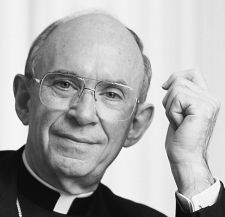
Cardinal Bernardin
Cardinal Bernardin

I have had the amazing opportunity these past 2+ years to study at Catholic Theological Union as a Bernardin Scholar. This has given me an opportunity–and responsibility–to learn more about Cardinal Joseph Bernardin and the great contributions he made to our church and Catholic social thought.  Perhaps his greatest and most far reaching contribution was his development of the Consistent Ethic of Life.

I am presently beginning work writing my masters thesis on human trafficking as social sin. One aspect of the trafficking experience is the commodification and dehumanization of the trafficked person. As I was writing the section on dehmanization, I thought I would look at what Cardinal Bernardin wrote about human dignity and see if I could weave it in. I vaguely remembered reading something he wrote which would apply, and happily just found it.

It’s an address he gave in 1984 to the National Consultation on Obscenity, Pornography, and Indecency. Here’s just a bit:

The theological foundation of our opposition to obscenity, pornography, and indecency is the dignity of the human person. …

It is clearly simply inadequate simply to say that human life is sacred and to explain why this is so. It is also necessary to examine and respond to the challenges to the unique dignity and sacredness of human life today. Human life has always been sacred, and there have always been threats to it. However, we live in a period of history when we have produced, sometimes with the best of intentions, a technology and a capacity to threaten and diminish human life which previous generations could not even imagine.

In the first instance, there are life-threatening issues such as genetics, abortion, capital punishment, modern warfare, and euthenasia. These assaults on life cannot be collapsed into one problem; they are all distinct, enormously complicated, and deserving of individual treatment. ….

That is why I have argued frequently during the past year for the need of developing a ‘consistent ethic of life’ that seeks to build a bridge of common interest and common insight on a range of social and moral questions. Successful resolution on any of these issues is dependent upon the broader attitude within society regarding overall respect for life. …

In the second instance, there are life-diminishing issues, such as prostitution, pornography, sexism, and racism. Again, each is a distinct problem, enormously complex, worthy of individual attention and action. Nonetheless, understanding that they all contribute in some way to a diminishment of human dignity provides a theological foundation for more specific reflection and concrete action.

Keep in mind, he wrote these words in 1984. Decades before human trafficking became a public policy issue on the national and international stage.  However, it is not really a stretch to expand his observations about the dehumanizing effects of prostitution and pornography—which can be considered trafficking when force, fraud, or coercion is involved—to other forms of human trafficking, such as forced labor, where the creative capacities of the human person are exploited for profit and ill-gotten gain.

Ultimately, Bernardin’s consistent ethic of life helps us focus our attention on the human part of human trafficking. When we realize that what is at stake is the inherent human dignity of persons deserving respect, hopefully we are spurred to “more specific reflection and concrete action.”

Pray for us, Cardinal Bernardin.