Tag Archives: ethic of resistance

Resistance in the Christian Tradition – Episode 3, Contemporary Resistance in Everyday Actions

See Episode 1 – Introduction

See Episode 2 – Holocaust: Resisting Extreme Social Sin

I am sharing excerpts from my theological research on the Ethics of Resistance to Social Sin. In Episode 3, I explore how to resist social sin in everyday actions. Ten years ago, when I wrote this, I looked at resistance to the social sin of human trafficking. Re-reading what I wrote then, I see potential insights that might be helpful as we seek in 2025 to resist other social sins, including those that seek to undermine democracy and consolidate power through oligarchy and autocracy. We are all enmeshed in a complex web of unjust structures and distorted consciousness in the best of times. In these times, you might be forgiven for feeling overwhelmed. The primary locus for resistance to social sin is in our connections in our own lives, areas where we have influence and can take actions, no matter how small, grounded in love and right relationship. Resistance is not futile. Each and every act of resistance, no matter how small, can serve to affirm inherent human dignity and the integrity of God’s creation, even if it does not actually serve, by itself, to end the social sin.

CONTEMPORARY RESISTANCE IN EVERYDAY ACTIONS
Most people are not likely to face the dramatic life and death choices that were almost an everyday occurrence under the Nazi regime. Yet, as discussed in chapters Episodes One and Two, social sin enmeshes ordinary people in a web of “unjust structures, distorted consciousness, and collective actions and inaction that facilitate injustice and dehumanization.” (Heyer, 415) Most often, this web manifests itself in daily lives and choices in an increasingly globalized social, political, and economic system. It follows then that contemporary Christians seeking to resist social sin must look first at their connections to social sin in their everyday lives and choices. This is their primary locus for change.

The Second Vatican Council recognized the moral importance of everyday ordinary actions. Gaudium et Spes claims that human beings, created in God’s image, have a mandate to “rule the world in justice and holiness.” We do this through “the massive endeavor of humanity,” both at the individual and collective level. Yet, as the Council reminds us, this mandate “also applies to everyday activities.” (Gaudium et Spes, 34) Hence, it should govern our actions in every sphere of life, not just dramatic choices. Evoking the memory of Jesus, the Council asserts that “the way of love is open to all people and that … this love is to be pursued not just in great matters but above all in the ordinary circumstances of life.” (GS, 38) Facing the life-threatening and life-diminishing realities of contemporary forms of social sin, by extension this mandate also extends to actions for justice, both in extraordinary and ordinary circumstances.

In his introduction to Resist! Christian Dissent for the 21st Century, Michael G. Long asserts that resistance is a call for “everyday Christians, ordinary Christians.” 1 He also ponders “what it means to be Christian resisters” in the dominant US culture today. (Long, xxviii, xxx)

“What exactly should we resist as we make our way through this new century? Should we restrict ourselves to the evils identified in the Bible? Or are there new targets of Christian resistance? Should we resist just the governing authorities? Or are there additional forces that demand our resistance?” (Long, xxxi)

German Theologian Dorothee Sölle also ponders exactly what it is we are to resist today. Given that she was fifteen years old when the second world war ended, she was of course intimately familiar with the context of resistance discussed in the previous section. She contends that while it is important to remember that resistance carries “the memory of the dead, such as Sophie Scholl,” it cannot be reduced to the mere veneration of heroes. Rather, today’s realities require us to “offer resistance actively and deliberately and in very diverse situations, against becoming habituated to death, something that is one of the spiritual foundations of the culture of the First World.” (Sölle, Silent Cry, 4)

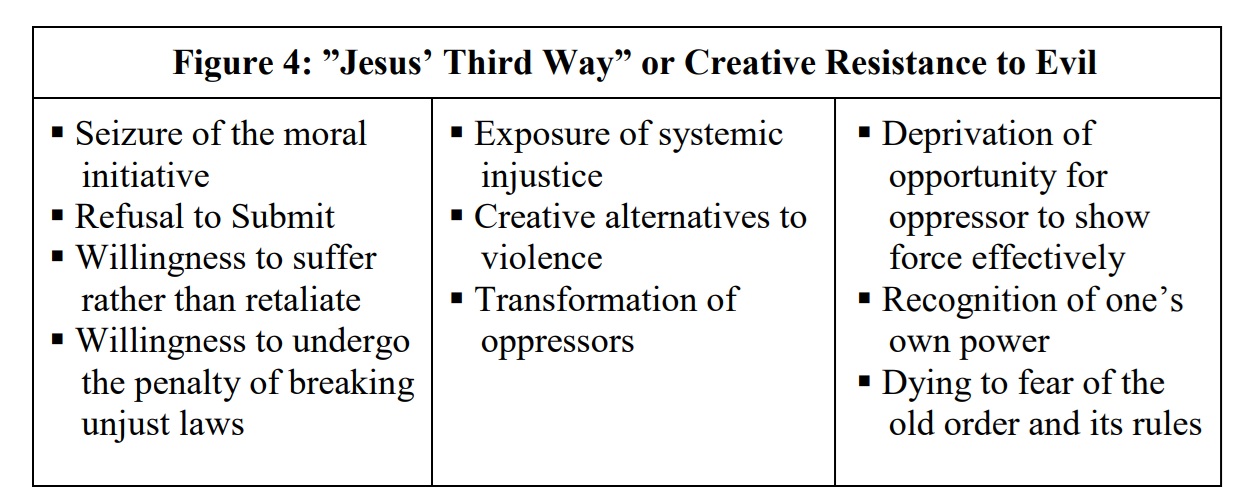
Sölle suggests that resistance is the “adequate form of struggle for those Christians” who are part of the dominant culture, such as “members of the white bourgeoisie—those who normally participate in the oppression and profit from exploitation.” Such resistance is a “form of liberation theology” from their social location of privilege. It is a “radical NO to the capitalist murder machine.” (Sölle, Resistance, 178-179) This “no” may take a variety of forms, such as “evasion, dissent, abstinence, refusal, boycott or strike, reform or counterproposal, dialogue or mediation.” There are echoes of Wink’s list of creative alternatives for those who follow the third way of Jesus. Sölle believes that these acts of resistance, from within the dominant culture, require a “radically mystical consciousness” which maintains connection to “those who think otherwise … No one is excluded or eliminated.” (Sölle, Silent Cry, 198) Here, Monroe’s research finding comes to mind— that only the rescuer group was able to include everyone in their worldview, and thus find the strength to advocate for the powerless at great personal risk.

Cynthia Moe-Lobeda also reflects from within the dominant culture on resistance to the life-threatening and life-diminishing reality of social sin. “‘Resistance’ means refusing to participate in some aspects of an economic system that is in fact destroying earth’s atmosphere and countless livelihoods, communities, and lives.” (Moe-Lobeda, 242) This resistance can, and must, occur at various levels: individuals and households, civil society, business, and government. “The actions of each reinforce the work of the others.” (Moe-Lobeda, 246) Moe-Lobeda’s multi-level understanding of resistance recognizes the complex structural reality of social sin. “While structural sin transcends individual moral agency, it does not transcend collective agency. … Social movements demonstrate that people, working together, can indeed counter structural sin.” (Moe-Lobeda, 63)

Moe-Lobeda outlines a three-tiered schema for practices of resistance by individuals, civil society, business, and government. The first level is direct action against the impact of the social sin, such as buying goods which are certified as fair trade, meaning the producers received a just wage. The second level is aimed at changes in public policy, such as legislative advocacy. The third level forms people “capable of making choices” against the social sin. (Moe-Lobeda, 252)

It is important to remember that actions of resistance from within the dominant culture, whether undertaken by individual actors or larger social groups, take place within a “paradox of privilege. … Even when a person does recognize and repent of structural sin, it is not possible to divest oneself from the impact of the social structures into which our lives are woven.” (Moe-Lobeda, 61)

Christian resistance to evil has always taken place within a particular social context and requires navigating a web of social, political, and economic relationships. When ethical reflection on the social problem of human trafficking begins from the experience of trafficked persons, resistance emerges as an appropriate moral response which holds fast to the truth of human dignity.2

The goal of the above discussion of resistance—from the Christian tradition, to the example of resistance to extreme social sin in the Nazi holocaust, to reflection on contemporary resistance from within the dominant culture—has been to set the stage for the development of an ethic of resistance to the social sin. It should be clear that even in the face of extreme social sin, resistance is possible and serves to affirm inherent human dignity, even if it does not actually serve, by itself, to end the social sin. Furthermore, given that identity constrains moral choice, it is important to consider how acts of resistance might help transform the social context in ways which “move us beyond generalized feelings of sympathy, sorrow, or even outrage to a sense of moral imperative.” (Monroe, 231)

Next Up: Episode 4 – Layers of Resistance Model


1 Emphasis in original text.

2 While my Masters Thesis looked at the social sin of human trafficking, I believe this theological reflection and analysis can be useful for ordinary persons seeking an ethical response to other social sins, including those that seek to undermine democracy and consolidate power through oligarchy and autocracy.

Sources

Kristin E. Heyer, “Social Sin and Immigration: Good Fences Make Bad Neighbors.” Theological Studies 71, no 2. (Summer 2010)

Michael G. Long, ed, Resist! Christian Dissent for the 21st Century (Maryknoll, NY: Orbis Books, 2008)

Moe-Lobeda, Cynthia D. Resisting Structural Evil: Love as Ecological Economic Vocation. Minneapolis, MN: Fortress Press, 2013.

Kristen Renwick Monroe, Ethics in an Age of Terror and Genocide: Identity and Moral Choice (Princeton: Princeton University Press, 2012)

Second Vatican Council, Gaudium et Spes, 1965 https://www.vatican.va/archive/hist_councils/ii_vatican_council/documents/vat-ii_const_19651207_gaudium-et-spes_en.html

Dorothy Sölle, “Resistance: Toward a First World Theology,” Christianity and Crisis 30, no. 12 (July 1979)

Dorothy Sölle, The Silent Cry: Mysticism and Resistance (Minneapolis, MN, Fortress Press 2001)

Excerpt from: “Human Trafficking as Social Sin: An Ethic of Resistance,” by Susan Rose Francois, CSJP. Submitted to the Faculty of The Catholic Theological Union at Chicago in partial fulfillment of the requirement for the degree of Masters of Arts in Theology, March 2015.

Resistance in the Christian Tradition – Episode 2, Nazi Holocaust: Resisting Extreme Social Sin

See Episode 1 – Introduction

I am sharing excerpts from my theological research on the Ethics of Resistance to Social Sin. In Episode 2, I share critical learnings from the experience of ordinary Christians resisting the death dealing reality of the Nazi regime in Germany and occupied territories. One major finding is that identity constrains the menu of moral choice. So how you see yourself, and the world, matters! Will you be a bystander who feels they are one person alone and can’t make a difference? A perpetrator/supporter who lashes out preemptively? Or a resister/rescuer who understands we all have agency to effect change and incorporate human dignity into your worldview? The choice my friends is ours!

NAZI HOLOCAUST: RESISTING EXTREME SOCIAL SIN
The metanarrative of the Nazi Holocaust rightly focuses on the violence, repression, and death-dealing atrocities committed against millions of innocent people in the name of National Socialism and its corresponding ideology. Yet, there is another narrative, sometimes neglected, which is also set within Nazi Germany and the territories it occupied by force. It is the story of ordinary people—farmers, college students, and average citizens—who resisted the Nazi regime from within their own spheres of influence, frequently paying for their resistance with their own lives.

To be sure, many Germans supported Adolf Hitler and company when they assumed power, while others chose a position on the sidelines. As of 1941, the majority of the population had not become members of the Nazi party or its organizations. What is less well known is the story of the thousands of people arrested or executed for acts of resistance: 300,000 German political resisters were in prison by 1939; 5,000 active resisters were executed; and 15,000 members of the military were killed for desertion or other actions deemed subversive. (Kidder, vii-viii)

Mark A. Wolfgam asserts that, behind these numbers, one can discern still other “very ordinary Germans [who] were able to carry out meaningful acts of resistance.” The reason these acts of resistance by ordinary persons are not well known, at least in part, is because in the immediate decades after the war, resistance narratives “were focused primarily upon heroic elite resistance.” More recent efforts to collect oral histories from the wider population who survived the war, however, have illustrated that many ordinary people “sought to work for the end of the regime in more limited and private ways.” (Wolfgam, 202-203)

Those who sought to resist this extreme reality of social sin were faced with an overarching bureaucratic machine that impacted and controlled many facets of daily life. Hence, the path to resistance was not an easy one, nor was it easy to sustain.

“Sometimes a single gesture was all that could be dared. The range of actions that constitute resistance is very broad, encompassing flight, hiding, sheltering those in danger, participating in forbidden activities, maintaining a sense of humanity in a dehumanizing environment, and engaging in military or quasi-military actions that would physically harm the Nazi machine.” (Gurewitsch, 221)

Some, like Franz Jägerstätter, an Austrian farmer beatified by the Catholic Church in 2007, resisted military involvement all together. Jägerstätter was beheaded in 1943 for his refusal to serve in the Nazi military, despite repeated counsel to the contrary by Church officials.
(Kidder, 34) He wrote of his discernment to resist: “Does it still bear witness to Christian love of neighbor if I commit an act, which I truly regard as evil and very unjust, and yet I continue to commit the act because otherwise I would suffer either physical or economic harm?” (Putz, 70)1

Other ordinary people sought to transform the social context by raising consciousness and conscience regarding the atrocities of the Nazi regime. In Munich, Germany, a group of college students calling themselves the White Rose Society widely distributed six strongly worded leaflets “to encourage passive resistance to the Nazi regime by unmasking its evil.” (Kidder, 34) They asked: “Why do the German people behave so apathetically in the face of all these abominable crimes, crimes so unworthy of the human race?” (White Rose Society, “Second Leaflet”) In February 1942, after being caught in the act of distributing the sixth leaflet on the campus of the University of Munich, siblings Hans and Sophie Scholl were arrested, sentenced with high treason, and executed. Other White Rose Society members were later executed. (Michalczyk and Müller, 49)

Seven months after the arrest of the Scholl siblings, thousands of ordinary people in Denmark managed a remarkable act of resistance on a grand scale. Within two days of a leaked announcement of a Nazi plan to round up the Danish Jewish population en masse—around 7,000 people—on the eve of Rosh Hashanah, “most Jews had succeeding in finding refuge with other Danes or in going into hiding.” They were helped by “thousands of unknown individuals” across the wide spectrum of Danish society. Still other Danes “knew what was going on, from neighbors to the staff on trains to the Danish police, and did not tell the Germans.” Within two months, most Danish Jews had escaped via small fishing boats to safety in neutral Sweden. (Trautner-Kromann, 91-93)

The contemporary reader, reflecting on what is now known of the extent of the atrocities of the Nazi holocaust and the probable cost for these acts of resistance, might be forgiven for thinking that these ordinary resisters were extraordinary, if not heroic. Andrew Michael Flescher contends that even those named “heroes” are both “ordinary and extraordinary.” They are extraordinary in that they “perform considerable altruistic actions at great costs,” yet they are ordinary because “they affirm rather than transcend their humanity.” 2 (Flescher, 154-155)

Reflecting on his own study of oral histories by ordinary Germans who resisted the Nazi regime, Wolfgam observes that “these acts of resistance … open new questions as to why more was not done.” (Wolfgam, 216-217) This key ethical question has relevance beyond the Nazi holocaust, to contemporary genocide, and to individual and collective response to other forms of social sin. It is helpful to ask the reverse of this key question: what was it that enabled thousands of ordinary people to counter the dehumanization of the Nazi regime through acts of resistance to extreme social sin in their daily lives?

Political psychologist Kristen Renwick Monroe offers a critical insight on this reverse question of motive. Analyzing extensive interviews with rescuers, bystanders, and Nazi supporters to examine their “diverse responses to Genocide,” Monroe concludes that “identity constrains choice” across all three groups. (Monroe, 190) In other words, one’s identity—in relation to self, other, world, and agency—radically influences one’s ethical response and actions. (Monroe, 245) She proposes thinking of one’s identity as providing a “cognitive menu” of moral choice. “Acts not on the cognitive menu are not considered, just as pizza is not an option in a Japanese restaurant.” (Monroe, 200)

Monroe found that bystanders “saw themselves as weak, low on efficacy, with little control over the situation.” (Monroe, 193) Their common response was: “But what could I do? I was one person alone against the Nazis.” (Monroe, 214) Supporters of the Nazi regime, paradoxically, saw themselves as victims, “besieged by threats to their well-being.” (Monroe, 197) They were willing to strike “preemptively” at target groups out of a perceived need for self preservation. (Monroe, 200) They also perceived themselves as constrained by “forces beyond human control that drive world events.” (Monroe, 214) By contrast, Monroe found that rescuers saw themselves as “connected with everyone” and able to effect change. (Monroe, 192) Notably, she also discovered that they were the only group who “had integrated the value of human life into their worldview.” Monroe believes that her findings suggest that identity constitutes “the force that moves us beyond generalized feelings of sympathy, sorrow, or even outrage to a sense of moral imperative…” Finally, she encourages “other scholars to test” her results in various contexts. (Monroe, 247) It seems clear that a key question from her findings for the field of ethics, particularly as it regards the response to contemporary and enduring forms of social sin, is how to broaden the menu of moral choice.

Next Up in the Series – Episode 3, Contemporary Resistance in Everyday Actions


1 Putz is a biographer and editor of the writings of Jägerstatter. She does not cite the exact source of this quotation.

2 Emphasis in the original text.

Sources

Andrew Michael Flescher, Heroes, Saints and Ordinary Morality (Washington, DC: Georgetown University, 2003)

Brana Gurewitsch, ed., Mothers, Sisters, Resisters: Oral Histories of Women Who Survived the Holocaust (Tuscaloosa, AL: University of Alabama Press, 1998)

Annemarie S. Kidder, Ultimate Price: Testimonies of Christians Who Resisted the Third Reich (Maryknoll, NY: Orbis Books, 2012)

John J. Michalczyk and Franz J. Müller, “The White Rose Student Movement in Germany: Its History and Relevance Today,” in Resisters, Rescuers, and Refugees: Historical and Ethical Issues, ed. John J. Michalczyk (Kansas City: Sheed & Ward, 1997)

Kristen Renwick Monroe, Ethics in an Age of Terror and Genocide: Identity and Moral Choice (Princeton: Princeton University Press, 2012)

Erna Putz, “Franz Jägerstatter: Better the Hands in Chains than the Will,” in Christianity and Resistance in the 20th Century (Boston: Brill, 2009)

Hanne Trautner-Kromann, “The Role of Moral Examples in Teaching Ethics after the Holocaust,” in The Double Binds of Ethics After the Holocaust: Salvaging the Fragments, eds. Jennifer L. Geddes, John K. Roth, and Jules Simon (New York: Palgrave Macmillan, 2009),

White Rose Society, “Second Leaflet,” 1942. https://www.white-rose-studies.org/pages/leaflet-2

Mark A. Wolfgam, “Rediscovering Narratives of German Resistance: Opposing the Nazi ‘Terror-State,” Rethinking History 10 (June 2006)

Excerpt from: “Human Trafficking as Social Sin: An Ethic of Resistance,” by Susan Rose Francois, CSJP. Submitted to the Faculty of The Catholic Theological Union at Chicago in partial fulfillment of the requirement for the degree of Masters of Arts in Theology, March 2015.