Today is the anniversary of the death of German theologian Dorothee Sölle (she died in 2003). We would do well to remember and learn from her as we face what it means to live in a context where death dealing policies take hold and are carried out in our name.
She wrote about what she called the mysticism of resistance. This theology was grounded in her own grappling with her context, given that she was fifteen years old when the second world war ended.
Sölle believed that today’s realities require us to “offer resistance actively and deliberately and in very diverse situations, against becoming habituated to death, something that is one of the spiritual foundations of the culture of the First World.” Consequently, she suggests that resistance is the “adequate form of struggle for those Christians” who are part of the dominant culture, such as “members of the white bourgeoisie—those who normally participate in the oppression and profit from exploitation.”
Such resistance is a is a “radical NO to the capitalist murder machine.” This “no” may take a variety of forms, such as “evasion, dissent, abstinence, refusal, boycott or strike, reform or counterproposal, dialogue or mediation.”
These acts of resistance, from within the dominant culture, require a “radically mystical consciousness” which maintains connection to “those who think otherwise … No one is excluded or eliminated.”
“Without this form of mysticism,” she writes, “resistance loses it focus and dies before our very eyes. It is not that creating public awareness, winning fellow participants, and changing how we accept things is beside the point. But the ultimate criterion for taking part in actions of resistance and solidarity cannot be success because that would mean to go on dancing to the tunes of the bosses of this world.”
Quotes from The Silent Cry: Mysticism and Resistance (Minneapolis, MN, Fortress Press 2001)
I am feeling the call to write more during this time in history. Starting today I am going to be sharing excerpts from my Master Thesis for my Moral Theology degree (from Catholic Theological Union), in which I developed an ethic of resistance. I will publish this as a series. My original application was to the social sin of human trafficking, but you will see as this series moves forward that I looked at other examples and responses by ordinary Christians to extreme social sin, such as the death-dealing reality of the Nazi Holocaust. The identity and worldview of these resisters led them to counter dehumanization through acts of resistance, often at great personal cost. Their witness offers ordinary persons seeking to resist social sin today a model and path to follow in our times. Who knew that just one decade later I would be mining my own research for practical applications in our country?
First, a few introductory words about how I understand resistance as an ethical framework.
Resistance can be understood as “standing fast to a position or principle.” Margaret Collins Weitz derives this understanding from the Latin roots of the word for resistance, resistere. The prefix re intensifies the stronger form of the verb stare, to stand. In this light, resistance involves an “inner certainty … allied with a strong sense of conscience and belief in human dignity.” (Weitz, 33-34)
So as we navigate these days, let us hold fast to that which we know to be true: we are good. God is good. And our job is to promote good for others and, indeed, all of God’s creation. It’s that simple. We have to keep it simple so as to stay the course in the face of misinformation, deception, disconnection, globalized indifference, and the normalization of extreme social sin. And with that, episode one.
Episode 1: Resistance in the Christian Tradition
The Christian tradition of resistance of course begins with the person of Jesus. “The practice of resistance in the life of Jesus is where Christians must begin for understanding how to resist evil.” (DeYoung, 6) Curtiss Paul DeYoung identifies three key modes of resistance practiced by Jesus in the Gospels. First, Jesus “resisted the popular notion of who was ‘worthy’ of relationship by developing friendships with persons at the margins of society in his day—women, tax collectors, Samaritans, militant activists, people with disabilities, poor people, and working people.” (DeYoung, 6) In other words, Jesus resisted social norms of exclusion in his own personal sphere by “creating a wide web of relationships” around himself. (DeYoung, 6-7) Second, Jesus “resisted stereotypes and transformed cultural images in his day by injecting into popular culture positive descriptions of Samaritans and women.” (DeYoung, 11) Third, Jesus resisted through public protest, such as the incident against the money changers in the temple. “This demand for equal access to the central institution of religion and community governance was so significant and memorable that it is included by all of the Gospel writers.” (DeYoung, 12)
Another Gospel passage directly related to resistance is the Sermon on the Mount, in particular Matthew 5:39a: “ But I say to you, offer no resistance to one who is evil” (NAB). Johannes Nissen notes that this passage is traditionally understood as advocating “non-resistance to evil.” (Nissen, 184). It is potentially problematic because, as Walter Wink observes, “if Jesus commands us not to resist, then the only other choice would appear to be passivity, complicity in our own oppression, surrender.” (Wink, 184)
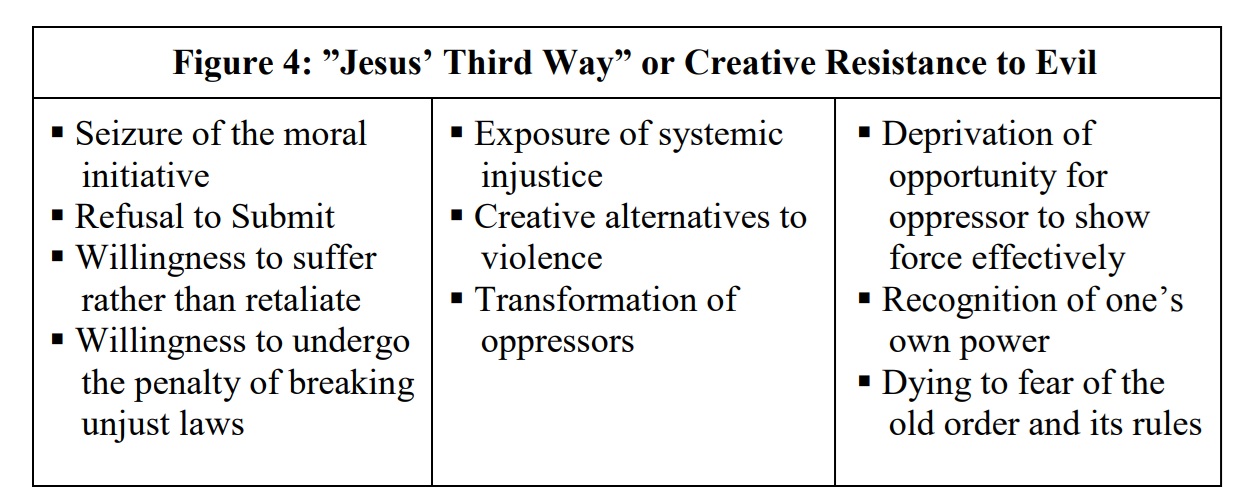
However, Wink asserts that the Greek word used in Matthew, antisēnai, does not merely mean “resist” or “stand against,” but rather to “resist violently, to revolt or rebel, to engage in an insurrection.” In other words, the message of Jesus to his followers is not to “mirror evil” with evil. Wink concludes that the “logic of the text” points neither to passivity nor violent resistance, but instead to finding “a third way, a way that is neither submission nor assault, neither fight nor flight, a way that can secure your human dignity and begin to change the power equation.” (Wink, 184-185)
The actions suggested by Jesus in the passages following this admonition against resisting evildoers—to turn the other cheek, give away one’s cloak, walk a second mile, and give to those who borrow (Matthew 5: 39b-41)—are “not rules to be followed legalistically, but examples to spark an infinite variety of creative response in new and changed circumstances.” (Wink, 185) Inspired by these examples, Wink suggests creative alternatives for the Christian choosing to follow Jesus’ third way of resisting evil (see Figure 4). (Wink, 186-187)
In choosing creative resistance, followers of Jesus seek to deny, defuse, and defeat the dehumanizing tactics of oppressors.
Christian resistance to evil has always been played out within a social context, as Christians have navigated relationships with the state, society, and economy in light of the Gospel and the reality of evil. “Resistance is the process of drawing attention to evil and injustice while pressuring the powers that be to pursue positive social change.” (DeYoung, 16)
From its very beginnings as a “tiny, fragile organization,” the Christian Church faced state sponsored discrimination. Søren Dosenrode observes that, from this minority position, “Christians rendered passive resistance to the state as no other real alternative remained.” Martyrdom was often the result of such resistance. (Dosenrode, 11-12) In their daily lives, early Christians resisted poverty and economic oppression by “creating a countercultural community that practiced its own economy of grace,” such as that depicted in Acts 4: 32-37. (Long, xxi-iii) It was not until the legalization of Christianity in 313, and the evolving close relationship between church and state when Christianity became the official religion of the Roman Empire, that resistance became a serious question for Christians. (Donsenrode, 11-12)
One early model for Christian resistance is St. Maximus the Confessor (580-662 CE). His Four Centuries on Love is cited by Charles C. McCarthy as containing the core of his teaching on resistance, centered on the example of Jesus and the primacy of love. (McCarthy, 77) “The one who loves Christ thoroughly imitates him as much as he can.” (Maximus, 81) Maximus taught that in the struggle against evil, the “microcosmic deed of love is all that humanity has to work with,” and indeed, all it needs. (McCarthy, 82)
Maximus lived out this teaching on resistance in his own life. He stood fast against monothelitism, the “theology that Christ was not as the Council of Chalcedon had stated, ‘true God and true man,’ but, in fact, had one will (divine), not a human will and a divine will.” 1 (McCarthy, 84). His belief in the doctrine that Christ had two wills led him to resist both civil and ecclesial authorities who supported monothelitism; he “suffered imprisonment and torture for this stand.” (McCarthy, 78) Maximus was later exiled to Lazica where he died in 662 CE. (McCarthy, 65)
For Thomas Merton, a Trappist monk who contemplated the spirituality of resistance, Maximus is a model of what is possible for human persons facing evil. Maximus “portrays nonviolent resistance under suffering and persecution as the normal way of the Christian.” Countering those who dismiss resistance as impractical or impossible, Merton holds up Maximus as one who believed that Jesus “does not command the impossible, but clearly what is possible.” Furthermore, for Maximus, Gospel resistance, modeled on the way Jesus actually resisted evil, should be “aimed not at the evildoer but at evil as its source.” 2 (Merton, 176)
Notwithstanding early models of Christian nonviolent resistance such as Maximus, in practice the ongoing marriage between church and state led to a mixed assessment of resistance. Dosenrode observes that in the Middle Ages, certain forms of passive resistance were “known and accepted as common law,” such as refusing to pay taxes, provided they were proportional. More active forms of resistance were also carefully assessed by theologians and Church authorities. For example, tyrannicide was accepted as a last resort by Thomas Aquinas, “provided that it was rooted in a higher power than an individual’s idea.” At the Council of Constance (1414-1418), however, the Catholic Church condemned tyrannicide outright as contrary to the moral life. Protestant and Reformed churches “became more open to resistance to defend the true faith” during the Reformation, while the Catholic Church held close to its condemnation. By the twentieth century, the doctrine of resistance in the Catholic, Reformed, and Protestant churches was one of “restraint in the use of power” and support of the state and status quo. (Dosenrode, 13-14, 17) The experience of the Nazi holocaust called this stance into question.
1 The Third Council of Constantople declared monothelitism as a heresy in 681 CE.
2 Emphasis in the original text.
Sources:
Curtiss Paul DeYoung, “From Resistance to Reconciliation: The Means and Goal of Christian Resistance,” in Resist! Christian Dissent for the 21st Century, ed. Michael. G. Long (Maryknoll, NY: Orbis Books, 2008)
Søren Dosnerode, ed., Christianity and Resistance in the 20th Century: From Kaj Munk to Dietrich Bonhoeffer to Desmond Tutu (Boston: Brill, 2009)
Michael G. Long, ed, Resist! Christian Dissent for the 21st Century (Maryknoll, NY: Orbis Books, 2008)
Maximus the Confessor, Maximus the Confessor: Selected Writings, trans. George C. Berthold (New York: Paulist Press, 1985),
Charles C. McCarthy, “Maximus the Confessor (580-662),” in Non-Violence—Central to Christian Spirituality: Perspectives from Scripture to the Present, ed. Joseph T. Culliton (New York: The Edwin Mellen Press, 1982),
Johannes Nissen, “Between Conformity and Nonconformity: The Issue of Non-Violent Resistance in Early Christianity and its Relevance Today,” in Christianity and Resistance in the 20th Century: From Kaj Munk and Dietrich Bonhoeffer to Desmond Tutu, ed. Søren Dosenrode (Boston: Brill, 2009)
Margaret Collins Weitz, “Resistance: A Matter of Conscience,” in Resisters, Rescuers, and Refugees: Historical and Ethical Issues, ed. John J. Michalczyk (Kansas City: Sheed & Ward, 1997)
Walter Wink, Engaging the Powers: Discernment and Resistance in a World of Domination (Minneapolis: Fortress Press, 1992)
Excerpt from: “Human Trafficking as Social Sin: An Ethic of Resistance,” by Susan Rose Francois, CSJP. Submitted to the Faculty of The Catholic Theological Union at Chicago in partial fulfillment of the requirement for the degree of Masters of Arts in Theology, March 2015.
Today is the feast day of St. Angela Merici who died in 1540. She was a visionary woman who gathered others around her. She won approval from her Diocese for the first rule written by a woman for a community of women.
The first chapter speaks about the need to have a breadth of vision and includes this powerful quote from Angela:
‘This charge must not be a burden for you; on the contrary, you have to thank God most greatly that he has deigned to see to it that you are among those he wants to spend themselves in governing and safeguarding such a treasure [as] his own … Do not be afraid of not knowing and not being able to do what is rightly required in such a singular government. Do something. Get moving. Be confident. Risk new things. Stick with it. Get on your knees. Then be ready for big surprises.’
She wrote these words just before her death. They were written for the Company of Ursula, the small community she had gathered just five years earlier.
Given my new adventure, I have been struck by her words in a particular way, but I think they apply to so many people and situations. If we waited until we had everything figured out, then nothing would ever happen. Sometimes we have to just do something. To move. To risk. To stick with it. And to pray. And when we do, to be sure, God has even more surprises in store.
I’m reviving a feature from my old blog, at least until I finish my present life as a graduate student in Catholic theological ethics. From time to time, I’ve been sharing a quote from a theologian which I think people might find interesting, challenging, or otherwise important. This particular quote is from a book which I highly recommend, especially in light of the most recent manifestations of what the U.S. Bishops named in 1979 as “an evil which endures in our society and in our Church” (Brothers & Sisters to Us) … racism.
The book is called Racial Justice and the Catholic Church(Orbis Books, 2010) by Bryan N. Massingale. Fr. Bryan Massingale is a highly respected Catholic moral theologian who has worked extensively both as an academic and as a practitioner on the issue of racial justice. I was lucky enough to take a very challenging course on the ethics of power and racial justice during my studies at Catholic Theological Union. Massingale’s 2010 book was one of our central texts for the course. It’s easy to read and yet nimbly engages the complex reality of racism, the challenge it poses for the church, and the promise of racial justice.
I found his book very challenging and incredibly important. I also found it empowering, especially his work on the need for a theology and practice of lament. Massingale astutely observes that racism engages us viscerally at the gut level. For this reason, we can’t merely rely on reason as we work for racial justice. The emotional responses on all sides to what’s been happening in Ferguson and across the country illustrate this key point. Our shared history and present reality is just too messy to logically “fix” the enduring and embedded reality of racism.
Because racism and racial injustice hit us in the gut, they tend to be “impervious” to appeals to reason. If we cannot think, reason, or debate our way through this impasse, what do we do?
Massingale believes that we need to “lament the ambiguity and distortions of our history and their tragically deforming effects on ourselves. We need to lament, mourn, and grieve our history. … Lament has the power to challenge the entrenched cultural beliefs that legitimate privilege. It engages a level of human consciousness deeper than logical reason. Lamenting can propel us to new levels of truth seeking and risk taking as we grieve our past history and strive to create an ethical discourse that is more reflective of the universality of our Catholic Faith.” (Bryan Massingale, “The Systemic Erasure,” in Catholic Theological Ethics, Past, Present, and Future: the Trento Conference, ed. James F. Keenan, Orbis Books, 2011).
I share his insights because they have been powerful for me, informing both my prayer and my action as a white woman who experiences white privilege every day that distances me from the entrenched reality of racial injustice which my brothers and sisters of color cannot escape. Massingale believes that not only the victims of racial injustice, but even the beneficiaries of privilege, can and should lament.
“For the beneficiaries of white privilege, lament involves the difficult task of acknowledging their individual and communal complicity in past and present racial injustices. It entails a hard acknowledgement that one has benefited from another’s burden and that one’s social advantages have been purchased at a high cost to others. Here lament takes the form of a forthright confession of human wrongdoing in the light of God’s mercy. It is a form of truth-telling and contrition that acknowledges both the harms that have been done to others and one’s personal and communal culpability for them.” (Racial Justice and the Catholic Church)
Until we recognize, lament, and mourn this unfortunately reality, we can never effectively counter the distorted denial of our God given equality or find our way to the path towards racial justice. Until we recognize, lament, and mourn this unfortunate reality, we continue to get caught up on rational discussions of bias and prejudice, from which it is easy to distance ourselves, and fail to see the embedded and structural nature of racial injustice from which we cannot escape.