Friends, it might be an understatement to say that we are living in an overwhelming time. What is one person who might be anxious or worried about the common good do in this moment? I recently had the opportunity to be interviewed by Jeff Renner on the program Challenge 2.0. The entire 30 minute interview is available on the Paths to Understanding YouTube Channel, which was mostly focused on shareholder advocacy.
Below is a 3 minute clip where I try to answer the question on what ordinary folks can do in this moment, drawing from the tradition of the Sisters of St. Joseph of Peace and my research on the ethics of resistance.
As a Bernardin Scholar at Catholic Theological Union (MA in Theology 2015) I have the honor of carrying the name of Cardinal Joseph Bernardin, perhaps most recognized for his articulation of the consistent ethic of life. Simply put, human dignity and the right to life extend from the beginning of life to natural death.
As I read the news this morning, especially this article detailing the deaths that will be caused by the US backing out of its commitments to share our abundant resources with those most in need of life saving assistance across the globe, I remembered these words from an address Cardinal Bernardin gave in 1984:
“It is clearly simply inadequate simply to say that human life is sacred and to explain why this is so. It is also necessary to examine and respond to the challenges to the unique dignity and sacredness of human life today. Human life has always been sacred, and there have always been threats to it. However, we live in a period of history when we have produced, sometimes with the best of intentions, a technology and a capacity to threaten and diminish human life which previous generations could not even imagine.”
I find it tragic, indeed sinful, that those with the power of my nation today who have the capacity to protect and save life are instead taking swift, rash, and devastating actions to withhold resources from those most in need for ideological purposes. Millions of people will literally die in the coming months and years, and in our globalized society we in this country will not be immune.
One child who becomes paralyzed because we let Polio vaccines expire in a warehouse is too much. 200,000 will be paralyzed without US assistance.
One child starving is unacceptable, and these cuts mean one million children will not receive life saving malnutrition treatment.
Some of the contracts that were ended by a terse email claiming these good works were no longer convenient for the US government included:
-TB treatment for one million people including 300,000 children
-The only source of water for 250,000 people in a refugee camp in Democratic Republic of the Congo
-Malaria tests, nets and treatments for 93 million people
-A grant to UNICEF’s polio immunization program, which paid for planning, logistics and delivery of vaccines to millions of children.
-HIV treatment 350,000 people in Lesotho, Tanzania and Eswatini, including 10,000 children and 10,000 pregnant women who were receiving care so that they would not transmit the virus to their babies at birth.
The list goes on and on and we, the American people whose “convenience” was named as the reason why, will be complicit in the deaths that will result if we do not speak up and call this what it is … sinful.
I for one will not and cannot be silent.
I will pray, especially this morning for the intercession of Cardinal Bernardin.
I will act by speaking out and advocating for what is right.
I will stay informed and raise consciousness so that we can all form our conscience.
I am sharing excerpts from my theological research on the Ethics of Resistance to Social Sin. In Episode 2, I share critical learnings from the experience of ordinary Christians resisting the death dealing reality of the Nazi regime in Germany and occupied territories. One major finding is that identity constrains the menu of moral choice. So how you see yourself, and the world, matters! Will you be a bystander who feels they are one person alone and can’t make a difference? A perpetrator/supporter who lashes out preemptively? Or a resister/rescuer who understands we all have agency to effect change and incorporate human dignity into your worldview? The choice my friends is ours!
NAZI HOLOCAUST: RESISTING EXTREME SOCIAL SIN The metanarrative of the Nazi Holocaust rightly focuses on the violence, repression, and death-dealing atrocities committed against millions of innocent people in the name of National Socialism and its corresponding ideology. Yet, there is another narrative, sometimes neglected, which is also set within Nazi Germany and the territories it occupied by force. It is the story of ordinary people—farmers, college students, and average citizens—who resisted the Nazi regime from within their own spheres of influence, frequently paying for their resistance with their own lives.
To be sure, many Germans supported Adolf Hitler and company when they assumed power, while others chose a position on the sidelines. As of 1941, the majority of the population had not become members of the Nazi party or its organizations. What is less well known is the story of the thousands of people arrested or executed for acts of resistance: 300,000 German political resisters were in prison by 1939; 5,000 active resisters were executed; and 15,000 members of the military were killed for desertion or other actions deemed subversive. (Kidder, vii-viii)
Mark A. Wolfgam asserts that, behind these numbers, one can discern still other “very ordinary Germans [who] were able to carry out meaningful acts of resistance.” The reason these acts of resistance by ordinary persons are not well known, at least in part, is because in the immediate decades after the war, resistance narratives “were focused primarily upon heroic elite resistance.” More recent efforts to collect oral histories from the wider population who survived the war, however, have illustrated that many ordinary people “sought to work for the end of the regime in more limited and private ways.” (Wolfgam, 202-203)
Those who sought to resist this extreme reality of social sin were faced with an overarching bureaucratic machine that impacted and controlled many facets of daily life. Hence, the path to resistance was not an easy one, nor was it easy to sustain.
“Sometimes a single gesture was all that could be dared. The range of actions that constitute resistance is very broad, encompassing flight, hiding, sheltering those in danger, participating in forbidden activities, maintaining a sense of humanity in a dehumanizing environment, and engaging in military or quasi-military actions that would physically harm the Nazi machine.” (Gurewitsch, 221)
Some, like Franz Jägerstätter, an Austrian farmer beatified by the Catholic Church in 2007, resisted military involvement all together. Jägerstätter was beheaded in 1943 for his refusal to serve in the Nazi military, despite repeated counsel to the contrary by Church officials. (Kidder, 34) He wrote of his discernment to resist: “Does it still bear witness to Christian love of neighbor if I commit an act, which I truly regard as evil and very unjust, and yet I continue to commit the act because otherwise I would suffer either physical or economic harm?” (Putz, 70)1
Other ordinary people sought to transform the social context by raising consciousness and conscience regarding the atrocities of the Nazi regime. In Munich, Germany, a group of college students calling themselves the White Rose Society widely distributed six strongly worded leaflets “to encourage passive resistance to the Nazi regime by unmasking its evil.” (Kidder, 34) They asked: “Why do the German people behave so apathetically in the face of all these abominable crimes, crimes so unworthy of the human race?” (White Rose Society, “Second Leaflet”) In February 1942, after being caught in the act of distributing the sixth leaflet on the campus of the University of Munich, siblings Hans and Sophie Scholl were arrested, sentenced with high treason, and executed. Other White Rose Society members were later executed. (Michalczyk and Müller, 49)
Seven months after the arrest of the Scholl siblings, thousands of ordinary people in Denmark managed a remarkable act of resistance on a grand scale. Within two days of a leaked announcement of a Nazi plan to round up the Danish Jewish population en masse—around 7,000 people—on the eve of Rosh Hashanah, “most Jews had succeeding in finding refuge with other Danes or in going into hiding.” They were helped by “thousands of unknown individuals” across the wide spectrum of Danish society. Still other Danes “knew what was going on, from neighbors to the staff on trains to the Danish police, and did not tell the Germans.” Within two months, most Danish Jews had escaped via small fishing boats to safety in neutral Sweden. (Trautner-Kromann, 91-93)
The contemporary reader, reflecting on what is now known of the extent of the atrocities of the Nazi holocaust and the probable cost for these acts of resistance, might be forgiven for thinking that these ordinary resisters were extraordinary, if not heroic. Andrew Michael Flescher contends that even those named “heroes” are both “ordinary and extraordinary.” They are extraordinary in that they “perform considerable altruistic actions at great costs,” yet they are ordinary because “they affirm rather than transcend their humanity.” 2 (Flescher, 154-155)
Reflecting on his own study of oral histories by ordinary Germans who resisted the Nazi regime, Wolfgam observes that “these acts of resistance … open new questions as to why more was not done.” (Wolfgam, 216-217) This key ethical question has relevance beyond the Nazi holocaust, to contemporary genocide, and to individual and collective response to other forms of social sin. It is helpful to ask the reverse of this key question: what was it that enabled thousands of ordinary people to counter the dehumanization of the Nazi regime through acts of resistance to extreme social sin in their daily lives?
Political psychologist Kristen Renwick Monroe offers a critical insight on this reverse question of motive. Analyzing extensive interviews with rescuers, bystanders, and Nazi supporters to examine their “diverse responses to Genocide,” Monroe concludes that “identity constrains choice” across all three groups. (Monroe, 190) In other words, one’s identity—in relation to self, other, world, and agency—radically influences one’s ethical response and actions. (Monroe, 245) She proposes thinking of one’s identity as providing a “cognitive menu” of moral choice. “Acts not on the cognitive menu are not considered, just as pizza is not an option in a Japanese restaurant.” (Monroe, 200)
Monroe found that bystanders “saw themselves as weak, low on efficacy, with little control over the situation.” (Monroe, 193) Their common response was: “But what could I do? I was one person alone against the Nazis.” (Monroe, 214) Supporters of the Nazi regime, paradoxically, saw themselves as victims, “besieged by threats to their well-being.” (Monroe, 197) They were willing to strike “preemptively” at target groups out of a perceived need for self preservation. (Monroe, 200) They also perceived themselves as constrained by “forces beyond human control that drive world events.” (Monroe, 214) By contrast, Monroe found that rescuers saw themselves as “connected with everyone” and able to effect change. (Monroe, 192) Notably, she also discovered that they were the only group who “had integrated the value of human life into their worldview.” Monroe believes that her findings suggest that identity constitutes “the force that moves us beyond generalized feelings of sympathy, sorrow, or even outrage to a sense of moral imperative…” Finally, she encourages “other scholars to test” her results in various contexts. (Monroe, 247) It seems clear that a key question from her findings for the field of ethics, particularly as it regards the response to contemporary and enduring forms of social sin, is how to broaden the menu of moral choice.
Next Up in the Series – Episode 3, Contemporary Resistance in Everyday Actions
1 Putz is a biographer and editor of the writings of Jägerstatter. She does not cite the exact source of this quotation.
2 Emphasis in the original text.
Sources
Andrew Michael Flescher, Heroes, Saints and Ordinary Morality (Washington, DC: Georgetown University, 2003)
Brana Gurewitsch, ed., Mothers, Sisters, Resisters: Oral Histories of Women Who Survived the Holocaust (Tuscaloosa, AL: University of Alabama Press, 1998)
Annemarie S. Kidder, Ultimate Price: Testimonies of Christians Who Resisted the Third Reich (Maryknoll, NY: Orbis Books, 2012)
John J. Michalczyk and Franz J. Müller, “The White Rose Student Movement in Germany: Its History and Relevance Today,” in Resisters, Rescuers, and Refugees: Historical and Ethical Issues, ed. John J. Michalczyk (Kansas City: Sheed & Ward, 1997)
Kristen Renwick Monroe, Ethics in an Age of Terror and Genocide: Identity and Moral Choice (Princeton: Princeton University Press, 2012)
Erna Putz, “Franz Jägerstatter: Better the Hands in Chains than the Will,” in Christianity and Resistance in the 20th Century (Boston: Brill, 2009)
Hanne Trautner-Kromann, “The Role of Moral Examples in Teaching Ethics after the Holocaust,” in The Double Binds of Ethics After the Holocaust: Salvaging the Fragments, eds. Jennifer L. Geddes, John K. Roth, and Jules Simon (New York: Palgrave Macmillan, 2009),
Mark A. Wolfgam, “Rediscovering Narratives of German Resistance: Opposing the Nazi ‘Terror-State,” Rethinking History 10 (June 2006)
Excerpt from: “Human Trafficking as Social Sin: An Ethic of Resistance,” by Susan Rose Francois, CSJP. Submitted to the Faculty of The Catholic Theological Union at Chicago in partial fulfillment of the requirement for the degree of Masters of Arts in Theology, March 2015.
I am feeling the call to write more during this time in history. Starting today I am going to be sharing excerpts from my Master Thesis for my Moral Theology degree (from Catholic Theological Union), in which I developed an ethic of resistance. I will publish this as a series. My original application was to the social sin of human trafficking, but you will see as this series moves forward that I looked at other examples and responses by ordinary Christians to extreme social sin, such as the death-dealing reality of the Nazi Holocaust. The identity and worldview of these resisters led them to counter dehumanization through acts of resistance, often at great personal cost. Their witness offers ordinary persons seeking to resist social sin today a model and path to follow in our times. Who knew that just one decade later I would be mining my own research for practical applications in our country?
First, a few introductory words about how I understand resistance as an ethical framework.
Resistance can be understood as “standing fast to a position or principle.” Margaret Collins Weitz derives this understanding from the Latin roots of the word for resistance, resistere. The prefix re intensifies the stronger form of the verb stare, to stand. In this light, resistance involves an “inner certainty … allied with a strong sense of conscience and belief in human dignity.” (Weitz, 33-34)
So as we navigate these days, let us hold fast to that which we know to be true: we are good. God is good. And our job is to promote good for others and, indeed, all of God’s creation. It’s that simple. We have to keep it simple so as to stay the course in the face of misinformation, deception, disconnection, globalized indifference, and the normalization of extreme social sin. And with that, episode one.
Episode 1: Resistance in the Christian Tradition
The Christian tradition of resistance of course begins with the person of Jesus. “The practice of resistance in the life of Jesus is where Christians must begin for understanding how to resist evil.” (DeYoung, 6) Curtiss Paul DeYoung identifies three key modes of resistance practiced by Jesus in the Gospels. First, Jesus “resisted the popular notion of who was ‘worthy’ of relationship by developing friendships with persons at the margins of society in his day—women, tax collectors, Samaritans, militant activists, people with disabilities, poor people, and working people.” (DeYoung, 6) In other words, Jesus resisted social norms of exclusion in his own personal sphere by “creating a wide web of relationships” around himself. (DeYoung, 6-7) Second, Jesus “resisted stereotypes and transformed cultural images in his day by injecting into popular culture positive descriptions of Samaritans and women.” (DeYoung, 11) Third, Jesus resisted through public protest, such as the incident against the money changers in the temple. “This demand for equal access to the central institution of religion and community governance was so significant and memorable that it is included by all of the Gospel writers.” (DeYoung, 12)
Another Gospel passage directly related to resistance is the Sermon on the Mount, in particular Matthew 5:39a: “ But I say to you, offer no resistance to one who is evil” (NAB). Johannes Nissen notes that this passage is traditionally understood as advocating “non-resistance to evil.” (Nissen, 184). It is potentially problematic because, as Walter Wink observes, “if Jesus commands us not to resist, then the only other choice would appear to be passivity, complicity in our own oppression, surrender.” (Wink, 184)
However, Wink asserts that the Greek word used in Matthew, antisēnai, does not merely mean “resist” or “stand against,” but rather to “resist violently, to revolt or rebel, to engage in an insurrection.” In other words, the message of Jesus to his followers is not to “mirror evil” with evil. Wink concludes that the “logic of the text” points neither to passivity nor violent resistance, but instead to finding “a third way, a way that is neither submission nor assault, neither fight nor flight, a way that can secure your human dignity and begin to change the power equation.” (Wink, 184-185)
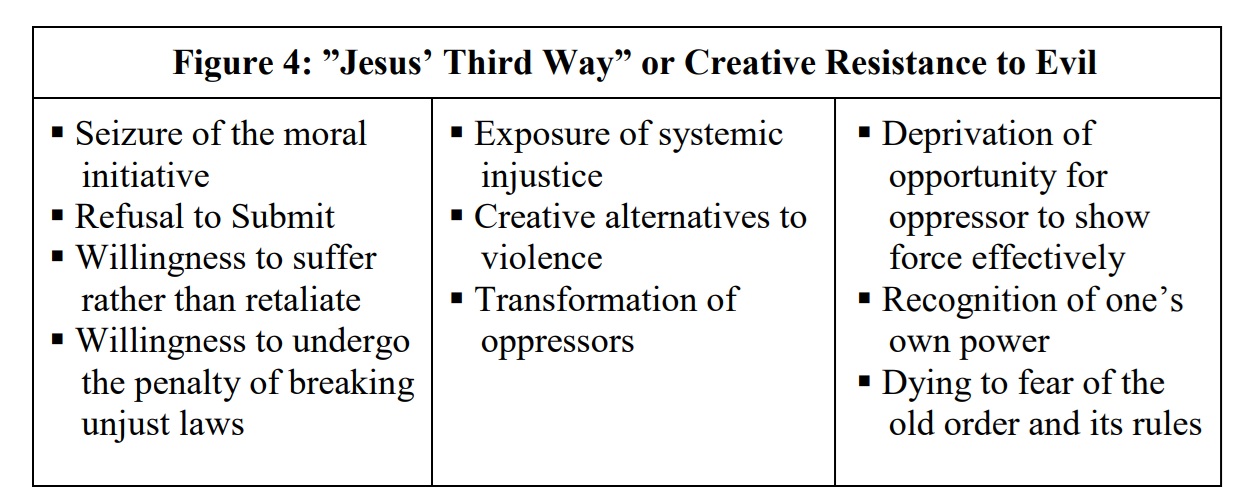
The actions suggested by Jesus in the passages following this admonition against resisting evildoers—to turn the other cheek, give away one’s cloak, walk a second mile, and give to those who borrow (Matthew 5: 39b-41)—are “not rules to be followed legalistically, but examples to spark an infinite variety of creative response in new and changed circumstances.” (Wink, 185) Inspired by these examples, Wink suggests creative alternatives for the Christian choosing to follow Jesus’ third way of resisting evil (see Figure 4). (Wink, 186-187)
In choosing creative resistance, followers of Jesus seek to deny, defuse, and defeat the dehumanizing tactics of oppressors.
Christian resistance to evil has always been played out within a social context, as Christians have navigated relationships with the state, society, and economy in light of the Gospel and the reality of evil. “Resistance is the process of drawing attention to evil and injustice while pressuring the powers that be to pursue positive social change.” (DeYoung, 16)
From its very beginnings as a “tiny, fragile organization,” the Christian Church faced state sponsored discrimination. Søren Dosenrode observes that, from this minority position, “Christians rendered passive resistance to the state as no other real alternative remained.” Martyrdom was often the result of such resistance. (Dosenrode, 11-12) In their daily lives, early Christians resisted poverty and economic oppression by “creating a countercultural community that practiced its own economy of grace,” such as that depicted in Acts 4: 32-37. (Long, xxi-iii) It was not until the legalization of Christianity in 313, and the evolving close relationship between church and state when Christianity became the official religion of the Roman Empire, that resistance became a serious question for Christians. (Donsenrode, 11-12)
One early model for Christian resistance is St. Maximus the Confessor (580-662 CE). His Four Centuries on Love is cited by Charles C. McCarthy as containing the core of his teaching on resistance, centered on the example of Jesus and the primacy of love. (McCarthy, 77) “The one who loves Christ thoroughly imitates him as much as he can.” (Maximus, 81) Maximus taught that in the struggle against evil, the “microcosmic deed of love is all that humanity has to work with,” and indeed, all it needs. (McCarthy, 82)
Maximus lived out this teaching on resistance in his own life. He stood fast against monothelitism, the “theology that Christ was not as the Council of Chalcedon had stated, ‘true God and true man,’ but, in fact, had one will (divine), not a human will and a divine will.” 1 (McCarthy, 84). His belief in the doctrine that Christ had two wills led him to resist both civil and ecclesial authorities who supported monothelitism; he “suffered imprisonment and torture for this stand.” (McCarthy, 78) Maximus was later exiled to Lazica where he died in 662 CE. (McCarthy, 65)
For Thomas Merton, a Trappist monk who contemplated the spirituality of resistance, Maximus is a model of what is possible for human persons facing evil. Maximus “portrays nonviolent resistance under suffering and persecution as the normal way of the Christian.” Countering those who dismiss resistance as impractical or impossible, Merton holds up Maximus as one who believed that Jesus “does not command the impossible, but clearly what is possible.” Furthermore, for Maximus, Gospel resistance, modeled on the way Jesus actually resisted evil, should be “aimed not at the evildoer but at evil as its source.” 2 (Merton, 176)
Notwithstanding early models of Christian nonviolent resistance such as Maximus, in practice the ongoing marriage between church and state led to a mixed assessment of resistance. Dosenrode observes that in the Middle Ages, certain forms of passive resistance were “known and accepted as common law,” such as refusing to pay taxes, provided they were proportional. More active forms of resistance were also carefully assessed by theologians and Church authorities. For example, tyrannicide was accepted as a last resort by Thomas Aquinas, “provided that it was rooted in a higher power than an individual’s idea.” At the Council of Constance (1414-1418), however, the Catholic Church condemned tyrannicide outright as contrary to the moral life. Protestant and Reformed churches “became more open to resistance to defend the true faith” during the Reformation, while the Catholic Church held close to its condemnation. By the twentieth century, the doctrine of resistance in the Catholic, Reformed, and Protestant churches was one of “restraint in the use of power” and support of the state and status quo. (Dosenrode, 13-14, 17) The experience of the Nazi holocaust called this stance into question.
1 The Third Council of Constantople declared monothelitism as a heresy in 681 CE.
2 Emphasis in the original text.
Sources:
Curtiss Paul DeYoung, “From Resistance to Reconciliation: The Means and Goal of Christian Resistance,” in Resist! Christian Dissent for the 21st Century, ed. Michael. G. Long (Maryknoll, NY: Orbis Books, 2008)
Søren Dosnerode, ed., Christianity and Resistance in the 20th Century: From Kaj Munk to Dietrich Bonhoeffer to Desmond Tutu (Boston: Brill, 2009)
Michael G. Long, ed, Resist! Christian Dissent for the 21st Century (Maryknoll, NY: Orbis Books, 2008)
Maximus the Confessor, Maximus the Confessor: Selected Writings, trans. George C. Berthold (New York: Paulist Press, 1985),
Charles C. McCarthy, “Maximus the Confessor (580-662),” in Non-Violence—Central to Christian Spirituality: Perspectives from Scripture to the Present, ed. Joseph T. Culliton (New York: The Edwin Mellen Press, 1982),
Johannes Nissen, “Between Conformity and Nonconformity: The Issue of Non-Violent Resistance in Early Christianity and its Relevance Today,” in Christianity and Resistance in the 20th Century: From Kaj Munk and Dietrich Bonhoeffer to Desmond Tutu, ed. Søren Dosenrode (Boston: Brill, 2009)
Margaret Collins Weitz, “Resistance: A Matter of Conscience,” in Resisters, Rescuers, and Refugees: Historical and Ethical Issues, ed. John J. Michalczyk (Kansas City: Sheed & Ward, 1997)
Walter Wink, Engaging the Powers: Discernment and Resistance in a World of Domination (Minneapolis: Fortress Press, 1992)
Excerpt from: “Human Trafficking as Social Sin: An Ethic of Resistance,” by Susan Rose Francois, CSJP. Submitted to the Faculty of The Catholic Theological Union at Chicago in partial fulfillment of the requirement for the degree of Masters of Arts in Theology, March 2015.
I have been pondering what, if anything, to share regarding my post election thoughts. It hasn’t quite been a week, but I have been reading the national temperature and preparing for this result for a while now. So here goes…
First, before you ask, I have already discerned that this time around, I will not be reviving my daily practice of posting a prayer for President Trump.
Why?
For one thing, the platform itself has changed from Twitter to X, resulting in a significant change in ownership, philosophy, and audience. Somehow (the grace of God?), for the most part, I avoided being trolled or harassed last time. I suspect that may not be true this time around, and dealing with that possibility is not where I wish to place my energy.
This does not mean I stop praying. I pray for our elected leaders each and every day, and the 47th President and his administration will certainly be included in my daily prayers. As will the most vulnerable people and ecosystems who will be impacted by policy changes he proposes.
I have been posting short videos that share some simple messages about God’s love, goodness, the beauty of God’s creation, human dignity, the call to be still and grounded…
These are simple yet profound truths that seem to be lost or drowned out in the noise of the globalization of indifference and toxic nature of our (un)civil discourse that makes fertile ground for misinformation and the sowing of fear, hate and division. These posts seem to be finding an audience, if modest in size. More importantly, I believe this type of messaging is urgently needed in our public space. Let me explain.
When I was in graduate theological studies, my research focused on resistance to social sin. One of my key findings had to do with identity and moral choice.
Political psychologist Kristen Renwick Monroe analyzed first hand accounts of ordinary Germans during the Nazi regime and found that how they saw themselves directly impacted how they responded. I believe there are lessons to be learned for our present moment.
Those who supported the regime saw themselves as victims. They were willing to act preemptively against the other out of a desire for self-preservation.
Bystanders saw themselves as helpless, just one person alone against the Nazis. What could they do?
Rescuers saw themselves as connected with everyone and able to effect change. Notably, Monroe also discovered that they were the only group who “had integrated the value of human life into their worldview.”
She concludes that “identity constrains choice” across all three groups. In other words, one’s identity—in relation to self, other, world, and agency—radically influences one’s ethical response and actions. Monroe believes that her findings suggest that identity constitutes “the force that moves us beyond generalized feelings of sympathy, sorrow, or even outrage to a sense of moral imperative.”
So, in addition to getting ready to be a strong, vocal, and persistent advocate for the common good, human rights, peace, and the integrity of creation in the face of likely policy, legislative, and economic changes over the next four years, I also want to do my part to help (re)form our collective sense of identity and expand our menu of moral choice.
I see myself as connected to everyone. My worldview, informed and inspired by my parents and their/my Catholic faith, calls me to see human life and dignity and the goodness of all of God’s creation as central to my worldview and demanding of my action. My religious community strengthens and expands this understanding through our common life, prayer, mission, and charism.
I feel a deep sense of call to use my gifts, talents, and influence to spread that message in the belief that it will make a difference. Also, I am hoping it will help me stay grounded during the next four years.
Last night, I saw White Rose The Musical, a new off-Broadway production. I was intrigued to see how this story of resistance to the Nazi regime by ordinary Germans would be portrayed on stage, in particular in musical form. I enjoyed the production. Most critically, it expressed the importance of doing something in the face of evil, holding fast to what matters, and staying with the questions in messy times. Overall it was hopeful, something we need these days in the face of rising fascism and threats to democracy.
One reason I travelled across the Hudson last night to see the musical was this … My research topic for my MA Ethics thesis at Catholic Theological Union was the ethics of resistance. The students of the White Rose Society were one of the case studies I explored.
During WWII, a group of college students came together in Munich to resist what they knew in their core to be wrong, using the written word to encourage resistance to the Nazi regime among ordinary Germans by speaking plainly about the evil being perpetrated in their name. In six strongly worded leaflets, they sought to raise consciousness and conscience.
“Why do the German people behave so apathetically in the face of all these abominable crimes, crimes so unworthy of the human race? … For through his apathetic behavior he gives these evil men the opportunity to act as they do; he tolerates this ‘government’ which has taken upon itself such an infinitely great burden of guilt; indeed, he himself is to blame for the fact that it came about at all! Each man wants to be exonerated of a guilt of this kind, each one continues on his way with the most placid, the calmest conscience. But he cannot be exonerated; he is guilty, guilty, guilty!”
This second leaflet was written and distributed in 1942, shortly after the Wansee Conference and implementation of the “final solution.” The first four flyers were produced in the summer of 1942. The students suspended leafleting in late 1942, when three members, all medical students—Hans Scholl, Alexander Schmorell, and Willi Graf—were drafted to medical service on the Russian front. The students wrote the final two leaflets upon their return in early 1943.
The leaflets were distributed throughout Germany by post, apparently inspired by a mimeographed sermon by Catholic Bishop Clement von Galen, condemning the Nazi euthanasia of disabled persons, which was widely distributed in this fashion. Upon receiving a copy of the sermon in the mail, Hans Scholl is reported to have said: “Finally someone has the courage to speak, and all you need is a duplication machine.”
It was the choice of Hans Scholl and his sister Sophie Scholl to distribute copies of the sixth leaflet in person at the University of Munich that led to their arrest on February 18, 1943. While students and faculty were in class, the siblings placed copies on steps, windowsills, and ledges, throwing the last leaflets over a balcony. They were arrested. Four days later the two siblings and another student, Christopher Probst, were sentenced with high treason and executed. Other White Rose members were executed in later months. Due to their arrest and execution, the students were unable to keep an appointment they had scheduled for February 25th—with Dietrich Bonhoeffer—to discuss plans for a network of student resistance groups.
Inge Scholl, sister of Hans and Sophie, later observed: “They stood up for a simple matter, an elementary principle: the right of the individual to choose his manner of life and to live in freedom.” As a group, their motivations were of course varied. Some, such as Willi Graf, were deeply motivated by the central Christian theme of love of neighbor. Graf and the other two students sent to the Russian front were certainly motivated by personally witnessing horrific violence and dehumanization of the Jewish people in concentration camps.
Sophie and Hans Scholl were influenced by their devout Lutheran upbringing in a home where Scripture was central and current issues of justice and pacifism were engaged at the kitchen table. Sophie’s own diary indicates she was motivated by her faith: “My God … Oh, how far from you I am, and the best thing about me is the pain I feel on that account. But I’m often so torpid and apathetic. Help me to be singlehearted and remain with me.”
Guided by individual motivations, the White Rose Society creatively and collectively responded both to evil and bystanders. They exposed the injustice of the system. They found a creative alternative to violence. Finally, they sought the transformation of an oppressive regime and the German people, whose apathy gave the Nazi regime power and opportunity.
Sources:
Kidder, Annemarie S. Ultimate Price: Testimonies of Christians Who Resisted the Third Reich. Maryknoll, NY: Orbis Books, 2012.
Michalczyk, John J. and Franz J. Müller. “The White Rose Student Movement in Germany: It’s History and Relevance Today.” In Resisters, Rescuers, and Refugees: Historical and Ethical Issues, ed. John J. Michalczyk, 49-57. Kansas City: Sheed & Ward, 1997.






 At the Corner of Susan and St. Joseph