I spent yesterday morning with other volunteers at Delaney Hall providing hospitality and solidarity to families visiting loved ones.
I have been recovering from Covid so hadn’t been in a while. As always I found myself inspired by the courage of the families waiting to visit loved ones and the open hearts and dedication of the volunteers. I was also heartbroken. This time it was the children who have to face this cruelty, some born while their fathers have been detained. Others just trying to be a kid in very difficult circumstances. I couldn’t help but think of the words of Jesus in Matthew’s Gospel: “Let the little children come to me, and do not hinder them, for the kingdom of heaven belongs to such as these.”
Last night as I went to bed, I realized that not only was my heart broken 💔, I had over estimated my post covid energy level. While I had planned to attend the prayer service this morning outside Delaney Hall, instead I prayed at home with the Scriptures for todays liturgy, where I found strength for the journey.
The Prophet Habakkuk was reading the signs of injustice in his own time and calling on the people to hold fast in faith. It is one of my all time favorite passages.
“How long, O Lord? I cry for help / but you do not listen! / I cry out to you, “Violence!” / but you do not intervene. / Why do you let me see ruin; / why must I look at misery? / Destruction and violence are before me; / there is strife, and clamorous discord. / Then the Lord answered me and said: / Write down the vision clearly upon the tablets, / so that one can read it readily. / For the vision still has its time, / presses on to fulfillment, and will not disappoint; / if it delays, wait for it, / it will surely come, it will not be late. / The rash one has no integrity; / but the just one, because of his faith, shall live.”
In his letter to Timothy St. Paul tells his community (and us):
“Beloved: I remind you to stir into flame the gift of God that you have through the imposition of my hands. For God did not give us a spirit of cowardice but rather of power and love and self-control. So do not be ashamed of your testimony to our Lord, nor of me, a prisoner for his sake; but bear your share of hardship for the gospel with the strength that comes from God.”
The Gospel from Luke is a call from Jesus to risk the bigness of smallness.
“The apostles said to the Lord, “Increase our faith.” The Lord replied, “If you have faith the size of a mustard seed, you would say to this mulberry tree, ‘Be uprooted and planted in the sea,’ and it would obey you.”
As Pope Leo XIV said when he first stepped out on the balcony at St Peter’s Basilica: “God loves us, God loves you all, and evil will not prevail. “
God of justice, love, and mercy, help us to remember and always to be animated by your love. Give us courage to act in the face of oppression and violations of human dignity. Help us to participate in your creating power of love in ways big and small. Most of all, increase our faith that we may truly believe in You who are bigger than it all. Amen
I am feeling the call to write more during this time in history. Starting today I am going to be sharing excerpts from my Master Thesis for my Moral Theology degree (from Catholic Theological Union), in which I developed an ethic of resistance. I will publish this as a series. My original application was to the social sin of human trafficking, but you will see as this series moves forward that I looked at other examples and responses by ordinary Christians to extreme social sin, such as the death-dealing reality of the Nazi Holocaust. The identity and worldview of these resisters led them to counter dehumanization through acts of resistance, often at great personal cost. Their witness offers ordinary persons seeking to resist social sin today a model and path to follow in our times. Who knew that just one decade later I would be mining my own research for practical applications in our country?
First, a few introductory words about how I understand resistance as an ethical framework.
Resistance can be understood as “standing fast to a position or principle.” Margaret Collins Weitz derives this understanding from the Latin roots of the word for resistance, resistere. The prefix re intensifies the stronger form of the verb stare, to stand. In this light, resistance involves an “inner certainty … allied with a strong sense of conscience and belief in human dignity.” (Weitz, 33-34)
So as we navigate these days, let us hold fast to that which we know to be true: we are good. God is good. And our job is to promote good for others and, indeed, all of God’s creation. It’s that simple. We have to keep it simple so as to stay the course in the face of misinformation, deception, disconnection, globalized indifference, and the normalization of extreme social sin. And with that, episode one.
Episode 1: Resistance in the Christian Tradition
The Christian tradition of resistance of course begins with the person of Jesus. “The practice of resistance in the life of Jesus is where Christians must begin for understanding how to resist evil.” (DeYoung, 6) Curtiss Paul DeYoung identifies three key modes of resistance practiced by Jesus in the Gospels. First, Jesus “resisted the popular notion of who was ‘worthy’ of relationship by developing friendships with persons at the margins of society in his day—women, tax collectors, Samaritans, militant activists, people with disabilities, poor people, and working people.” (DeYoung, 6) In other words, Jesus resisted social norms of exclusion in his own personal sphere by “creating a wide web of relationships” around himself. (DeYoung, 6-7) Second, Jesus “resisted stereotypes and transformed cultural images in his day by injecting into popular culture positive descriptions of Samaritans and women.” (DeYoung, 11) Third, Jesus resisted through public protest, such as the incident against the money changers in the temple. “This demand for equal access to the central institution of religion and community governance was so significant and memorable that it is included by all of the Gospel writers.” (DeYoung, 12)
Another Gospel passage directly related to resistance is the Sermon on the Mount, in particular Matthew 5:39a: “ But I say to you, offer no resistance to one who is evil” (NAB). Johannes Nissen notes that this passage is traditionally understood as advocating “non-resistance to evil.” (Nissen, 184). It is potentially problematic because, as Walter Wink observes, “if Jesus commands us not to resist, then the only other choice would appear to be passivity, complicity in our own oppression, surrender.” (Wink, 184)
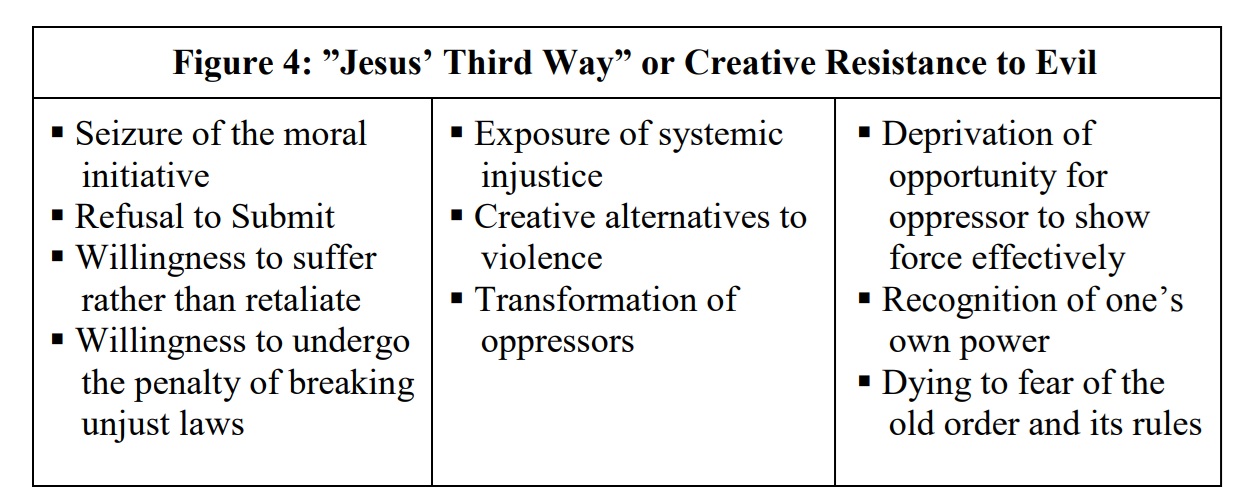
However, Wink asserts that the Greek word used in Matthew, antisēnai, does not merely mean “resist” or “stand against,” but rather to “resist violently, to revolt or rebel, to engage in an insurrection.” In other words, the message of Jesus to his followers is not to “mirror evil” with evil. Wink concludes that the “logic of the text” points neither to passivity nor violent resistance, but instead to finding “a third way, a way that is neither submission nor assault, neither fight nor flight, a way that can secure your human dignity and begin to change the power equation.” (Wink, 184-185)
The actions suggested by Jesus in the passages following this admonition against resisting evildoers—to turn the other cheek, give away one’s cloak, walk a second mile, and give to those who borrow (Matthew 5: 39b-41)—are “not rules to be followed legalistically, but examples to spark an infinite variety of creative response in new and changed circumstances.” (Wink, 185) Inspired by these examples, Wink suggests creative alternatives for the Christian choosing to follow Jesus’ third way of resisting evil (see Figure 4). (Wink, 186-187)
In choosing creative resistance, followers of Jesus seek to deny, defuse, and defeat the dehumanizing tactics of oppressors.
Christian resistance to evil has always been played out within a social context, as Christians have navigated relationships with the state, society, and economy in light of the Gospel and the reality of evil. “Resistance is the process of drawing attention to evil and injustice while pressuring the powers that be to pursue positive social change.” (DeYoung, 16)
From its very beginnings as a “tiny, fragile organization,” the Christian Church faced state sponsored discrimination. Søren Dosenrode observes that, from this minority position, “Christians rendered passive resistance to the state as no other real alternative remained.” Martyrdom was often the result of such resistance. (Dosenrode, 11-12) In their daily lives, early Christians resisted poverty and economic oppression by “creating a countercultural community that practiced its own economy of grace,” such as that depicted in Acts 4: 32-37. (Long, xxi-iii) It was not until the legalization of Christianity in 313, and the evolving close relationship between church and state when Christianity became the official religion of the Roman Empire, that resistance became a serious question for Christians. (Donsenrode, 11-12)
One early model for Christian resistance is St. Maximus the Confessor (580-662 CE). His Four Centuries on Love is cited by Charles C. McCarthy as containing the core of his teaching on resistance, centered on the example of Jesus and the primacy of love. (McCarthy, 77) “The one who loves Christ thoroughly imitates him as much as he can.” (Maximus, 81) Maximus taught that in the struggle against evil, the “microcosmic deed of love is all that humanity has to work with,” and indeed, all it needs. (McCarthy, 82)
Maximus lived out this teaching on resistance in his own life. He stood fast against monothelitism, the “theology that Christ was not as the Council of Chalcedon had stated, ‘true God and true man,’ but, in fact, had one will (divine), not a human will and a divine will.” 1 (McCarthy, 84). His belief in the doctrine that Christ had two wills led him to resist both civil and ecclesial authorities who supported monothelitism; he “suffered imprisonment and torture for this stand.” (McCarthy, 78) Maximus was later exiled to Lazica where he died in 662 CE. (McCarthy, 65)
For Thomas Merton, a Trappist monk who contemplated the spirituality of resistance, Maximus is a model of what is possible for human persons facing evil. Maximus “portrays nonviolent resistance under suffering and persecution as the normal way of the Christian.” Countering those who dismiss resistance as impractical or impossible, Merton holds up Maximus as one who believed that Jesus “does not command the impossible, but clearly what is possible.” Furthermore, for Maximus, Gospel resistance, modeled on the way Jesus actually resisted evil, should be “aimed not at the evildoer but at evil as its source.” 2 (Merton, 176)
Notwithstanding early models of Christian nonviolent resistance such as Maximus, in practice the ongoing marriage between church and state led to a mixed assessment of resistance. Dosenrode observes that in the Middle Ages, certain forms of passive resistance were “known and accepted as common law,” such as refusing to pay taxes, provided they were proportional. More active forms of resistance were also carefully assessed by theologians and Church authorities. For example, tyrannicide was accepted as a last resort by Thomas Aquinas, “provided that it was rooted in a higher power than an individual’s idea.” At the Council of Constance (1414-1418), however, the Catholic Church condemned tyrannicide outright as contrary to the moral life. Protestant and Reformed churches “became more open to resistance to defend the true faith” during the Reformation, while the Catholic Church held close to its condemnation. By the twentieth century, the doctrine of resistance in the Catholic, Reformed, and Protestant churches was one of “restraint in the use of power” and support of the state and status quo. (Dosenrode, 13-14, 17) The experience of the Nazi holocaust called this stance into question.
1 The Third Council of Constantople declared monothelitism as a heresy in 681 CE.
2 Emphasis in the original text.
Sources:
Curtiss Paul DeYoung, “From Resistance to Reconciliation: The Means and Goal of Christian Resistance,” in Resist! Christian Dissent for the 21st Century, ed. Michael. G. Long (Maryknoll, NY: Orbis Books, 2008)
Søren Dosnerode, ed., Christianity and Resistance in the 20th Century: From Kaj Munk to Dietrich Bonhoeffer to Desmond Tutu (Boston: Brill, 2009)
Michael G. Long, ed, Resist! Christian Dissent for the 21st Century (Maryknoll, NY: Orbis Books, 2008)
Maximus the Confessor, Maximus the Confessor: Selected Writings, trans. George C. Berthold (New York: Paulist Press, 1985),
Charles C. McCarthy, “Maximus the Confessor (580-662),” in Non-Violence—Central to Christian Spirituality: Perspectives from Scripture to the Present, ed. Joseph T. Culliton (New York: The Edwin Mellen Press, 1982),
Johannes Nissen, “Between Conformity and Nonconformity: The Issue of Non-Violent Resistance in Early Christianity and its Relevance Today,” in Christianity and Resistance in the 20th Century: From Kaj Munk and Dietrich Bonhoeffer to Desmond Tutu, ed. Søren Dosenrode (Boston: Brill, 2009)
Margaret Collins Weitz, “Resistance: A Matter of Conscience,” in Resisters, Rescuers, and Refugees: Historical and Ethical Issues, ed. John J. Michalczyk (Kansas City: Sheed & Ward, 1997)
Walter Wink, Engaging the Powers: Discernment and Resistance in a World of Domination (Minneapolis: Fortress Press, 1992)
Excerpt from: “Human Trafficking as Social Sin: An Ethic of Resistance,” by Susan Rose Francois, CSJP. Submitted to the Faculty of The Catholic Theological Union at Chicago in partial fulfillment of the requirement for the degree of Masters of Arts in Theology, March 2015.




 At the Corner of Susan and St. Joseph