“In the absence of holiness, You are still God. You are steadfast.”
This morning, I prayed with these words from the song Steadfast by singer songwriter Leslie Jordan. A good reminder with everything going on in our world and even in my own head and heart. Because, you see, we are human. We get hooked, we get annoyed, we can hook and annoy other people. Then there is the state of the world and the harm done to real families and earth, our common home, by selfish and misguided individual and collective human action. Yet God is still God. God is steadfast. Always.
God is still God and God is always on the lookout for us, steadfast and in love with these imperfect souls created in the image and likeness of God. God is love, and so this means we are a reflection of this love, created in and for love, and even when we stray from that path, God is there already in love with us, loving us into our fullest being.
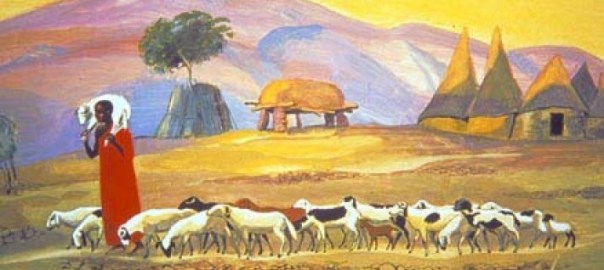
In today’s Gospel reading (Luke 15: 1-10), Jesus tells two stories to a group of folks who are complaining about the sinfulness of another group of folks (when they no doubt had their own flaws to contend with). In the first, the story is of a shepherd who leaves 99 sheep alone in the desert to search out for the one who is lost.
And when he does find it, he sets it on his shoulders with great joy and, upon his arrival home, he calls together his friends and neighbors and says to them, ‘Rejoice with me because I have found my lost sheep.’
The second story is of the woman who searches high and low in her house for her lost coin, her treasure. She too rejoices when her seeking ends in the discovery of that which was lost. Jesus tells those gathered around him–and us–“In just the same way, I tell you, there will be rejoicing among the angels of God over one sinner who repents.”
God is love, and God’s love is bigger than our brokenness. In the absence of holiness–in ourselves, in others, in society–God is still God and God’s love is abundant and never ending. God does not give up on us!
I was struck by these words at the end of a reflection on this reading, by Nick Wagner in the book I use for my morning prayer, Give Us this Day:
“These are stories about a God who loves us with wild extravagance. The Divine Seeker refuses to calculate odds or cut losses. God’s love persists beyond reason and celebrates beyond proportion. Jesus invites us to participate in God’s excessive seeking–not because it makes sense, but because the joy of finding transcends all calculation.”
May we who are made in the image and likeness of God, imperfect as we are, strive to mirror God’s excessive seeking for goodness, light, love, and peace. May we never give up on ourselves or one another. May we be steadfast like God is steadfast. Amen.
This morning during my contemplative prayer time, these words came to me over and over: “YOU are God.”
God is love. God is the source of everything that is good. God is God, and we are not … hence all the humanness of our shared reality.
God is.
As the saying goes in the Black church: “God is good all the time. All the time, God is good.”
YOU are God. These words grounded my heart during my silent prayer this morning, as my mind wandered to the many troubles plaguing our human and earth community. God is God. Those humans in power and those abusing power are not God.
Later, I found myself reflecting on the character Groot in the Marvel Guardians of the Galaxy movies. Just as the one phrase, “YOU are God,” repeated over and over again in my heart during my meditation this morning, Groot has just one phrase: “I am Groot.”
Yet this phrase has a surplus of meaning. In the Marvel universe, Groot is a a member of the Flora Colossi, a race of treelike alien beings from Planet X. Highly intelligent creatures, Flora Colossi have a stiff larynx that is only capable of making a sequence of sounds that we hear as “I am Groot.” His friend Rocket apparently understands Groot’s language, and helpfully offers his interpretation skills for the benefit of all. What sounds to us like three simple words can carry a variety of meanings, depending on the context and delivery. Without giving away any serious spoilers, at one point Groot’s sequence of sounds meaningfully shifts to “We are Groot” after a moment of self-sacrificing love for his friends.
Now, WE are not God. Yet we are made in the image and likeness of God. We are made to love. We are made to be and do good. We are made to care for creation and one another. We are not good all the time, but all the time we are called back to love and goodness through the mercy of God. And for that, I am very grateful.
Today, this brown eyed Susan turns another year older. Three years into my fifth decade and I continue to be astounded.
Astounded by the love of God who created all things even you and me and everyone and everything in between, for all eternity … created out of and for love.
Astounded by the beauty of creation. No words necessary.
Astounded by the gift of life and the invitation to share my gifts (and even vulnerablities) for the good of the whole, to be present to the beauty and the pain, to witness to God’s love even amidst suffering, and to remember and re-member in service of God’s dreams for us.
Astounded by the witness, love and challenge of family, friends, community, colleagues, strangers, bunny rabbits and birds and dragonflies. You name it.
In today’s first reading from Deuteronomy (30) we hear:
“Choose life, then, that you and your descendants may live, by loving the Lord, your God, heeding his voice, and holding fast to him. For that will mean life for you, a long life for you to live on the land that the Lord swore he would give to your fathers Abraham, Isaac and Jacob.”
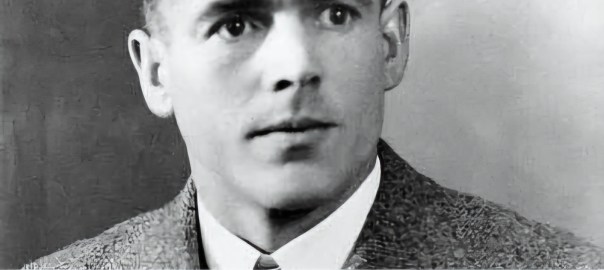
I had started my morning prayer time reflecting on another reading, this one from Blessed Franz Jägerstätter, who I have chosen (or has chosen me) as my spiritual companion this Lent.
“When something difficult comes about, whoever remains in love will receive everything for the best.”
It seems to me that these two readings are linked. God is good all the time, yet we humans make life messy and sometimes difficult for ourselves and others with our choices.
It is good to remember, to quote a well-worn phrase from fictional character Anne with an e of Lucy M. Montgomery’s Green Gables, “Tomorrow is a new day with no mistakes in it.”
We can never undo what is done, but we can face today and the days ahead by holding fast to the truth of God’s love.
Holding fast … interestingly that phrase has come to mean more to me these days, as it is a definition of resistance.
I commit in these challenging times to hold fast to goodness, love, justice, human dignity, compassion, and mercy as I follow the God of Peace. I choose life. I choose to love always, fiercely, inclusively.
Franz Jägerstätter faced hard choices in a time of extreme social sin as he refused to fight for the Nazi regime. He held fast to his love for God, his family, and the people of God at great cost. In the end he was murdered by the Nazi government. In the end following the path to love did not lead to a long life for him on earth. His memory, indeed his very name, is blessed and his witness of a life of love lives on to inspire us today.
Pray for us Blessed Franz Jägerstätter, that we may hold fast to God’s love, that we may act in love and for love and with love. Always. Amen.
I am feeling the call to write more during this time in history. Starting today I am going to be sharing excerpts from my Master Thesis for my Moral Theology degree (from Catholic Theological Union), in which I developed an ethic of resistance. I will publish this as a series. My original application was to the social sin of human trafficking, but you will see as this series moves forward that I looked at other examples and responses by ordinary Christians to extreme social sin, such as the death-dealing reality of the Nazi Holocaust. The identity and worldview of these resisters led them to counter dehumanization through acts of resistance, often at great personal cost. Their witness offers ordinary persons seeking to resist social sin today a model and path to follow in our times. Who knew that just one decade later I would be mining my own research for practical applications in our country?
First, a few introductory words about how I understand resistance as an ethical framework.
Resistance can be understood as “standing fast to a position or principle.” Margaret Collins Weitz derives this understanding from the Latin roots of the word for resistance, resistere. The prefix re intensifies the stronger form of the verb stare, to stand. In this light, resistance involves an “inner certainty … allied with a strong sense of conscience and belief in human dignity.” (Weitz, 33-34)
So as we navigate these days, let us hold fast to that which we know to be true: we are good. God is good. And our job is to promote good for others and, indeed, all of God’s creation. It’s that simple. We have to keep it simple so as to stay the course in the face of misinformation, deception, disconnection, globalized indifference, and the normalization of extreme social sin. And with that, episode one.
Episode 1: Resistance in the Christian Tradition
The Christian tradition of resistance of course begins with the person of Jesus. “The practice of resistance in the life of Jesus is where Christians must begin for understanding how to resist evil.” (DeYoung, 6) Curtiss Paul DeYoung identifies three key modes of resistance practiced by Jesus in the Gospels. First, Jesus “resisted the popular notion of who was ‘worthy’ of relationship by developing friendships with persons at the margins of society in his day—women, tax collectors, Samaritans, militant activists, people with disabilities, poor people, and working people.” (DeYoung, 6) In other words, Jesus resisted social norms of exclusion in his own personal sphere by “creating a wide web of relationships” around himself. (DeYoung, 6-7) Second, Jesus “resisted stereotypes and transformed cultural images in his day by injecting into popular culture positive descriptions of Samaritans and women.” (DeYoung, 11) Third, Jesus resisted through public protest, such as the incident against the money changers in the temple. “This demand for equal access to the central institution of religion and community governance was so significant and memorable that it is included by all of the Gospel writers.” (DeYoung, 12)
Another Gospel passage directly related to resistance is the Sermon on the Mount, in particular Matthew 5:39a: “ But I say to you, offer no resistance to one who is evil” (NAB). Johannes Nissen notes that this passage is traditionally understood as advocating “non-resistance to evil.” (Nissen, 184). It is potentially problematic because, as Walter Wink observes, “if Jesus commands us not to resist, then the only other choice would appear to be passivity, complicity in our own oppression, surrender.” (Wink, 184)
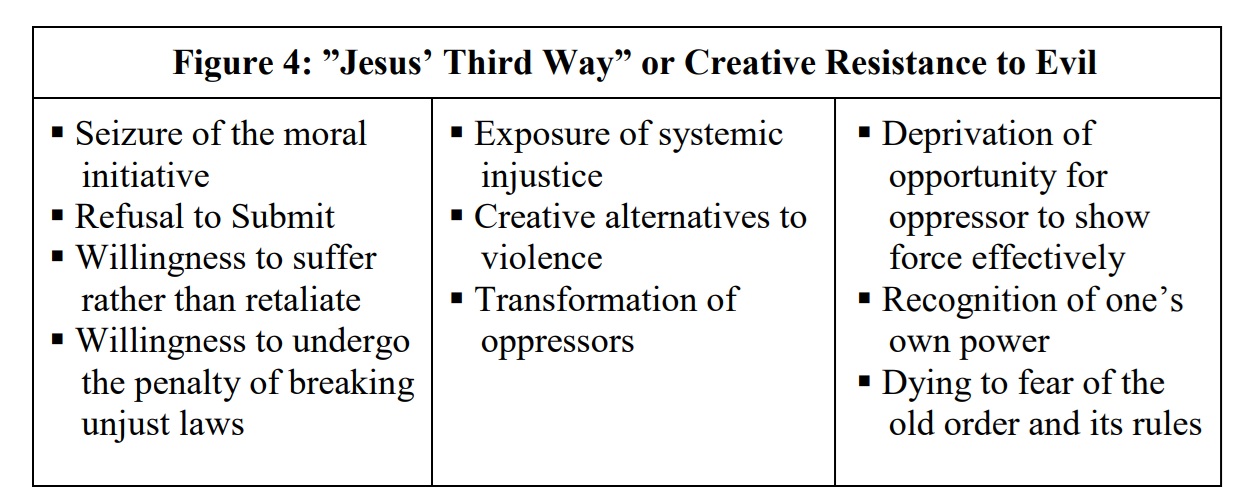
However, Wink asserts that the Greek word used in Matthew, antisēnai, does not merely mean “resist” or “stand against,” but rather to “resist violently, to revolt or rebel, to engage in an insurrection.” In other words, the message of Jesus to his followers is not to “mirror evil” with evil. Wink concludes that the “logic of the text” points neither to passivity nor violent resistance, but instead to finding “a third way, a way that is neither submission nor assault, neither fight nor flight, a way that can secure your human dignity and begin to change the power equation.” (Wink, 184-185)
The actions suggested by Jesus in the passages following this admonition against resisting evildoers—to turn the other cheek, give away one’s cloak, walk a second mile, and give to those who borrow (Matthew 5: 39b-41)—are “not rules to be followed legalistically, but examples to spark an infinite variety of creative response in new and changed circumstances.” (Wink, 185) Inspired by these examples, Wink suggests creative alternatives for the Christian choosing to follow Jesus’ third way of resisting evil (see Figure 4). (Wink, 186-187)
In choosing creative resistance, followers of Jesus seek to deny, defuse, and defeat the dehumanizing tactics of oppressors.
Christian resistance to evil has always been played out within a social context, as Christians have navigated relationships with the state, society, and economy in light of the Gospel and the reality of evil. “Resistance is the process of drawing attention to evil and injustice while pressuring the powers that be to pursue positive social change.” (DeYoung, 16)
From its very beginnings as a “tiny, fragile organization,” the Christian Church faced state sponsored discrimination. Søren Dosenrode observes that, from this minority position, “Christians rendered passive resistance to the state as no other real alternative remained.” Martyrdom was often the result of such resistance. (Dosenrode, 11-12) In their daily lives, early Christians resisted poverty and economic oppression by “creating a countercultural community that practiced its own economy of grace,” such as that depicted in Acts 4: 32-37. (Long, xxi-iii) It was not until the legalization of Christianity in 313, and the evolving close relationship between church and state when Christianity became the official religion of the Roman Empire, that resistance became a serious question for Christians. (Donsenrode, 11-12)
One early model for Christian resistance is St. Maximus the Confessor (580-662 CE). His Four Centuries on Love is cited by Charles C. McCarthy as containing the core of his teaching on resistance, centered on the example of Jesus and the primacy of love. (McCarthy, 77) “The one who loves Christ thoroughly imitates him as much as he can.” (Maximus, 81) Maximus taught that in the struggle against evil, the “microcosmic deed of love is all that humanity has to work with,” and indeed, all it needs. (McCarthy, 82)
Maximus lived out this teaching on resistance in his own life. He stood fast against monothelitism, the “theology that Christ was not as the Council of Chalcedon had stated, ‘true God and true man,’ but, in fact, had one will (divine), not a human will and a divine will.” 1 (McCarthy, 84). His belief in the doctrine that Christ had two wills led him to resist both civil and ecclesial authorities who supported monothelitism; he “suffered imprisonment and torture for this stand.” (McCarthy, 78) Maximus was later exiled to Lazica where he died in 662 CE. (McCarthy, 65)
For Thomas Merton, a Trappist monk who contemplated the spirituality of resistance, Maximus is a model of what is possible for human persons facing evil. Maximus “portrays nonviolent resistance under suffering and persecution as the normal way of the Christian.” Countering those who dismiss resistance as impractical or impossible, Merton holds up Maximus as one who believed that Jesus “does not command the impossible, but clearly what is possible.” Furthermore, for Maximus, Gospel resistance, modeled on the way Jesus actually resisted evil, should be “aimed not at the evildoer but at evil as its source.” 2 (Merton, 176)
Notwithstanding early models of Christian nonviolent resistance such as Maximus, in practice the ongoing marriage between church and state led to a mixed assessment of resistance. Dosenrode observes that in the Middle Ages, certain forms of passive resistance were “known and accepted as common law,” such as refusing to pay taxes, provided they were proportional. More active forms of resistance were also carefully assessed by theologians and Church authorities. For example, tyrannicide was accepted as a last resort by Thomas Aquinas, “provided that it was rooted in a higher power than an individual’s idea.” At the Council of Constance (1414-1418), however, the Catholic Church condemned tyrannicide outright as contrary to the moral life. Protestant and Reformed churches “became more open to resistance to defend the true faith” during the Reformation, while the Catholic Church held close to its condemnation. By the twentieth century, the doctrine of resistance in the Catholic, Reformed, and Protestant churches was one of “restraint in the use of power” and support of the state and status quo. (Dosenrode, 13-14, 17) The experience of the Nazi holocaust called this stance into question.
1 The Third Council of Constantople declared monothelitism as a heresy in 681 CE.
2 Emphasis in the original text.
Sources:
Curtiss Paul DeYoung, “From Resistance to Reconciliation: The Means and Goal of Christian Resistance,” in Resist! Christian Dissent for the 21st Century, ed. Michael. G. Long (Maryknoll, NY: Orbis Books, 2008)
Søren Dosnerode, ed., Christianity and Resistance in the 20th Century: From Kaj Munk to Dietrich Bonhoeffer to Desmond Tutu (Boston: Brill, 2009)
Michael G. Long, ed, Resist! Christian Dissent for the 21st Century (Maryknoll, NY: Orbis Books, 2008)
Maximus the Confessor, Maximus the Confessor: Selected Writings, trans. George C. Berthold (New York: Paulist Press, 1985),
Charles C. McCarthy, “Maximus the Confessor (580-662),” in Non-Violence—Central to Christian Spirituality: Perspectives from Scripture to the Present, ed. Joseph T. Culliton (New York: The Edwin Mellen Press, 1982),
Johannes Nissen, “Between Conformity and Nonconformity: The Issue of Non-Violent Resistance in Early Christianity and its Relevance Today,” in Christianity and Resistance in the 20th Century: From Kaj Munk and Dietrich Bonhoeffer to Desmond Tutu, ed. Søren Dosenrode (Boston: Brill, 2009)
Margaret Collins Weitz, “Resistance: A Matter of Conscience,” in Resisters, Rescuers, and Refugees: Historical and Ethical Issues, ed. John J. Michalczyk (Kansas City: Sheed & Ward, 1997)
Walter Wink, Engaging the Powers: Discernment and Resistance in a World of Domination (Minneapolis: Fortress Press, 1992)
Excerpt from: “Human Trafficking as Social Sin: An Ethic of Resistance,” by Susan Rose Francois, CSJP. Submitted to the Faculty of The Catholic Theological Union at Chicago in partial fulfillment of the requirement for the degree of Masters of Arts in Theology, March 2015.
I have been pondering what, if anything, to share regarding my post election thoughts. It hasn’t quite been a week, but I have been reading the national temperature and preparing for this result for a while now. So here goes…
First, before you ask, I have already discerned that this time around, I will not be reviving my daily practice of posting a prayer for President Trump.
Why?
For one thing, the platform itself has changed from Twitter to X, resulting in a significant change in ownership, philosophy, and audience. Somehow (the grace of God?), for the most part, I avoided being trolled or harassed last time. I suspect that may not be true this time around, and dealing with that possibility is not where I wish to place my energy.
This does not mean I stop praying. I pray for our elected leaders each and every day, and the 47th President and his administration will certainly be included in my daily prayers. As will the most vulnerable people and ecosystems who will be impacted by policy changes he proposes.
I have been posting short videos that share some simple messages about God’s love, goodness, the beauty of God’s creation, human dignity, the call to be still and grounded…
These are simple yet profound truths that seem to be lost or drowned out in the noise of the globalization of indifference and toxic nature of our (un)civil discourse that makes fertile ground for misinformation and the sowing of fear, hate and division. These posts seem to be finding an audience, if modest in size. More importantly, I believe this type of messaging is urgently needed in our public space. Let me explain.
When I was in graduate theological studies, my research focused on resistance to social sin. One of my key findings had to do with identity and moral choice.
Political psychologist Kristen Renwick Monroe analyzed first hand accounts of ordinary Germans during the Nazi regime and found that how they saw themselves directly impacted how they responded. I believe there are lessons to be learned for our present moment.
Those who supported the regime saw themselves as victims. They were willing to act preemptively against the other out of a desire for self-preservation.
Bystanders saw themselves as helpless, just one person alone against the Nazis. What could they do?
Rescuers saw themselves as connected with everyone and able to effect change. Notably, Monroe also discovered that they were the only group who “had integrated the value of human life into their worldview.”
She concludes that “identity constrains choice” across all three groups. In other words, one’s identity—in relation to self, other, world, and agency—radically influences one’s ethical response and actions. Monroe believes that her findings suggest that identity constitutes “the force that moves us beyond generalized feelings of sympathy, sorrow, or even outrage to a sense of moral imperative.”
So, in addition to getting ready to be a strong, vocal, and persistent advocate for the common good, human rights, peace, and the integrity of creation in the face of likely policy, legislative, and economic changes over the next four years, I also want to do my part to help (re)form our collective sense of identity and expand our menu of moral choice.
I see myself as connected to everyone. My worldview, informed and inspired by my parents and their/my Catholic faith, calls me to see human life and dignity and the goodness of all of God’s creation as central to my worldview and demanding of my action. My religious community strengthens and expands this understanding through our common life, prayer, mission, and charism.
I feel a deep sense of call to use my gifts, talents, and influence to spread that message in the belief that it will make a difference. Also, I am hoping it will help me stay grounded during the next four years.
Today’s Feast of the Transfiguration challenges us to remember we, too, are Beloved of God. Moreover, as followers of Jesus we are called to listen to him and act accordingly.
Over a decade ago, I made this prayer video, set to the song Transfiguration by Indie singer songwrote Sufjan Stevens. As I prayed with it this morning, I was caught by his repetition of the phrase “Lost in the cloud…”
Lost in the cloud, a voice. Have no fear! We draw near! Lost in the cloud, a sign. Son of man! Turn your ear. Lost in the cloud, a voice. Lamb of God! We draw near! Lost in the cloud, a sign. Son of man! Son of God!
We can get lost in the cloud. The cloud of indifference. The cloud of division. The cloud of misinformation. The cloud of …. insert that which separates us from God’s love. And yet, we are called to LISTEN to the Beloved. We are called to Be Loved. We are called to Be Love.
As we hear in today’s reading from the second letter of Saint Peter (1:19):
“You will do well to be attentive to it, as to a lamp shining in a dark place, until day dawns and the morning star rises in your hearts.”
Let us remember and transform the clouds of our lives into light and love and goodness, strengthened by the Source of every Good thing.
I finish my few days of retreat today, grateful for the blessing and opportunity of this time of solitude, prayer, and reflection.
In the words of our CSJP Constitutions:
“Recognizing gospel peace as both gift and task, we believe that prayer is fundamental to our life. …
In unity with the church and with all of creation we give praise and thanks to the Giver of all gifts. We open ourselves to the liberating power of God whose Spirit in us leads to peace.
Personal prayer deepens our desire to be united with God in faith, enabling us to see God’s presence and action in our lives and in the world.”
So much had happened since my annual retreat last October, good and bad, challenging and encouraging, and everything in between … in my own life, my life in community, and our wider world. There is so much to pray for and with! It is pure gift to have the ability to take time away in solitude with God’s love and mercy. Such a gift also carries responsibility, which I do not take lightly.
I have held in prayer many these days, those I promised to pray for, those I know, and many I do not. I know too I have been held in prayer. Again, such gift.
I have been so aware of God’s love these days away, love beyond measure. In the words of the song My Belovedby Eliza King (a soundtrack of sorts for this retreat), I have been “leaning on my beloved.”
Graced with time by the ocean, going on long walks and just sitting by the sea, I have been so aware of the gifts of creation given freely by the One who loved us into being, the healing power of Christ who became one of us, and the persistent presence of the Spirit nudging us into wholeness.
God is so good, and so are we. May we remember that in good times as well as the more challenging times. May we be people of peace and reflect God’s love, mercy, and care for all of God’s creation. Amen.




















 At the Corner of Susan and St. Joseph