True confession… Sunday’s Feast in the Catholoc tradition (Solemnity of Our Lord Jesus Christ, King of the Universe) is not my favorite. My relationship with Jesus is more as teacher, brother and friend than ruler. I resist the King and Lord imagery.
And yet when I reflect on this Sunday’s Gospel (Luke 25:35-43) what I experience is not the world’s image of a King. It is the crucifixion. The paradox of the paschal mystery.
Jesus is on the cross, fully human in his suffering, being jeered by the rulers, guards, and onlookers. Yes the inscription on the cross names as a king but that is all. He is not treated as King of the Universe.
So why does the church have us reflect on this passage on this particular feast? What can we learn? We might recognize some of the attitudes of the world to the suffering of our day.
“All these onlookers share a refrain that the text repeats three times: “If you are a king, then save yourself!” (cf. vv. 35, 37, 39). Save yourself! That is how they insult him; they challenge him! It is precisely the opposite of what Jesus is doing: he thinks not of saving himself, but of saving them. Yet those insulting words – “save yourself!” – are contagious; they spread from the leaders to the soldiers and then to the people; the ripple of evil reaches almost everyone there. Think about it: evil is contagious. Like an infectious disease, we catch it immediately. All those people talk about Jesus, but not for a second do they empathize with him. They stand apart and talk.
Such is the lethal infection of indifference. “This has nothing to do with me.” Indifference to Jesus, indifference to the sick, the poor, the destitute of the land.”
Evil and indifference are contagious. But so is goodness. And goodness can come from the most unexpected places.
I think we are meant to reflect on the man on the next cross, often referred to as the good thief. What can we learn from this, one of the last encounters of Jesus? Again, from Pope Francis:
“Yet there is another path: that of goodness. Amid all those onlookers, one person does get involved: the good thief. The others mock the Lord, but he turns to him and calls him by name: “Jesus”. That is all he asks of the Lord. A fine prayer that each of us can recite daily as a path to holiness. “Jesus, remember me!” Many jeer at Jesus, but he confesses his faults to Jesus. Many shout: “Save yourself!”, but he begs: “Jesus, remember me” (v. 42). In this way, a criminal becomes the first saint: he draws near to Jesus for an instant and the Lord keeps him at his side forever. The Gospel speaks of the good thief for our benefit: to invite us to overcome evil by refusing to remain as onlookers. Please, indifference is worse than evildoing.”
Indifference is worse than evildoing.
When he first walked out on the balcony of St. Peter’s, Pope Leo said:
“God loves us, God loves you all, and evil will not prevail!”
Evil will not prevail when we choose the way of Christ, when we resist the globalization of indifference, when we see the suffering Christ in our brother and sister and respond with love.
Let’s end this reflection with what Pope Leo said next that first day of his pontificate:
“All of us are in God’s hands. So, let us move forward, without fear, together, hand in hand with God and with one another other! We are followers of Christ. Christ goes before us. The world needs his light. Humanity needs him as the bridge that can lead us to God and his love. Help us, one and all, to build bridges through dialogue and encounter, joining together as one people, always at peace.”
May we bring the light and love of Christ into our world, through active listening and loving response.
In the first three episodes of this series, I have been publishing research from my 2015 MA theology Thesis on resistance to social sin. Today I am sharing the Layers of Resistance model I developed, with some updated thinking from a recent presentation I gave to a community of Catholic Sisters last autumn.
Drawing from the Church’s understanding of social sin and insights from feminist theology, the model urges us to resist the supposed impossibility of changing the world. We can resist the globalization of indifference by acts of resistance, big or small, that seek to heal distorted relationships. Our individual actions can and will influence our the collective – in fact we can coordinate our individual actions into collective ones. Resistance is not futile. It is the way of love.
Unpacking Social Sin
First of all, before we talk about how to resist social sin , it’s important to have some common understanding of what we mean by social sin in the first place. Social sin is a relative late comer to the field of Catholic moral theology, reflecting a major shift in understanding in later part of the 20th Century. Two major influences were the renewed inter-religious dialogue during and after the Second Vatican Council on questions of racism, poverty, war and peace and Latin American liberation theology.
This category of social sin was picked up by global church in 1971 synod of bishops – Justice in the World. The Synod recognized that we are indissolubly linked and responsible. The Bishops also recognized the inability to overcome social sin by our own strength and the need to forge new paths towards action in the cause of justice in the world. This document was instrumental in my own congregation’s reclaiming of our charism of peace through justice during the renewal period.
Social sin is a broad term that “encompasses the unjust structures, distorted consciousness, and collective actions and inaction that facilitate injustice and dehumanization.” (Heyer, 415) The Church understand social sin to be both personal and collective in its source, which implies that resisting social sin must also be personal and collective. “Every sin is personal under a certain aspect; under another, every sin is social, insofar as and because it also has social consequences.” (Compendium of the Social Doctrine of the Church, 117) It is a both/and reality, and this understanding must frame our response.
In his 1987 social encyclical Sollicitudo Rei Socialis, Pope John Paul II* boldly claimed that “one cannot easily gain a profound understanding of the reality that confronts us unless we give a name to the roots of the evils which afflict us,” that is, structural sin. Over time, these structures of sin “grow stronger, spread, and become the source of other sins, and so influence people’s behavior.” (36)
Three years earlier, in his 1984 apostolic exhortation, Reconciliatio et paenitentia, Pope John Paul IIreflected on the role of the individual in social sin and the relationship to the structural elements. I find this passage especially challenging:
“It is a case of the very personal sins of those who cause and support social evil or who exploit it, of those who are in a position to avoid, eliminate, or at least limit certain social evils but who fail to do so out of laziness, fear, or the conspiracy of silence, through secret complicity or indifference, of those who take refuge in the supposed impossibility of changing the world, and also of those who sidestep the effort and sacrifice required, producing specious reasons of a higher order.”
Pope Francis adds another element to the dynamic of social sin, which I think is critical in the present (mis)information age to understand and engage, namely the Globalization of Indifference which is playing out hourly on our current geopolitical stage.
“In today’s world, the sense of belonging to a single human family is fading, and the dream of working together for justice and peace seems an outdated utopia. What reigns instead is a cool, comfortable and globalized indifference, born of deep disillusionment concealed behind a deceptive illusion: thinking that we are all-powerful, while failing to realize that we are all in the same boat. This illusion, unmindful of the great fraternal values, leads to a sort of cynicism. For that is the temptation we face if we go down the road of disenchantment and disappointment.” (Fratelli Tutti, 30)
So we need to resistthe temptation of taking refuge in the supposed impossibility of changing the world. We need to resist the illusion of isolation, the temptation of cynicsm, and being comfortable with the globalization of indifference. Reading the signs of our current times, lives depend on our ability to resist. How? That’s where I offer the Layers of Resistance Model for your reflection and action.
Layers of Resistance
Social sin is inherently relational – the sum of individual and collective acts. Therefore, our resistance to social sin must also be relational.
Layer 1 – Responsibility and Consciousness
Each of us is born into and lives in a social context. We are enmeshed in unjust structures beyond our control, some of which we derive benefit from, others which might burden us. The first layer of resistance calls us to develop a critical conciousness of our own connections to social sin, and to raise the awareness of others.
In the Latin American theological understanding of social sin, this is called conscientization. In order to accept responsibility for social sin, we must be awake to sin embodied in structures which affront human dignity/creation. Salvadoran theologian Jon Sobrino notes that “[e]vil has its own dynamic and requires concealment and lying.” He observes that “the problem is not ‘seeing,’ but ‘wanting to see.’ If people do not want to see the reality in front of them, there is no solution.” (Sobrino 38, 41)
Layer 2 – Lamentation
Note, THIS IS NOT GUILT. “Guilt,” writes Gregory Baum, “is not a useful theological concept for understanding the situation of the great majority of persons, caught as they are in the inherited structures and in the corresponding legitimating ideologies.” (Baum 119) Instead, he points us to the power of the biblical tradition of lament.
Bryan Massingale also calls us to lament our connection to social sin. Lament “entails a hard acknowledgement that one has benefited from another’s burden and that one’s social advantages have been purchased at a high cost to others. Here lament takes the form of a forthright confession of human wrongdoing in the light of God’s mercy. It is a form of truth-telling and contrition that acknowledges both the harms that have been done to others and one’s personal and communal culpability for them.” (Massingale 111)
One of Massingale’s key insights is that this lament feels visceral. We feel it in our gut. It makes us comfortable, and this is as it should be. This compels us forward to action.
Layer 3 – Healing Distorted Relationships
The third step draws from the wisdom of both magisterial teaching (see discussion of Popes John Paull II and Francis above) and feminist theology. Because social sin is just that, social or relational, then the path towards resistance must heal the relationships that have been distorted by the social sin. Indeed, feminist theologian Rosemary Radford Ruether asserts that “there is no evil that is not relational.” The historical or systemic nature of sin does not absolve us of personal responsibility. (Ruether 181)
Looking specifically at the social sin of sexism, Ruether notes that on the one hand, the system of sexism was started by human beings and continues today through the cooperative actions of human beings of both genders. Yet, she believes that if we were to stop our “many sided cooperation with it, it could not continue to stand.” (182)
Just as the social sin of sexism had its beginning in the actions and choices of human persons, we can also choose to “make a beginning” toward conversion. “In making a beginning, we can discover that the power of sexism has already been disenchanted. It has begun to be defeated ‘spiritually’, that is, it has lost its authority over our lives.” (183) This beginning is situated in our own relationships and spheres of influence.
As we seek to heal relationships distorted by social sin, Pope Francis reminds us to look at the perfect model of relationship: the Trinity – a model of communion. “If we go to the ultimate source of that love which is the very life of the triune God, we encounter the community of three divine persons, the origin and perfect model of all life in society.” (Fratelli Tutti 85)
The model of divine love embodied in the Trinity–the root of our faith–calls us to recognize that we are all made in the image and likeness of God with inherent dignity. This truth of Trinitarian love challenges us to stand up for human dignity and to seek right relationship and heal distorted ones. These are the radical roots of our faith which ground us and bring forth life and goodness.
In his new encyclical, Dilexit Nos, Pope Francis tells us: “All our actions need to be put under the ‘political rule’ of the heart. In this way, our aggressiveness and obsessive desires will find rest in the greater good that the heart proposes and in the power of the heart to resist evil.” (13)
Resistance is the moral response to social sin – individual and collective resistance. Resistance must not only be grounded in love, it must be centered in our own spheres of influence. Think back to the example of the rescuers discussed in Episode 2. Their acts of resistance, no matter how small, made a difference in their spheres of influence. Grounded in their belief that they were connected to all people, integrating the value of human life in their world view, and that they were not powerless but that they had agency, they acted. This enabled them to resist the supposed impossibility of changing the world.
We too can resist this temptation, and the globalization of indifference or feeling overwhelmed by the sheer scope of social sin if we first peel away the layers and take action to resist social sin in our own lives.
Applying the Layers of Resistance Model
Choose one aspect of social sin that you feel called to resist. Focusing on one aspect can help us to avoid feeling overwhelmed as we seek ways to resist. Some questions to consider:
1st Layer of Resistance
What do you already know about the focus area.
How are you/we linked to, accepting of, complicit in the social sin of this focus area?
How are you, might you raise the awareness of others?
2nd Layer of Resistance
What truths need to be told about your/our complicity with the social sin of this focus area?
What risks might you/we be called to take?
What is this telling you about you/our moral identity?
3rd Layer of Resistance
Who are the persons and ecosystems you are related to through this focus area?
What relationships are being distorted through this social sin?
What concrete act(s) might you take within your sphere of influence to heal these distorted relationships?
*It is not surprising that Pope John Paul II addressed the reality of social sin, given his personal history, as noted in this memorial page on the US Holocaust Museum website: “With the passing of Pope John Paul II, the world has lost a moral leader fervently committed to fighting the prejudice and hatred that led to the Holocaust. His own personal experience of Nazi oppression and the persecution of Jews, including the deaths of his childhood Jewish friends and their families in the concentration camps, strongly influenced his leadership in Jewish-Christian relations.”
Sources
Gregory Baum, “Structures of Sin,” in The Logic of Solidarity: Commentaries on Pope John Paul II’s Encyclical “On Social Sin,” eds. Gregory Baum and Robert Ellsberg (Maryknoll, NY: Orbis Books, 1989)
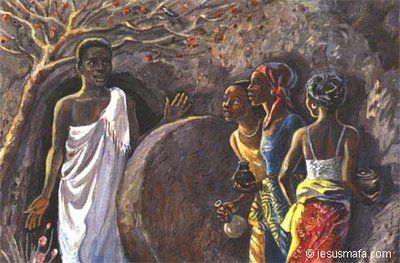
“The Church relives the amazement of the women who went to the tomb at dawn on the first day of the week. The tomb of Jesus had been sealed with a great stone. Today too, great stones, heavy stones, block the hopes of humanity: the stone of war, the stone of humanitarian crises, the stone of human rights violations, the stone of human trafficking, and other stones as well. Like the women disciples of Jesus, we ask one another: “Who will roll away the stone for us from the entrance to the tomb?” (cf. Mk 16:3).
This is the amazing discovery of that Easter morning: the stone, the immense stone, was rolled away. The astonishment of the women is our astonishment as well: the tomb of Jesus is open and it is empty! From this, everything begins anew! A new path leads through that empty tomb: the path that none of us, but God alone, could open: the path of life in the midst of death, the path of peace in the midst of war, the path of reconciliation in the midst of hatred, the path of fraternity in the midst of hostility.”
May we astonish one another in hope and love as we seek to roll away the stones that keep us from the goodness of God and one another
As we say in our CSJP Constitutions: “Strengthened by the Risen Christ, we go forth in peace to continue the work of love and service.”
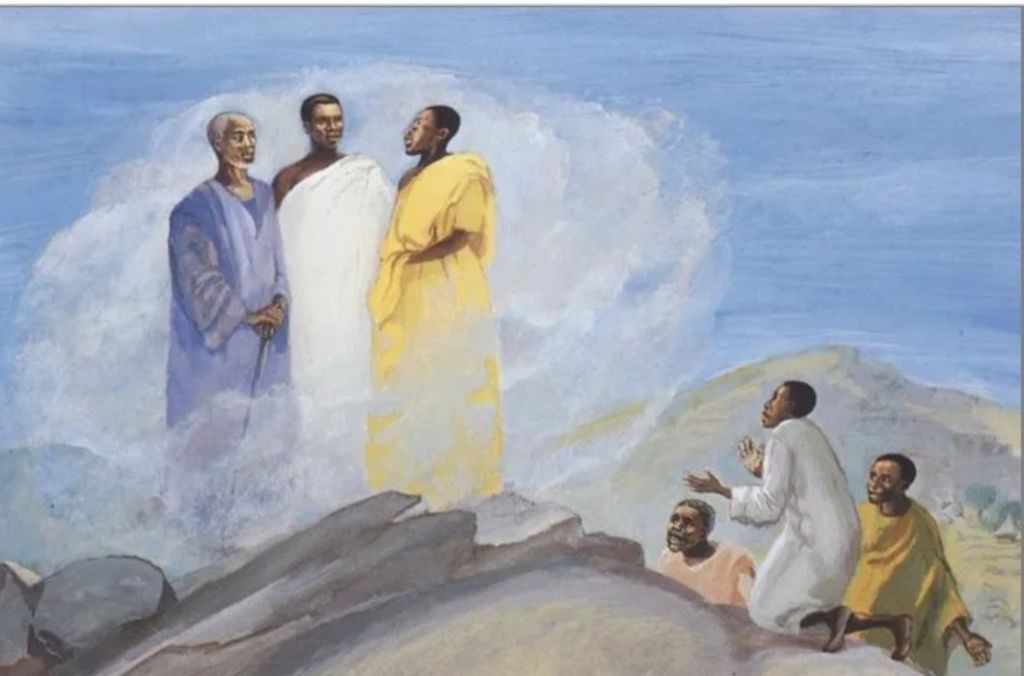
On this second Sunday of Lent, we hear the words of God, coming through the clouds: “This is my Beloved Son; listen to Him.”
Transfiguration (Jesus MAFA, Cameroon)
Moses and Elijah were apparently there on the mountain, and Jesus had already been Transfigured, his clothes a dazzling white. Understandable then that this freaked Peter, James, and John out just a bit. Or, as Mark writes, terrified them, so much so that Peter nervously started talking about building tents for the three. (Peter’s fumbling always makes me feel better.)
That is when the cloud appears and God’s voice can be heard. Seeing the light emanating from Jesus was not enough. So God made it clear for them (us). Jesus is his beloved. Listen to him. And then they saw him. Just him. Alone. With them. Their friend and rabbi who was also the beloved Son of God. They still didn’t quite get it, but they stayed with what it might mean.
“Here is the message: never divert your eyes from the light of Jesus. … This is what we Christians are called to do in the journey of life, always keep before our eyes the radiant face of Christ.”
What keeps us from seeing the light of Christ, ever present in our midst? What keeps us unable to BE the light of Christ for others? Can we echo Gos’s voice, reminding ourselves and others that we too are beloved children of God?
Pope Francis offered a tip for us all during these times, where shadows of darkness are also present and our woundedness, anxiety, and fear can prevent us from seeing the good also and always present in our midst if we but look for it:
“Here is a good resolution for Lent: cultivate open gazes, become ‘seekers of light,’ seekers of the light of Jesus, in prayer and in people.”
As I was praying with this Gospel and the Pope’s words this morning, I was reminded of a video prayer I made over a decade ago set to The Transfiguration by Sufjan Stevens.
Let us not be lost in the cloud, distracted by our fears. May we look out for the light and be the light for others.
It was unexpected when Pope Francis declared a year dedicated to Joseph last year. I had already spent significant time with my friend Joe, having just finished the manuscript of my book (My Friend Joe: Reflections on St. Joseph – available as a paperback or ebook) the month before.
Joseph is always there for us, with us. He doesn’t need a special year or day. He can be our friend every day.
He can also be a model for us as we navigate this thing called life.
In my religious Congregation we consider him to be a model of peace in times of struggle and uncertainty.
Check. That would be many times, but certainly now.
He can inspire us to dream. To take risks for those we love. To act justly. To serve God. To work creatively. To love always.
On this first day of 2021, I shared the following reflection on today’s Gospel during our prayer service for the Solemnity of Mary, Mother of God and the World Day of Peace.
In today’s Gospel reading, the Christmas story continues with the arrival of the shepherds who told their amazing story of how they had learned about the birth of Jesus and how to find the Holy Family.
All who heard the story were amazed, but Luke tells us that “Mary kept all these things, reflecting on them in her heart.”
A mother’s heart.
No doubt your own mother may have told you stories about you. Stories of love, care, concern, wonder, amazement, worry.
Today we celebrate the Solemnity of Mary, Mother of God.
In our amazing Christmas story, Mary, a woman, is the Mother of God. We hold this as a foundational truth today, in our own hearts. But it was hotly debated in the early church until eventually, she was given the title which had always been etched in her heart. Mother of God.
Her cousin Elizabeth of course knew this in her heart when she welcomed Mary at the Visitation, calling her “Mother of my Lord.”
“There can be no peace without a culture of care,” he says.
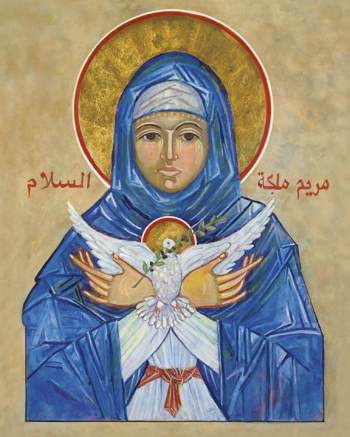
In other words, we need to nurture peace in our hearts, our words, and our actions. Mary, Mother of God is also known as Queen of Peace. She mothered peace, the Prince of Peace.
Mary Queen of Peace Icon written by Fr. Richard G. Cannuli
Pope Francis ends his Peace Day Message calling on another title of Mary we know well, Star of the Sea, Stella Maris. And Mother of Hope.
During these times of the pandemic, and these times of endless war and fractures, when we find ourselves “tossed by the storm” and seeking “a calmer and more serene horizon” we need a compass to guide us to peace.
In his message, Pope Francois points to the compass of the fundamental Catholic principles of Care—Care of the dignity and rights of each person, Care for the Common Good, and Care for Creation—as universal principles that might guide all people of Good Will on the path to peace.
“As Christians,” he writes, “we should always look to Our Lady, Star of the Sea and Mother of Hope.”
“May we work together,” he continues, “to advance towards a new horizon of love and peace, of fraternity and solidarity, of mutual support and acceptance. May we never yield to the temptation to disregard others, especially those in greatest need, and to look the other way; instead may we strive daily, in concrete and practical ways, to form a community composed of brothers and sisters who accept and care for one another.”
And so, we pray …
Hail Mary, full of grace ….
[I created a summary document of the Message of Pope Francis for this 54th Day of Peace. You can download a copy here:
I was reading the Urbi et Orbi message that Pope Francis gave today in an empty St. Peter’s square. He reflects on this time of Covid-19 in light of the story of the storm in Mark’s Gospel (4:35-41).
“Like the disciples in the Gospel we were caught off guard by an unexpected, turbulent storm. We have realized that we are on the same boat, all of us fragile and disoriented, but at the same time important and needed, all of us called to row together, each of us in need of comforting the other. On this boat… are all of us. Just like those disciples, who spoke anxiously with one voice, saying “We are perishing” (v. 38), so we too have realized that we cannot go on thinking of ourselves, but only together can we do this. …
Let us invite Jesus into the boats of our lives. Let us hand over our fears to him so that he can conquer them. Like the disciples, we will experience that with him on board there will be no shipwreck. Because this is God’s strength: turning to the good everything that happens to us, even the bad things. He brings serenity into our storms, because with God life never dies.” -Pope Francis
More than once in my life I have echoed the disciples refrain… do you not care that we are perishing?
Imagine their consternation, frustration and fear that he is, of all things, asleep!
We are terrified … we think we are alone.
But Jesus is with us in the storm.
A few years ago I created this video prayer reflecting on this passage, set to “How to Sleep in A Stormy Boat” by singer songwriter Amy Speace. The Pope’s message reminded me of this video, and so I share it here in case it is a helpful reflection for others in this time.
Peace. Be not afraid. We will weather the storm together.
I want to continue to believe in the presence of God, the one who strengthens, cheers, and encourages me at all times. – St. John XXIII
I have a little prayer booklet I use sometimes from Twenty Third Publications called Walking with St. John XXIII: 30 days with a good and beloved Pope. This morning I turned at random to a page, which happened to be the second to last page, and read this quote.
Interestingly enough, just a few minutes earlier, I had read this post on our current Pope’s Twitter feed:
In the midst of all those passing things in which we are so caught up, help us, Father, to seek what truly lasts; your presence and that of our brother or sister. – Pope Francis
And I was reminded, instantly, of this quote in our CSJP Constitutions:
We value the ministry of presence as an important dimension of the gospel of peace. In the hope of continuing our tradition of gracious hospitality, we welcome others to our communities and also try to be present to people in their own situations. – CSJP Constitution 18
We are so in danger of disconnection and tuning out all the noise and chaos and bad news and suffering, when truly the invitation is to see God present with us in and through and and beyond all that. Emmanuel, after all, means God with us. God created us, Jesus became one of us, and the Spirit is present among us. Ours is to grow in understanding what this means. Ours is to be open to the presence of God in our day to day moments, not only those precious aha spiritual moments, but in the messy bits too. And I don’t know about you but I have a lot more messy bits than spiritual highs. Our is to be the presence of God for others, and to experience (and accept) the presence of God in others.
At least that’s what my morning prayer time led me to ponder, and I join John XXII in praying and trusting in my loving God who strengthens, cheers, and encourages me/us at all times. If we but listen.
I have not posted in this space for quite some time. Life has been busy and the world has been crazy, you know how it goes.
But tonight, with the President choosing climate denial over truth, short term profit for a few over long term sustainability for this little planet we call earth and its inhabitants, isolationism over true leadership … I feel compelled to write.
The past few weeks have been a tough run. Terrorism and hatred in many forms grips the headlines, from Manchester to Portland. Terrorism in other parts of the world, places like Kabul and Bagdahd which have been ravaged by war, we try to ignore.
Then there is the ridiculousness from covfefe to the very probable meddling of a hostile foreign power in our democracy and hints of possible collusion by government officials.
It can all be too much, but in the midst of the swirly nature of life right now, I feel I must proclaim these words.
I believe in goodness.
The goodness of people to stand up to hateful speech in my adopted hometown of Portland, risking all for goodness.
The goodness of folks who stand up for what is right, on behalf of our immigrant brothers and sisters, Earth our common home, healthcare, justice and peace.
Yesterday I had the privelege of being with lay leaders from our csjp sponsored ministries in New Jersey. Day in and day out they provide compassionate care in health care, education and social service to people who are poor and vulnerable. We had the chance to hear stories of how the mission is alive today. In the midst of the challenge and strain of this crazy time, goodness abounds.
There is much we cannot control, but we can believe in goodness and act that way. We can choose to bring goodness into this world, little by little, relationship by relationship.
Pope Francis recently called for a revolution of tenderness.
Let’s be good and tender. Let’s follow that sage advice from Micah. Let’s act justly, love tenderly and walk humbly with God.
Today is the Feast of the Immaculate Conception of Mary.
I like to think of it as a celebration of Mary’s YES.
Yes to love, life, and possibility.
Yes to uncertainty and confusion.
Yes to perhaps not always understanding or being understood.
Yes to life as a mix of joy and sadness, suffering and compassion.
This morning I ask myself, how am I living into my yes?
Mary shows us that our yes, freely given and lived into day by day, has the power to change the world.
Or as Pope Francis recently said in an interview about negativity in media: “Today there is a need for a revolution of tenderness in this world that suffers from ‘cardiosclerosis.”






 At the Corner of Susan and St. Joseph