True confession… Sunday’s Feast in the Catholoc tradition (Solemnity of Our Lord Jesus Christ, King of the Universe) is not my favorite. My relationship with Jesus is more as teacher, brother and friend than ruler. I resist the King and Lord imagery.
And yet when I reflect on this Sunday’s Gospel (Luke 25:35-43) what I experience is not the world’s image of a King. It is the crucifixion. The paradox of the paschal mystery.
Jesus is on the cross, fully human in his suffering, being jeered by the rulers, guards, and onlookers. Yes the inscription on the cross names as a king but that is all. He is not treated as King of the Universe.
So why does the church have us reflect on this passage on this particular feast? What can we learn? We might recognize some of the attitudes of the world to the suffering of our day.
“All these onlookers share a refrain that the text repeats three times: “If you are a king, then save yourself!” (cf. vv. 35, 37, 39). Save yourself! That is how they insult him; they challenge him! It is precisely the opposite of what Jesus is doing: he thinks not of saving himself, but of saving them. Yet those insulting words – “save yourself!” – are contagious; they spread from the leaders to the soldiers and then to the people; the ripple of evil reaches almost everyone there. Think about it: evil is contagious. Like an infectious disease, we catch it immediately. All those people talk about Jesus, but not for a second do they empathize with him. They stand apart and talk.
Such is the lethal infection of indifference. “This has nothing to do with me.” Indifference to Jesus, indifference to the sick, the poor, the destitute of the land.”
Evil and indifference are contagious. But so is goodness. And goodness can come from the most unexpected places.
I think we are meant to reflect on the man on the next cross, often referred to as the good thief. What can we learn from this, one of the last encounters of Jesus? Again, from Pope Francis:
“Yet there is another path: that of goodness. Amid all those onlookers, one person does get involved: the good thief. The others mock the Lord, but he turns to him and calls him by name: “Jesus”. That is all he asks of the Lord. A fine prayer that each of us can recite daily as a path to holiness. “Jesus, remember me!” Many jeer at Jesus, but he confesses his faults to Jesus. Many shout: “Save yourself!”, but he begs: “Jesus, remember me” (v. 42). In this way, a criminal becomes the first saint: he draws near to Jesus for an instant and the Lord keeps him at his side forever. The Gospel speaks of the good thief for our benefit: to invite us to overcome evil by refusing to remain as onlookers. Please, indifference is worse than evildoing.”
Indifference is worse than evildoing.
When he first walked out on the balcony of St. Peter’s, Pope Leo said:
“God loves us, God loves you all, and evil will not prevail!”
Evil will not prevail when we choose the way of Christ, when we resist the globalization of indifference, when we see the suffering Christ in our brother and sister and respond with love.
Let’s end this reflection with what Pope Leo said next that first day of his pontificate:
“All of us are in God’s hands. So, let us move forward, without fear, together, hand in hand with God and with one another other! We are followers of Christ. Christ goes before us. The world needs his light. Humanity needs him as the bridge that can lead us to God and his love. Help us, one and all, to build bridges through dialogue and encounter, joining together as one people, always at peace.”
May we bring the light and love of Christ into our world, through active listening and loving response.
“In the absence of holiness, You are still God. You are steadfast.”
This morning, I prayed with these words from the song Steadfast by singer songwriter Leslie Jordan. A good reminder with everything going on in our world and even in my own head and heart. Because, you see, we are human. We get hooked, we get annoyed, we can hook and annoy other people. Then there is the state of the world and the harm done to real families and earth, our common home, by selfish and misguided individual and collective human action. Yet God is still God. God is steadfast. Always.
God is still God and God is always on the lookout for us, steadfast and in love with these imperfect souls created in the image and likeness of God. God is love, and so this means we are a reflection of this love, created in and for love, and even when we stray from that path, God is there already in love with us, loving us into our fullest being.
In today’s Gospel reading (Luke 15: 1-10), Jesus tells two stories to a group of folks who are complaining about the sinfulness of another group of folks (when they no doubt had their own flaws to contend with). In the first, the story is of a shepherd who leaves 99 sheep alone in the desert to search out for the one who is lost.
And when he does find it, he sets it on his shoulders with great joy and, upon his arrival home, he calls together his friends and neighbors and says to them, ‘Rejoice with me because I have found my lost sheep.’
The second story is of the woman who searches high and low in her house for her lost coin, her treasure. She too rejoices when her seeking ends in the discovery of that which was lost. Jesus tells those gathered around him–and us–“In just the same way, I tell you, there will be rejoicing among the angels of God over one sinner who repents.”
God is love, and God’s love is bigger than our brokenness. In the absence of holiness–in ourselves, in others, in society–God is still God and God’s love is abundant and never ending. God does not give up on us!
I was struck by these words at the end of a reflection on this reading, by Nick Wagner in the book I use for my morning prayer, Give Us this Day:
“These are stories about a God who loves us with wild extravagance. The Divine Seeker refuses to calculate odds or cut losses. God’s love persists beyond reason and celebrates beyond proportion. Jesus invites us to participate in God’s excessive seeking–not because it makes sense, but because the joy of finding transcends all calculation.”
May we who are made in the image and likeness of God, imperfect as we are, strive to mirror God’s excessive seeking for goodness, light, love, and peace. May we never give up on ourselves or one another. May we be steadfast like God is steadfast. Amen.
I spent yesterday morning with other volunteers at Delaney Hall providing hospitality and solidarity to families visiting loved ones.
I have been recovering from Covid so hadn’t been in a while. As always I found myself inspired by the courage of the families waiting to visit loved ones and the open hearts and dedication of the volunteers. I was also heartbroken. This time it was the children who have to face this cruelty, some born while their fathers have been detained. Others just trying to be a kid in very difficult circumstances. I couldn’t help but think of the words of Jesus in Matthew’s Gospel: “Let the little children come to me, and do not hinder them, for the kingdom of heaven belongs to such as these.”
Last night as I went to bed, I realized that not only was my heart broken 💔, I had over estimated my post covid energy level. While I had planned to attend the prayer service this morning outside Delaney Hall, instead I prayed at home with the Scriptures for todays liturgy, where I found strength for the journey.
The Prophet Habakkuk was reading the signs of injustice in his own time and calling on the people to hold fast in faith. It is one of my all time favorite passages.
“How long, O Lord? I cry for help / but you do not listen! / I cry out to you, “Violence!” / but you do not intervene. / Why do you let me see ruin; / why must I look at misery? / Destruction and violence are before me; / there is strife, and clamorous discord. / Then the Lord answered me and said: / Write down the vision clearly upon the tablets, / so that one can read it readily. / For the vision still has its time, / presses on to fulfillment, and will not disappoint; / if it delays, wait for it, / it will surely come, it will not be late. / The rash one has no integrity; / but the just one, because of his faith, shall live.”
In his letter to Timothy St. Paul tells his community (and us):
“Beloved: I remind you to stir into flame the gift of God that you have through the imposition of my hands. For God did not give us a spirit of cowardice but rather of power and love and self-control. So do not be ashamed of your testimony to our Lord, nor of me, a prisoner for his sake; but bear your share of hardship for the gospel with the strength that comes from God.”
The Gospel from Luke is a call from Jesus to risk the bigness of smallness.
“The apostles said to the Lord, “Increase our faith.” The Lord replied, “If you have faith the size of a mustard seed, you would say to this mulberry tree, ‘Be uprooted and planted in the sea,’ and it would obey you.”
As Pope Leo XIV said when he first stepped out on the balcony at St Peter’s Basilica: “God loves us, God loves you all, and evil will not prevail. “
God of justice, love, and mercy, help us to remember and always to be animated by your love. Give us courage to act in the face of oppression and violations of human dignity. Help us to participate in your creating power of love in ways big and small. Most of all, increase our faith that we may truly believe in You who are bigger than it all. Amen
I will be honest. Given the state of the world, it felt a little self-indulgent to spend a week away in silence and the beauty of God’s creation this year. And yet I leave renewed and strengthened by God’s love, grateful for the wisdom of tradition and my community’s expectation that each sister take an annual retreat (it’s in our Constitutions!).
Mother Evangelista, one of the first sisters to profess vows in the community in 1884, taught this to her novices:
“Retreat – What is it? A Spiritual Holiday with our Lord. … God comes to us now with His hands spread out over us, and filled with every kind of grace and gift. Are these gifts for me Lord? Is it I?“
I can relate. This year, I returned to Wisdom House, an interfaith retreat center in Connecticut run by the Daughters of Wisdom. When I was a novice, I made my retreat here both years. It is a sacred space filled with beauty where I have received many graces and gifts, this year being no exception.
I leave with three messages tucked into my heart from this week, wisdom for the journey.
1. Strengthen Your Weak Knees
The week before my retreat I twisted my knee. Given that one of my favorite things to do on retreat is go on long walks in the woods, this was problematic. Thankfully I am improving and was able to take (slow) walks with the help of a knee brace.
God has a (serious) sense of humor, however. The Sunday reading as I began retreat was from Hebrews 12:
For what “son” is there whom his father does not discipline? At the time, all discipline seems a cause not for joy but for pain, yet later it brings the peaceful fruit of righteousness to those who are trained by it.
So strengthen your drooping hands and your weak knees. Make straight paths for your feet, that what is lame may not be disjointed but healed (emphasis added by me).
I burst out laughing at mass as this passage was proclaimed. OK God, I get it. But just to make sure I got the message, later that same day, I was listening to new music by Sandra McCracken, who it happens released a song based on this same verse in July!
Strengthen your weak knees became a theme of sorts for this retreat. The journey is not without challenges, but I find strength in God and community (and knee braces) and stay on the path. Speaking of paths, I visited the Montfort Fathers Lourdes Shrine in Litchfield and made a prayer video set to the song.
2. Do Whatever He Tells You
I attended daily mass this week at a local parish, where on my second visit I noticed a beautiful stained glass window of the wedding at Cana. I love the look on Mary’s face as she looks over her shoulder at Jesus. Aren’t you going to do something, her whole being says to her son. And to the servants (and to me), she says simply, “Do whatever he tells you.”
Life can be overwhelming on the best of days. Right now … well. Sigh. I have been mostly unplugged this week but have been reading (and praying with) the news. Enough said.
I also carry with me the stories of the immigrant families I have met on my visits to the Delaney Hall detention center in the face of cruel, inhumane, and constantly changing visitation policies at the for-profit prison. Another reflection point this week that kept coming up for me (and is in the video above) was standing at the foot of the cross. My experience of accompaniment at Delaney Hall has been a true foot of the cross experience. I can feel helpless in such moments. Like Mary and the other women, I suppose.
As I prepare to return back to real life, I am encouraged by Mary to follow her son. “Do whatever he tells you. He is the way. Love is the way.” My task is simply to listen to him and act accordingly. Small acts of love add up. And as Pope Leo reminded us that first day from the balcony at St. Peter’s… “God loves all of us and evil will not prevail.”
3.Be Like Wise and Rational Fish
Bear with me here … This morning, on the feast of St Augustine, I was drawn to look at the Office of Readings for the day, which I presumed would have something from him. Sure enough, it was the “Late have I loved you” bit, which is lovely and worthy of reflection, to be sure.
But it was the daily reading from St. Columbanus (different from Columba apparently), a sixth century Irish Missionary that caught my attention. Reflecting on Living Water, he wrote:
“We are called to the source and fountain of life … From this Life comes everything: wisdom, life, eternal light. The Creator of life is the fountain from which life springs; the Creator of light is the fountain of light. So let us leave this world of visible things. Let us leave this world of time and head for the heavens. Like fish seeking water, like wise and rational fish let us seek the fountain of light, the fountain of life, the fountain of living water.“
His words came back to me later as I happened upon a bubbling brook on my morning walk in a nearby nature preserve. Remember, I was necessarily walking slowly thanks to my weak knees so I noticed things! I even took advantage of a conveniently placed bench to ponder this living water (and later make a video, because why not?).
God’s love is everywhere if we but have eyes to see and ears to hear (and weak knees to slow us down). God gives us living water to sustain, refresh, and renew us. May we, like wise and rational fish, remember to seek out and be light and love in the darkness amid the dry times in which we find ourselves.
Thanks for reading. I have been praying for you, yes you, during these days of retreat. May we all remember that God is good. All the time. And so are we.
Last night I made this prayer video featuring pictures of our global family set to a song that has been in my heart of late, Turning of the World by Sarah Thomsen.
Then, in this morning’s liturgical readings, I heard in Psalm 37:
Turn from evil and do good,
that you may abide forever;
For the Lord loves what is right,
and forsakes not his faithful ones
And from the Gospel of Matthew:
But beware of men, for they will hand you over to courts and scourge you in their synagogues, and you will be led before governors and kings for my sake as a witness before them and the pagans. When they hand you over, do not worry about how you are to speak or what you are to say. You will be given at that moment what you are to say. For it will not be you who speak but the Spirit of your Father speaking through you.
We are in times when much evil is being done by those in power. This leaves us with a choice. What will we do as …
Millions of children and families lose their lives that could have been saved with humanitarian food and medical assistance, which has already been funded by our government.
Families are torn apart by an inhumane immigration detention system on steroids fueled by greed and ideology.
The coffers of the ultra wealthy are overfilled by stealing life saving food and health care from those on the margins though drastic budget cuts and eliminating the social safety net.
We must call this what it is … social sin. We cannot be silent, even if as Jesus points out in this Gospel passage, there may be consequences. We must use whatever privilege we have and also take risks to turn from evil and do what is good, trusting in the Spirit of God.
Together we can turn the world through our loving, healing, and dreaming. Let us be hope for one another.
Today’s Gospel reading is one of my favorites, and so timely. From Matthew:
“As Jesus got into a boat, his disciples followed him. Suddenly a violent storm came up on the sea, so that the boat was being swamped by waves; but he was asleep. They came and woke him, saying, ‘Lord, save us! We are perishing!’ He said to them, ‘Why are you terrified, O you of little faith?’ Then he got up, rebuked the winds and the sea, and there was great calm. The men were amazed and said, ‘What sort of man is this, whom even the winds and the sea obey?’”
There is a beautiful song reflecting on this story by The Porter’s Gate, “Wake up Jesus,” in which the singer Liz Vice laments soulfully at the end: “How can you sleep when we’re in need. Won’t you rise up? Won’t you rise up?”
This morning in prayer it dawned on me … I need to be the one to rise up. You need to be the one to rise up. We need to be the ones to rise up. That’s how this whole Christianity thing works. They will know we are Christians by our love.
Our love for families who are separated by inhumane immigrant detention efforts.
Our love for the children and families who will lose food assistance if the budget bill goes through. Even Fox News admits 3 million people could lose benefits to combat hunger.
Our love for the estimated 12 million people who will no longer be covered by health insurance with cuts to Medicaid to pay for tax cuts for the wealthiest among us.
The storms keep coming and lives are literally at stake.
Will we rise up as our lawmakers prioritize greed and misguided ideology over life and human dignity?
Will we be Christ and use our God given agency to calm the raging seas, each doing our bit, contributing to the common good?
Will we be awake to the suffering of human beings, present to their pain and ready to act to rebuild our social fabric?
My prayer this morning is for Christ to guide me/us, to sustain me/us, and to inspire me/us to action.
This morning as we grapple with the death dealing decision of the current occupant of the White House to choose destruction over diplomacy, with far reaching consequences we can only imagine, I found myself praying with this poem by my friend Susan. She has been in heaven more than 5 years now. Praying with her wisdom and insight and wonderful way with words in this disturbing moment, and counting on her to whisper into the ear of her loving God on our behalf.
Peace for Us by Sister Susan Dewitt, CSJP
You who are peace for us came among us into such trouble, into the Emperor’s world of calculations, straight roads, good money, crucifixions.
You who are peace for us came among us into a conquered people, unfashionable stubborn believers in the promise and the Word.
You came to a serving woman, who trusted the impossible promise you who are peace for us would bring to birth in her,
You came naked and helpless, you who are peace for us, asking us to hold you, feed you, asking us to help you grow
You ask us now to help you to make a place for you who are peace for us among our tangled riches,
our politics, anger and fear, to be the womb that holds you, to be the milk that feeds you, to be peace for you.
On Tuesday, June 24, Catholic Sisters and their partners and friends will gather on the steps of the US Capitol, and in echo events across the country, for prayer and public witness in support of immigrants and a just economy. My Congregation, the Sisters of St. Joseph of Peace, is one of the sponsoring organizations of Sisters Speak Out. It does my heart good to see how the network has grown as evidenced by this graphic.
We will have representation at the DC event and our CSJP sisters and associates will also gather in Englewood Cliffs, New Jersey and Bellevue, Washington for echo events. The Bellevue prayer and witness is open to the public and will be live streamed. Click here for details and to register.
This is our moral moment. We must hold fast to Gospel values and stand together in support of human dignity. Speaking out is a requirement of justice even as we are overwhelmed by the inhumanity and unfathomability of actions undertaken in our name. It is a requirement of our faith precisely because these inhumane actions are being taken in our name. Catholic Social Teaching calls us to have a preferential option for those who are poor, to protect life and human dignity at all stages, to defend the rights of workers and migrants, to care for creation. All of these are presently under attack.
Yesterday, World Refugee Day, San Diego Bishop Elect Michael Pham visited the federal building to stand in solidarity with individuals making appearances in immigration court who were afraid of being summarily detained and held in private for profit immigration prisons. (Yes not only is this becoming routine, but these immigrants seeking to follow legal systems are being swept up by men in masks in 2025 in the United States!). This did not happen yesterday in the presence of the Bishop and his fellow clergy.
Per a news story: “masked immigration agents weren’t leaning against the off-white walls, waiting to grab people. They scattered Friday after seeing a clergy delegation led by Bishop Pham.
‘Like the story of Moses and Exodus, the Red Sea parted,’ said observer Scott Reid of the immigrant-aiding San Diego Organizing Project.
Said another observer: ‘We’ve never seen the hallways cleared out so quickly.’
The result: Nobody was detained as immigration lawyers said would happen.”
I will still be out of the country on June 24, visiting our sisters in the UK. It has been an interesting few weeks to be out of the country, that is for sure. And when I tell people the scale and scope of what is happening at home, they look at me with unbelief and a sort of pity.
Wherever you are on June 24 please join us in solidarity. And know that we are in this for the long haul, following in the footsteps of Jesus who always stood with those who were oppressed.
As we say in our CSJP Constitutions:
“Christ is our peace, the source of our power. United with him we engage in the struggle against the reality of evil and continue the work of establishing God’s reign of justice and peace.”
This Palm Sunday, praying as a visitor in a packed to the gills new-to-me church, the familiar readings from Luke’s Gospel spoke to me in a new and powerful way.
From the Gospel read before the Palm Sunday Procession:
Jesus proceeded on his journey up to Jerusalem. As he drew near to Bethphage and Bethany at the place called the Mount of Olives, he sent two of his disciples. He said, “Go into the village opposite you, and as you enter it you will find a colt tethered on which no one has ever sat. Untie it and bring it here. And if anyone should ask you, ‘Why are you untying it?’ you will answer, ‘The Master has need of it.’
My friends, Jesus has need of US. He needs us to untie ourselves from thinking we have no power to make a positive difference in the world. He needs us to empower one another to make the way for God’s love to break into our weary world.
Because like Jesus, many innocents are being condemned by the group think of the crowds.
Pilate addressed them a third time, “What evil has this man done? I found him guilty of no capital crime. Therefore I shall have him flogged and then release him.”
With loud shouts, however, they persisted in calling for his crucifixion, and their voices prevailed. The verdict of Pilate was that their demand should be granted.
The crowds can condemn, and the crowds can also speak out and stand up for those wrongly accused. Those whose free speech rights are in peril. Those who are wrongfully deported and detained. Those whose life-saving medicine and food is stopped by greed and ideology. Those who …
Christ has need of us. Today. Now. Here in this day and time.
Will we like Peter deny Christ and His love?
Or will we help to carry the cross and seek to bring about God’s reign of justice and peace.
I am feeling the call to write more during this time in history. Starting today I am going to be sharing excerpts from my Master Thesis for my Moral Theology degree (from Catholic Theological Union), in which I developed an ethic of resistance. I will publish this as a series. My original application was to the social sin of human trafficking, but you will see as this series moves forward that I looked at other examples and responses by ordinary Christians to extreme social sin, such as the death-dealing reality of the Nazi Holocaust. The identity and worldview of these resisters led them to counter dehumanization through acts of resistance, often at great personal cost. Their witness offers ordinary persons seeking to resist social sin today a model and path to follow in our times. Who knew that just one decade later I would be mining my own research for practical applications in our country?
First, a few introductory words about how I understand resistance as an ethical framework.
Resistance can be understood as “standing fast to a position or principle.” Margaret Collins Weitz derives this understanding from the Latin roots of the word for resistance, resistere. The prefix re intensifies the stronger form of the verb stare, to stand. In this light, resistance involves an “inner certainty … allied with a strong sense of conscience and belief in human dignity.” (Weitz, 33-34)
So as we navigate these days, let us hold fast to that which we know to be true: we are good. God is good. And our job is to promote good for others and, indeed, all of God’s creation. It’s that simple. We have to keep it simple so as to stay the course in the face of misinformation, deception, disconnection, globalized indifference, and the normalization of extreme social sin. And with that, episode one.
Episode 1: Resistance in the Christian Tradition
The Christian tradition of resistance of course begins with the person of Jesus. “The practice of resistance in the life of Jesus is where Christians must begin for understanding how to resist evil.” (DeYoung, 6) Curtiss Paul DeYoung identifies three key modes of resistance practiced by Jesus in the Gospels. First, Jesus “resisted the popular notion of who was ‘worthy’ of relationship by developing friendships with persons at the margins of society in his day—women, tax collectors, Samaritans, militant activists, people with disabilities, poor people, and working people.” (DeYoung, 6) In other words, Jesus resisted social norms of exclusion in his own personal sphere by “creating a wide web of relationships” around himself. (DeYoung, 6-7) Second, Jesus “resisted stereotypes and transformed cultural images in his day by injecting into popular culture positive descriptions of Samaritans and women.” (DeYoung, 11) Third, Jesus resisted through public protest, such as the incident against the money changers in the temple. “This demand for equal access to the central institution of religion and community governance was so significant and memorable that it is included by all of the Gospel writers.” (DeYoung, 12)
Another Gospel passage directly related to resistance is the Sermon on the Mount, in particular Matthew 5:39a: “ But I say to you, offer no resistance to one who is evil” (NAB). Johannes Nissen notes that this passage is traditionally understood as advocating “non-resistance to evil.” (Nissen, 184). It is potentially problematic because, as Walter Wink observes, “if Jesus commands us not to resist, then the only other choice would appear to be passivity, complicity in our own oppression, surrender.” (Wink, 184)
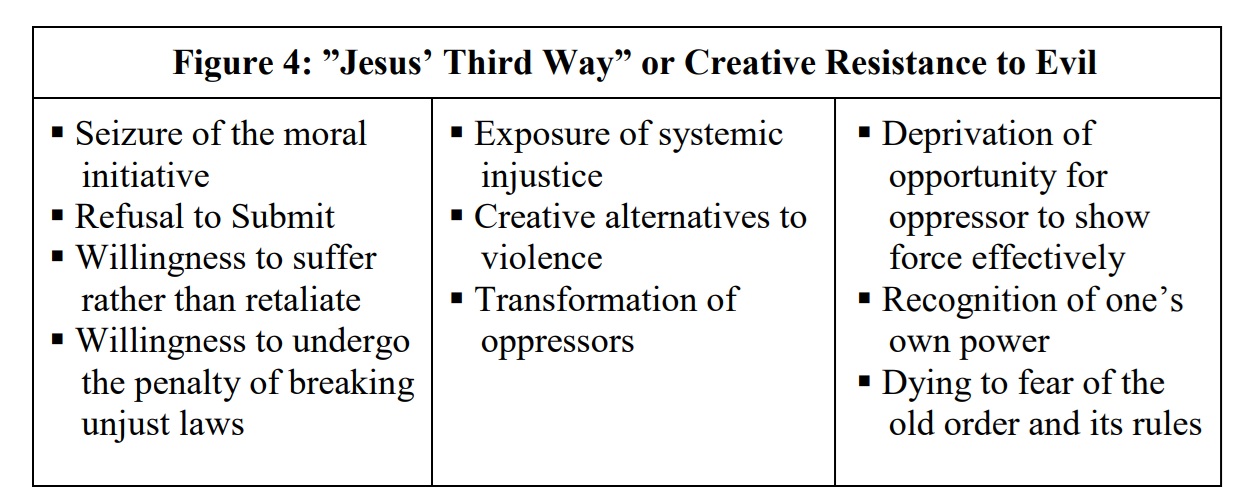
However, Wink asserts that the Greek word used in Matthew, antisēnai, does not merely mean “resist” or “stand against,” but rather to “resist violently, to revolt or rebel, to engage in an insurrection.” In other words, the message of Jesus to his followers is not to “mirror evil” with evil. Wink concludes that the “logic of the text” points neither to passivity nor violent resistance, but instead to finding “a third way, a way that is neither submission nor assault, neither fight nor flight, a way that can secure your human dignity and begin to change the power equation.” (Wink, 184-185)
The actions suggested by Jesus in the passages following this admonition against resisting evildoers—to turn the other cheek, give away one’s cloak, walk a second mile, and give to those who borrow (Matthew 5: 39b-41)—are “not rules to be followed legalistically, but examples to spark an infinite variety of creative response in new and changed circumstances.” (Wink, 185) Inspired by these examples, Wink suggests creative alternatives for the Christian choosing to follow Jesus’ third way of resisting evil (see Figure 4). (Wink, 186-187)
In choosing creative resistance, followers of Jesus seek to deny, defuse, and defeat the dehumanizing tactics of oppressors.
Christian resistance to evil has always been played out within a social context, as Christians have navigated relationships with the state, society, and economy in light of the Gospel and the reality of evil. “Resistance is the process of drawing attention to evil and injustice while pressuring the powers that be to pursue positive social change.” (DeYoung, 16)
From its very beginnings as a “tiny, fragile organization,” the Christian Church faced state sponsored discrimination. Søren Dosenrode observes that, from this minority position, “Christians rendered passive resistance to the state as no other real alternative remained.” Martyrdom was often the result of such resistance. (Dosenrode, 11-12) In their daily lives, early Christians resisted poverty and economic oppression by “creating a countercultural community that practiced its own economy of grace,” such as that depicted in Acts 4: 32-37. (Long, xxi-iii) It was not until the legalization of Christianity in 313, and the evolving close relationship between church and state when Christianity became the official religion of the Roman Empire, that resistance became a serious question for Christians. (Donsenrode, 11-12)
One early model for Christian resistance is St. Maximus the Confessor (580-662 CE). His Four Centuries on Love is cited by Charles C. McCarthy as containing the core of his teaching on resistance, centered on the example of Jesus and the primacy of love. (McCarthy, 77) “The one who loves Christ thoroughly imitates him as much as he can.” (Maximus, 81) Maximus taught that in the struggle against evil, the “microcosmic deed of love is all that humanity has to work with,” and indeed, all it needs. (McCarthy, 82)
Maximus lived out this teaching on resistance in his own life. He stood fast against monothelitism, the “theology that Christ was not as the Council of Chalcedon had stated, ‘true God and true man,’ but, in fact, had one will (divine), not a human will and a divine will.” 1 (McCarthy, 84). His belief in the doctrine that Christ had two wills led him to resist both civil and ecclesial authorities who supported monothelitism; he “suffered imprisonment and torture for this stand.” (McCarthy, 78) Maximus was later exiled to Lazica where he died in 662 CE. (McCarthy, 65)
For Thomas Merton, a Trappist monk who contemplated the spirituality of resistance, Maximus is a model of what is possible for human persons facing evil. Maximus “portrays nonviolent resistance under suffering and persecution as the normal way of the Christian.” Countering those who dismiss resistance as impractical or impossible, Merton holds up Maximus as one who believed that Jesus “does not command the impossible, but clearly what is possible.” Furthermore, for Maximus, Gospel resistance, modeled on the way Jesus actually resisted evil, should be “aimed not at the evildoer but at evil as its source.” 2 (Merton, 176)
Notwithstanding early models of Christian nonviolent resistance such as Maximus, in practice the ongoing marriage between church and state led to a mixed assessment of resistance. Dosenrode observes that in the Middle Ages, certain forms of passive resistance were “known and accepted as common law,” such as refusing to pay taxes, provided they were proportional. More active forms of resistance were also carefully assessed by theologians and Church authorities. For example, tyrannicide was accepted as a last resort by Thomas Aquinas, “provided that it was rooted in a higher power than an individual’s idea.” At the Council of Constance (1414-1418), however, the Catholic Church condemned tyrannicide outright as contrary to the moral life. Protestant and Reformed churches “became more open to resistance to defend the true faith” during the Reformation, while the Catholic Church held close to its condemnation. By the twentieth century, the doctrine of resistance in the Catholic, Reformed, and Protestant churches was one of “restraint in the use of power” and support of the state and status quo. (Dosenrode, 13-14, 17) The experience of the Nazi holocaust called this stance into question.
1 The Third Council of Constantople declared monothelitism as a heresy in 681 CE.
2 Emphasis in the original text.
Sources:
Curtiss Paul DeYoung, “From Resistance to Reconciliation: The Means and Goal of Christian Resistance,” in Resist! Christian Dissent for the 21st Century, ed. Michael. G. Long (Maryknoll, NY: Orbis Books, 2008)
Søren Dosnerode, ed., Christianity and Resistance in the 20th Century: From Kaj Munk to Dietrich Bonhoeffer to Desmond Tutu (Boston: Brill, 2009)
Michael G. Long, ed, Resist! Christian Dissent for the 21st Century (Maryknoll, NY: Orbis Books, 2008)
Maximus the Confessor, Maximus the Confessor: Selected Writings, trans. George C. Berthold (New York: Paulist Press, 1985),
Charles C. McCarthy, “Maximus the Confessor (580-662),” in Non-Violence—Central to Christian Spirituality: Perspectives from Scripture to the Present, ed. Joseph T. Culliton (New York: The Edwin Mellen Press, 1982),
Johannes Nissen, “Between Conformity and Nonconformity: The Issue of Non-Violent Resistance in Early Christianity and its Relevance Today,” in Christianity and Resistance in the 20th Century: From Kaj Munk and Dietrich Bonhoeffer to Desmond Tutu, ed. Søren Dosenrode (Boston: Brill, 2009)
Margaret Collins Weitz, “Resistance: A Matter of Conscience,” in Resisters, Rescuers, and Refugees: Historical and Ethical Issues, ed. John J. Michalczyk (Kansas City: Sheed & Ward, 1997)
Walter Wink, Engaging the Powers: Discernment and Resistance in a World of Domination (Minneapolis: Fortress Press, 1992)
Excerpt from: “Human Trafficking as Social Sin: An Ethic of Resistance,” by Susan Rose Francois, CSJP. Submitted to the Faculty of The Catholic Theological Union at Chicago in partial fulfillment of the requirement for the degree of Masters of Arts in Theology, March 2015.
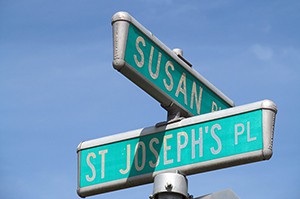








 At the Corner of Susan and St. Joseph