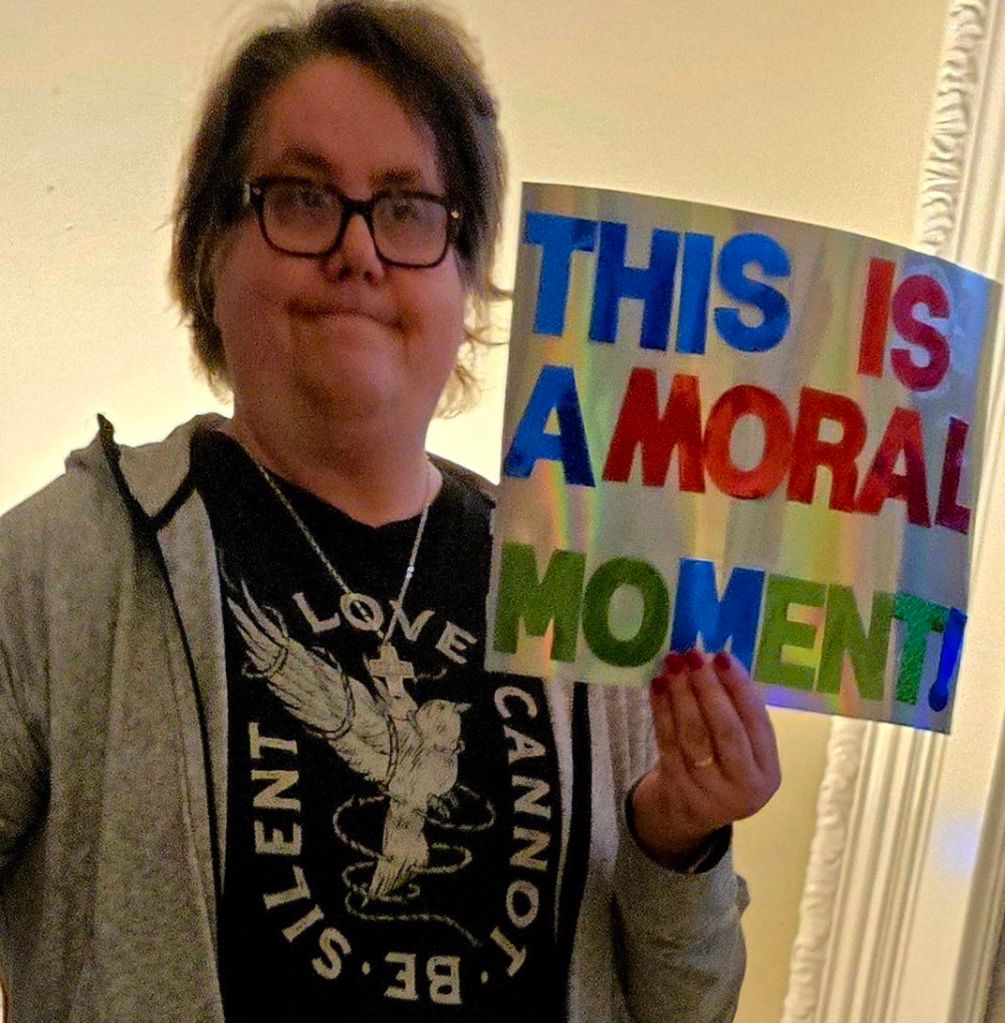
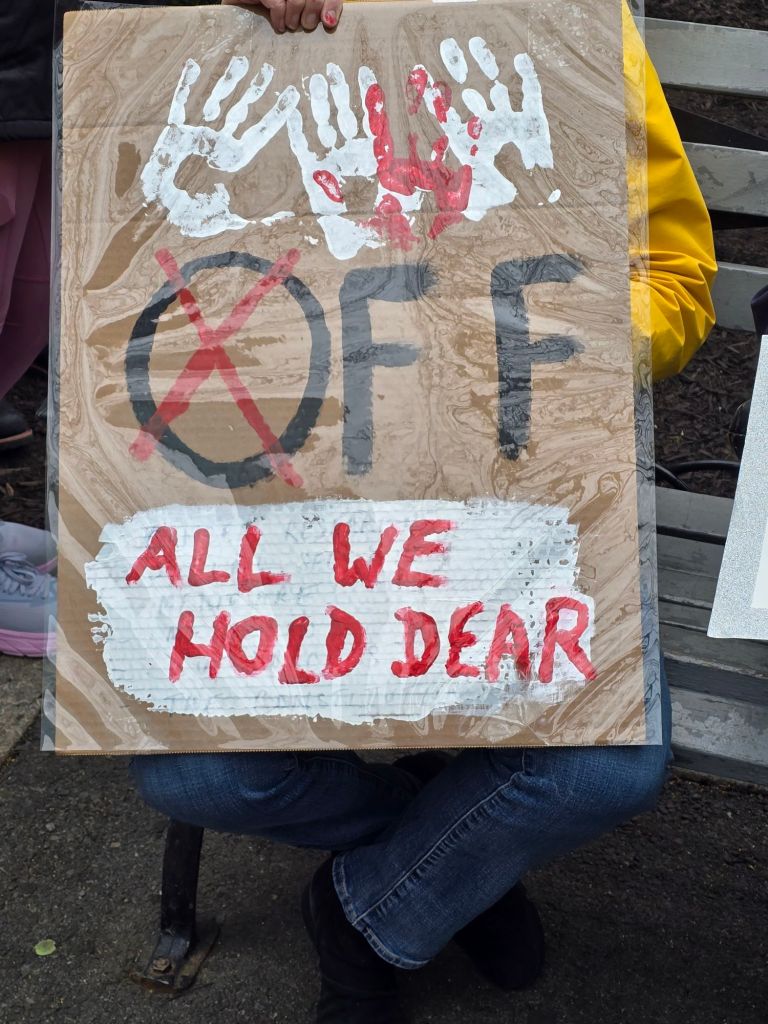
I started my day with a community of strangers outside a downtown subway station in Jersey City this morning, standing up and speaking out for our democracy, the common good, and human rights (among other things). This was one of over 1,300 events organized for today across the country under the unifying theme of #HandsOff. I carried my homemade sign which said on one side, “This is a moral moment” (quoting my Senator Cory Booker), and “Time 4 Good Trouble” (quoting John Lewis) onthe other. Under my raincoat I wore my “Love cannot be silent” t-shirt. (Before I left the house I prayed with St. Joseph and showed him my signs, because, well, I am me!)
Some reflections …
People of all ages showed up, even with the forecasted rainy weather. From families with toddlers in tow and even a mom-to-be with a very visible baby bump to grandparents and retirees and every generation in between. They even stayed when it rained, although thankfully the organizers had premptively shifted to a location that provided some shelter. Good organizing is appreciated and important and Knitty Gritty JC, a new to me local organization, did a great job planning this event.
For the most part these were not your standard protest goers (although some of us were there to be sure) but ordinary folks who answered the call to do something! They quickly went from standing around awkwardly to learning and loudly joining the chants, from the oldie but goodies (Tell me what democracy looks like, this is what democracy looks like) to hot off the news cycle ones (Ho ho, hey hey, Donald Trump crashed your 401k). Moreover, they held their signs high and joined in boisterously. I particularly loved seeing the toddlers dancing to the chants.
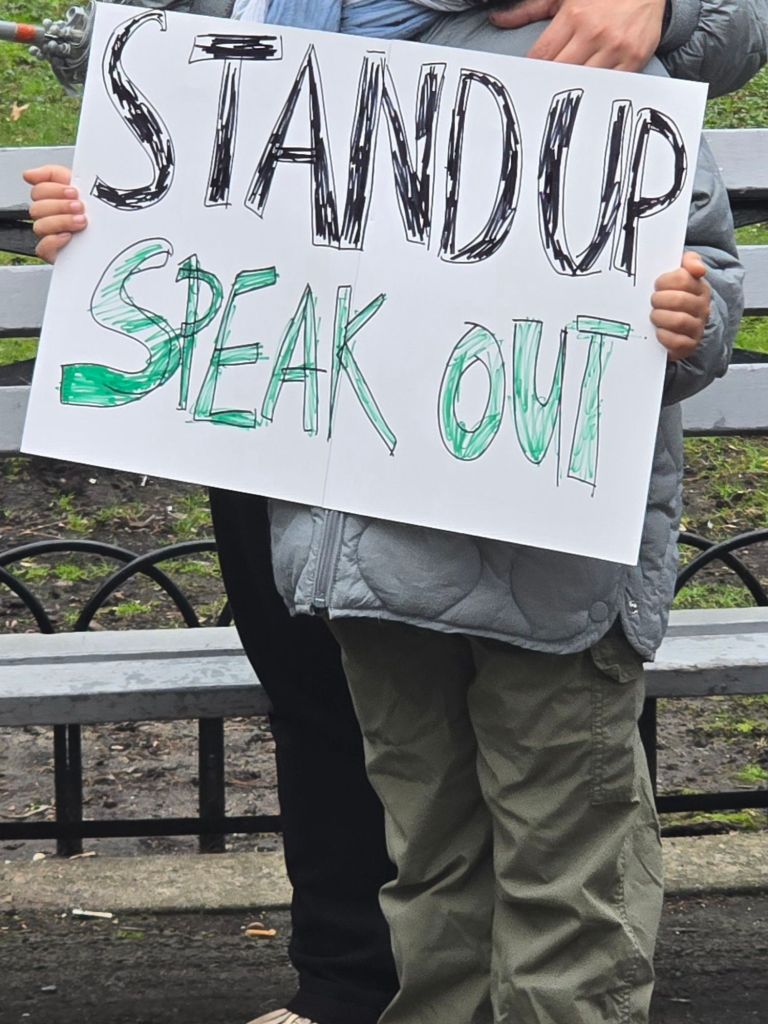
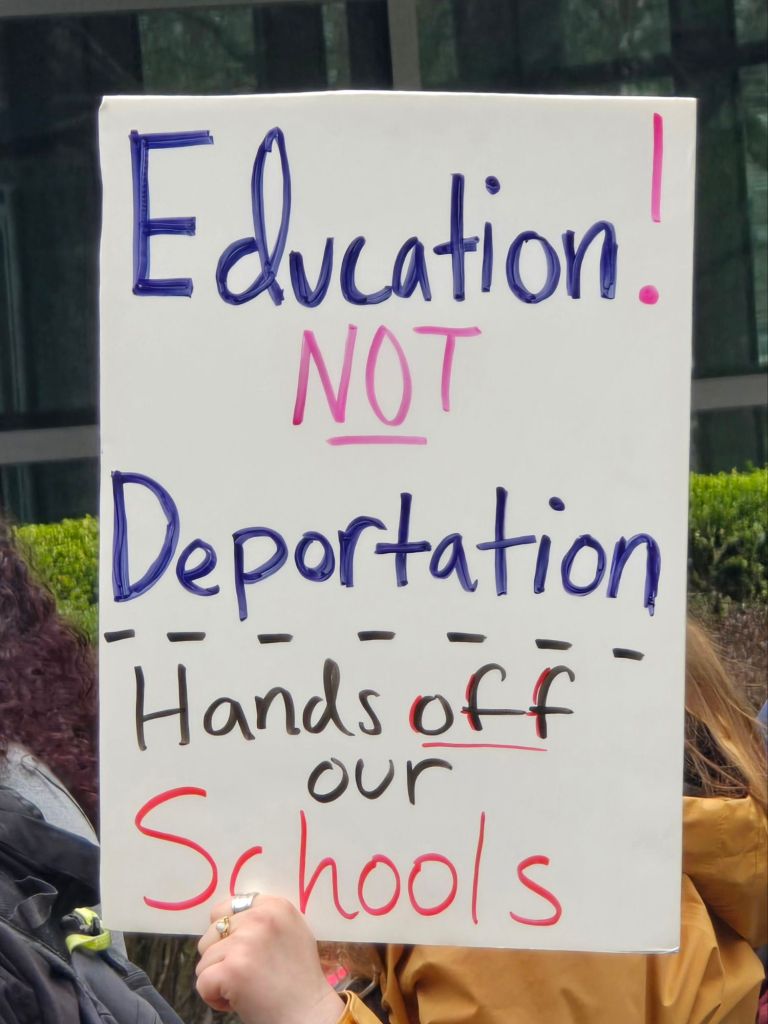
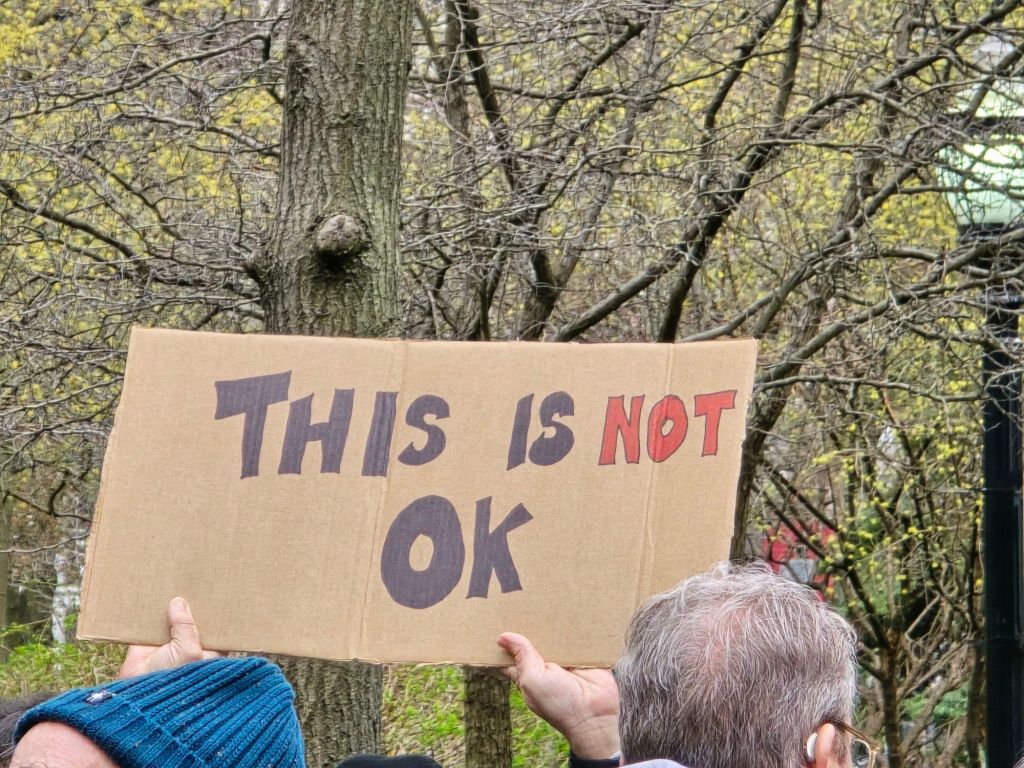
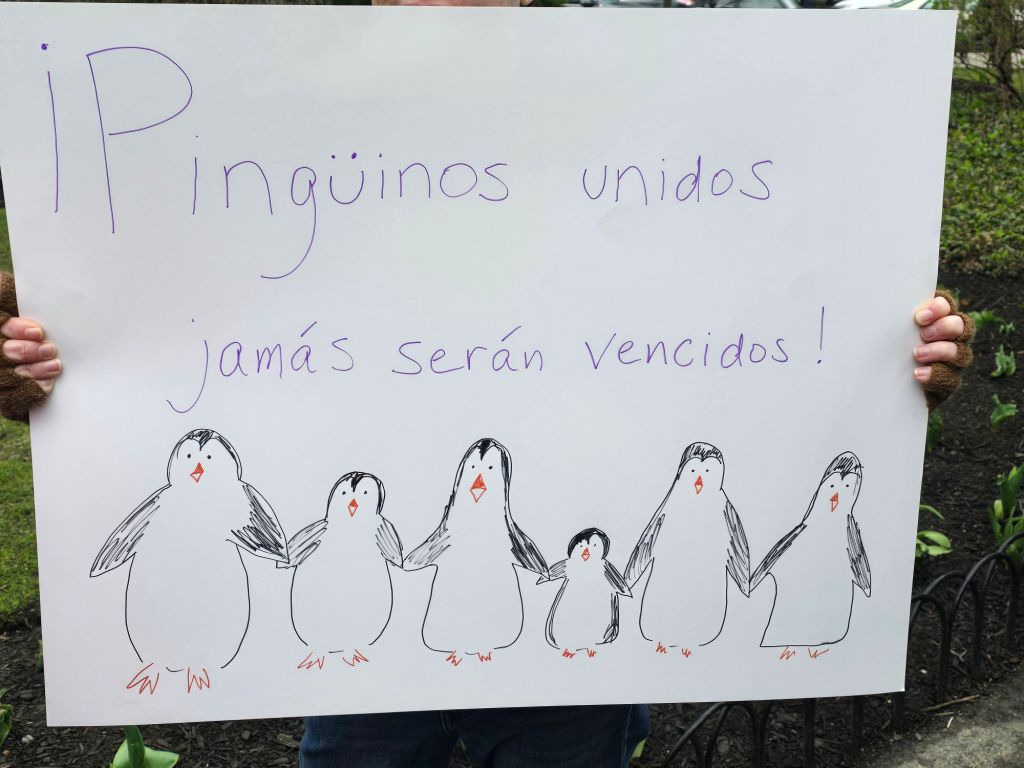
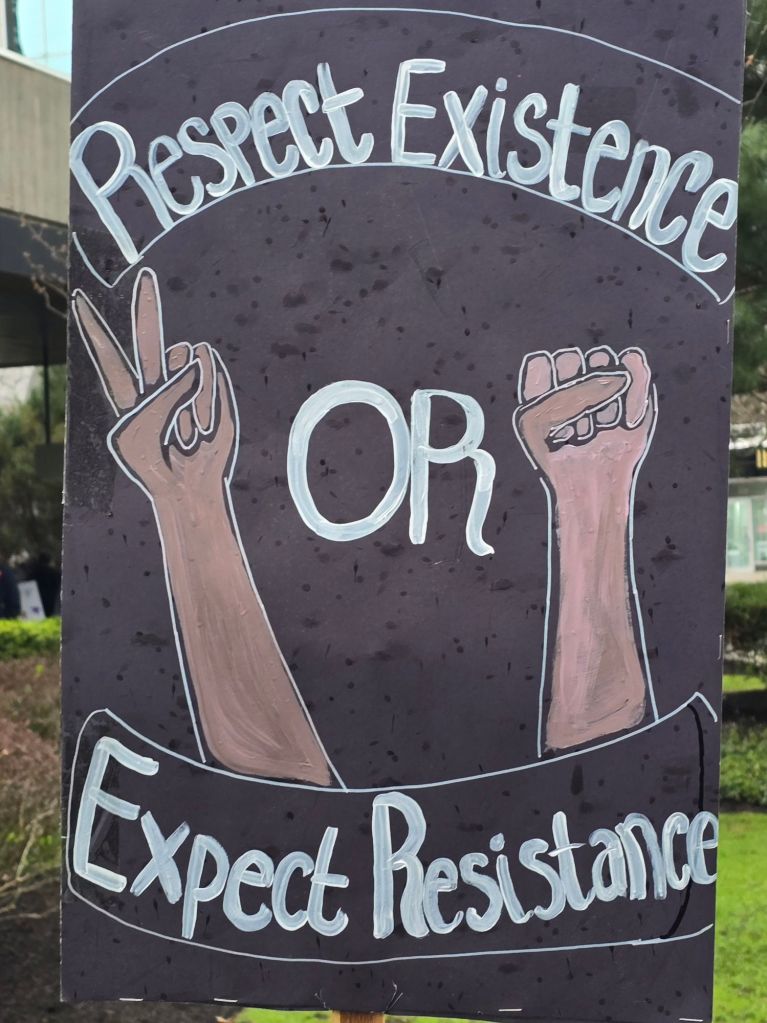
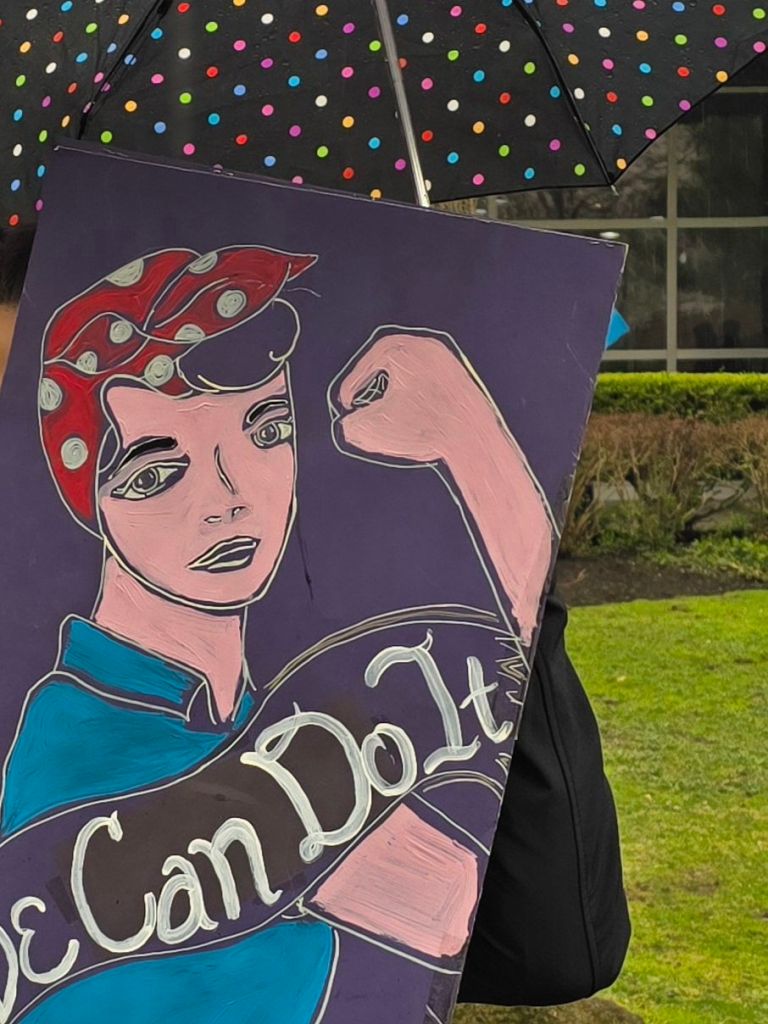
Speaking of signs … such creativity! Careful thought and consideration clearly went into these signs, messages of extreme concern for things we have been used to taking for granted like due process, libraries, and social security. There was a laundry list, but that is only because everything that serves the common good seems to be on the chopping block under the current regime. And yes, it feels more like a regime than an administration, if I am honest, just three months in.
A personal observation. This was not my first protest. I always come with my id and a form of payment just in case my right to protest is challenged by law enforcement or things go south. However, this was the first time that I decided it was prudent to bring my Global Entry card, which is government issued ID that declares my US citizenship. I am a US born white woman, yet current events led me to this precaution in these extraordinary times when our human and civil rights are under attack like never before in my lifetime. I will say that the Jersey City police were polite and just asked us to make sure we were not blocking pedestrian access to the PATH station.
Having been to many protests over the years, standing up for peace and justice from the Gulf War under Bush Senior to Title 42 under Biden, this moment feels different. As Senator Booker named it on the Senate floor this week, this is not a right or left moment but a right and wrong moment. The general vibe of today carried a particular unifying ethos and for lack of a better word, simply felt different, even from the President’s Day event I attended earlier this year. This morning’s energy was a mix of joy and anger. It felt like a community, people showing up when a family member is sick. It felt like an all hands on deck moment. And it gave me hope. Indeed, as we chanted: The people united will never be defeated.
I find myself reminded of and praying with these words from Gaudium et Spes, the Pastoral Constitution of the Second Vatican Council:
“The joys and the hopes, the griefs and the anxieties of the people of this age, especially those who are poor or in any way afflicted, these are the joys and hopes, the griefs and anxieties of the followers of Christ. Indeed, nothing genuinely human fails to raise an echo in their hearts. .. That is why this community realizes that it is truly linked with humankind and its history by the deepest of bonds.”
May we, people of all and no faiths, be bound together in hope and loving action for all that is good. May we resist joyfully. Amen
I am feeling the call to write more during this time in history. Starting today I am going to be sharing excerpts from my Master Thesis for my Moral Theology degree (from Catholic Theological Union), in which I developed an ethic of resistance. I will publish this as a series. My original application was to the social sin of human trafficking, but you will see as this series moves forward that I looked at other examples and responses by ordinary Christians to extreme social sin, such as the death-dealing reality of the Nazi Holocaust. The identity and worldview of these resisters led them to counter dehumanization through acts of resistance, often at great personal cost. Their witness offers ordinary persons seeking to resist social sin today a model and path to follow in our times. Who knew that just one decade later I would be mining my own research for practical applications in our country?
First, a few introductory words about how I understand resistance as an ethical framework.
Resistance can be understood as “standing fast to a position or principle.” Margaret Collins Weitz derives this understanding from the Latin roots of the word for resistance, resistere. The prefix re intensifies the stronger form of the verb stare, to stand. In this light, resistance involves an “inner certainty … allied with a strong sense of conscience and belief in human dignity.” (Weitz, 33-34)
So as we navigate these days, let us hold fast to that which we know to be true: we are good. God is good. And our job is to promote good for others and, indeed, all of God’s creation. It’s that simple. We have to keep it simple so as to stay the course in the face of misinformation, deception, disconnection, globalized indifference, and the normalization of extreme social sin. And with that, episode one.
Episode 1: Resistance in the Christian Tradition
The Christian tradition of resistance of course begins with the person of Jesus. “The practice of resistance in the life of Jesus is where Christians must begin for understanding how to resist evil.” (DeYoung, 6) Curtiss Paul DeYoung identifies three key modes of resistance practiced by Jesus in the Gospels. First, Jesus “resisted the popular notion of who was ‘worthy’ of relationship by developing friendships with persons at the margins of society in his day—women, tax collectors, Samaritans, militant activists, people with disabilities, poor people, and working people.” (DeYoung, 6) In other words, Jesus resisted social norms of exclusion in his own personal sphere by “creating a wide web of relationships” around himself. (DeYoung, 6-7) Second, Jesus “resisted stereotypes and transformed cultural images in his day by injecting into popular culture positive descriptions of Samaritans and women.” (DeYoung, 11) Third, Jesus resisted through public protest, such as the incident against the money changers in the temple. “This demand for equal access to the central institution of religion and community governance was so significant and memorable that it is included by all of the Gospel writers.” (DeYoung, 12)
Another Gospel passage directly related to resistance is the Sermon on the Mount, in particular Matthew 5:39a: “ But I say to you, offer no resistance to one who is evil” (NAB). Johannes Nissen notes that this passage is traditionally understood as advocating “non-resistance to evil.” (Nissen, 184). It is potentially problematic because, as Walter Wink observes, “if Jesus commands us not to resist, then the only other choice would appear to be passivity, complicity in our own oppression, surrender.” (Wink, 184)
However, Wink asserts that the Greek word used in Matthew, antisēnai, does not merely mean “resist” or “stand against,” but rather to “resist violently, to revolt or rebel, to engage in an insurrection.” In other words, the message of Jesus to his followers is not to “mirror evil” with evil. Wink concludes that the “logic of the text” points neither to passivity nor violent resistance, but instead to finding “a third way, a way that is neither submission nor assault, neither fight nor flight, a way that can secure your human dignity and begin to change the power equation.” (Wink, 184-185)
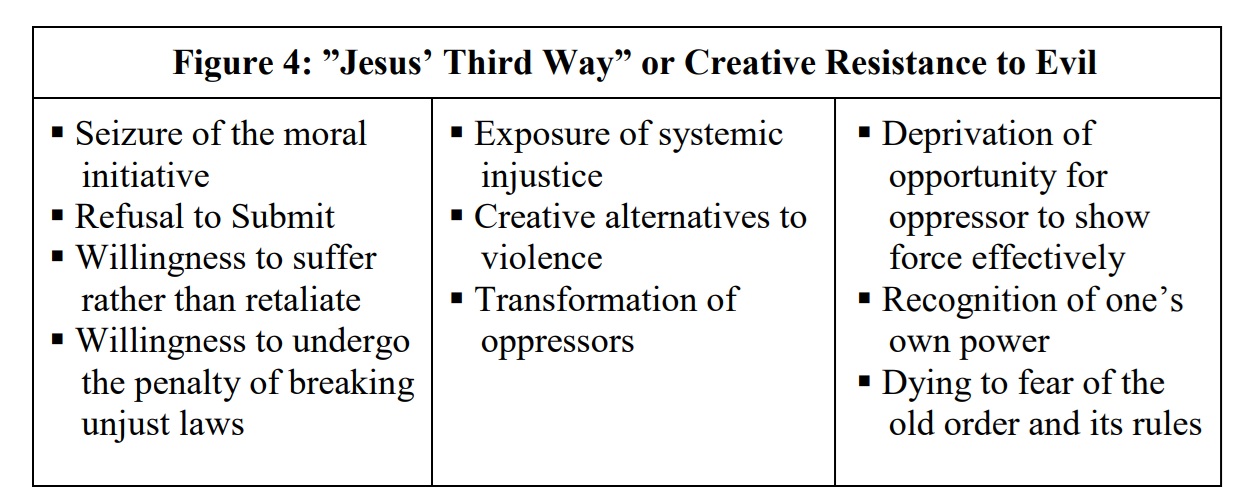
The actions suggested by Jesus in the passages following this admonition against resisting evildoers—to turn the other cheek, give away one’s cloak, walk a second mile, and give to those who borrow (Matthew 5: 39b-41)—are “not rules to be followed legalistically, but examples to spark an infinite variety of creative response in new and changed circumstances.” (Wink, 185) Inspired by these examples, Wink suggests creative alternatives for the Christian choosing to follow Jesus’ third way of resisting evil (see Figure 4). (Wink, 186-187)
In choosing creative resistance, followers of Jesus seek to deny, defuse, and defeat the dehumanizing tactics of oppressors.
Christian resistance to evil has always been played out within a social context, as Christians have navigated relationships with the state, society, and economy in light of the Gospel and the reality of evil. “Resistance is the process of drawing attention to evil and injustice while pressuring the powers that be to pursue positive social change.” (DeYoung, 16)
From its very beginnings as a “tiny, fragile organization,” the Christian Church faced state sponsored discrimination. Søren Dosenrode observes that, from this minority position, “Christians rendered passive resistance to the state as no other real alternative remained.” Martyrdom was often the result of such resistance. (Dosenrode, 11-12) In their daily lives, early Christians resisted poverty and economic oppression by “creating a countercultural community that practiced its own economy of grace,” such as that depicted in Acts 4: 32-37. (Long, xxi-iii) It was not until the legalization of Christianity in 313, and the evolving close relationship between church and state when Christianity became the official religion of the Roman Empire, that resistance became a serious question for Christians. (Donsenrode, 11-12)
One early model for Christian resistance is St. Maximus the Confessor (580-662 CE). His Four Centuries on Love is cited by Charles C. McCarthy as containing the core of his teaching on resistance, centered on the example of Jesus and the primacy of love. (McCarthy, 77) “The one who loves Christ thoroughly imitates him as much as he can.” (Maximus, 81) Maximus taught that in the struggle against evil, the “microcosmic deed of love is all that humanity has to work with,” and indeed, all it needs. (McCarthy, 82)
Maximus lived out this teaching on resistance in his own life. He stood fast against monothelitism, the “theology that Christ was not as the Council of Chalcedon had stated, ‘true God and true man,’ but, in fact, had one will (divine), not a human will and a divine will.” 1 (McCarthy, 84). His belief in the doctrine that Christ had two wills led him to resist both civil and ecclesial authorities who supported monothelitism; he “suffered imprisonment and torture for this stand.” (McCarthy, 78) Maximus was later exiled to Lazica where he died in 662 CE. (McCarthy, 65)
For Thomas Merton, a Trappist monk who contemplated the spirituality of resistance, Maximus is a model of what is possible for human persons facing evil. Maximus “portrays nonviolent resistance under suffering and persecution as the normal way of the Christian.” Countering those who dismiss resistance as impractical or impossible, Merton holds up Maximus as one who believed that Jesus “does not command the impossible, but clearly what is possible.” Furthermore, for Maximus, Gospel resistance, modeled on the way Jesus actually resisted evil, should be “aimed not at the evildoer but at evil as its source.” 2 (Merton, 176)
Notwithstanding early models of Christian nonviolent resistance such as Maximus, in practice the ongoing marriage between church and state led to a mixed assessment of resistance. Dosenrode observes that in the Middle Ages, certain forms of passive resistance were “known and accepted as common law,” such as refusing to pay taxes, provided they were proportional. More active forms of resistance were also carefully assessed by theologians and Church authorities. For example, tyrannicide was accepted as a last resort by Thomas Aquinas, “provided that it was rooted in a higher power than an individual’s idea.” At the Council of Constance (1414-1418), however, the Catholic Church condemned tyrannicide outright as contrary to the moral life. Protestant and Reformed churches “became more open to resistance to defend the true faith” during the Reformation, while the Catholic Church held close to its condemnation. By the twentieth century, the doctrine of resistance in the Catholic, Reformed, and Protestant churches was one of “restraint in the use of power” and support of the state and status quo. (Dosenrode, 13-14, 17) The experience of the Nazi holocaust called this stance into question.
1 The Third Council of Constantople declared monothelitism as a heresy in 681 CE.
2 Emphasis in the original text.
Sources:
Curtiss Paul DeYoung, “From Resistance to Reconciliation: The Means and Goal of Christian Resistance,” in Resist! Christian Dissent for the 21st Century, ed. Michael. G. Long (Maryknoll, NY: Orbis Books, 2008)
Søren Dosnerode, ed., Christianity and Resistance in the 20th Century: From Kaj Munk to Dietrich Bonhoeffer to Desmond Tutu (Boston: Brill, 2009)
Michael G. Long, ed, Resist! Christian Dissent for the 21st Century (Maryknoll, NY: Orbis Books, 2008)
Maximus the Confessor, Maximus the Confessor: Selected Writings, trans. George C. Berthold (New York: Paulist Press, 1985),
Charles C. McCarthy, “Maximus the Confessor (580-662),” in Non-Violence—Central to Christian Spirituality: Perspectives from Scripture to the Present, ed. Joseph T. Culliton (New York: The Edwin Mellen Press, 1982),
Johannes Nissen, “Between Conformity and Nonconformity: The Issue of Non-Violent Resistance in Early Christianity and its Relevance Today,” in Christianity and Resistance in the 20th Century: From Kaj Munk and Dietrich Bonhoeffer to Desmond Tutu, ed. Søren Dosenrode (Boston: Brill, 2009)
Margaret Collins Weitz, “Resistance: A Matter of Conscience,” in Resisters, Rescuers, and Refugees: Historical and Ethical Issues, ed. John J. Michalczyk (Kansas City: Sheed & Ward, 1997)
Walter Wink, Engaging the Powers: Discernment and Resistance in a World of Domination (Minneapolis: Fortress Press, 1992)
Excerpt from: “Human Trafficking as Social Sin: An Ethic of Resistance,” by Susan Rose Francois, CSJP. Submitted to the Faculty of The Catholic Theological Union at Chicago in partial fulfillment of the requirement for the degree of Masters of Arts in Theology, March 2015.
One word keeps coming to me in my prayer these first days of Lent in 2022: Love.
In our first reading today from Leviticus we hear the great commandment, “You shall love your neighbor as yourself.”
I have long wondered if the greatest crisis in our world today isn’t that we don’t realize how much we are, each of us, worthy of love. We are all God’s own beloved. God loved us into being. God calls us to love one another as God has loved us.
This morning I prayed with a booklet created several years ago by a group in my religious Congregation focused on growing in nonviolence. Each week the booklet explores Lent with the Principles of Nonviolence. The principle for the first week of Lent is: Nonviolence chooses love instead of hate.
Our founder Margaret Anna Cusack wrote in 1874: “Force was no longer to be the rule, except, indeed, the force of love.”
In 2020 Philadelphia singer songwriter Joy Ike released a song called “Wearing Love.” It is a song I return to again and again to reground myself on this journey. (It is also good to dance to.)
Slow your breathing No more scheming Quit competing Just love
And everyone will wonder You did not go under You were undercover Wearing love
Keep your words They won’t fix anything All that works is the love that you bring
This Lent, and beyond, may I find my ground and center in God’s unconditional love. May I bring the force of that love into my actions and relationships. May I wear love always. Just love.
I found myself at the airport very early this morning, as my friend Sarah says before God was awake.
It was quiet as I went through security, so as I put my bags on the xray belt I heard a TSA agent, apparently originally from Poland, tell a coworker that she needs to get her family Polish passports because under Trump it will get harder to travel on an American passport.
As I sat having a cup of coffee to wake up, I heard two young business folks talking about the appointments of Trump and debating whether his actions and cabinet appointments would be good for business or hurt the economy and people who won’t realize what is happening until it is too late.
We are a preoccupied nation. We are rumbling and concerned, no matter what side of the spectrum we are on. Many of those who voted for President Trump were motivated by their own rumblings and concerns about being left behind. Many who did not vote for him now find themselves alert to what devastation may come as a result of his policies.
What to do with all this agitated energy? I highly recommend reading this article where Tich Naht Han and other zen masters give advice on coping with Trump.
Brothet Phap Dung points to the Buddhist teaching of interdependence: that people we perceive as our greatest enemies can be our greatest teachers, because they show aspects of ourselves that we find unpalatable and give us the chance to heal.
“We have the wrong perception that we are separate from the other,” he said. “So in a way Trump is a product of a certain way of being in this world so it is very easy to have him as a scapegoat. But if we look closely, we have elements of Trump in us and it is helpful to have time to reflect on that.”
Today’s Gospel from Matthew is certainly timely (Matt 5:38-48).
Go read it.
Love your enemies. Resist evil itself, not evildoers. The way of Jesus is not easy my friends, but it is transformative. It can transform our own hearts, our web of relationships, and our world.
The first reading from Levitivus is also challenging and timely (Lev 19: 1-2, 17-18).
“Though you may have to reprove your fellow citizen, do not incur sin because of him. Take no revenge and cherish no grudge against any of your people. You shall love your neighbor as yourself.”
When I was studying theological ethics at Catholic Theological Union in Chicago, one of my main research areas was the ethics and spirituality of Christian nonviolent resistance.
Resistance of course now is a trending hashtag on Twitter. I was invited to share some of my thoughts and research about the urgent need for an ethic of resistance grounded in relationship in a guest blog post for NETWORK Lobby (the folks behind Nuns on the Bus).
Whatever comes next, it is crucial that we develop an ethic of resistance that is grounded in human dignity and right relationship. Otherwise, we face the danger of recreating and repeating negative cycles of violent and dehumanizing language and actions. …
In fact, we would all do well to read up on the history of resistance to social sin. Resistance is not futile, but neither is it easy. The Christian tradition of resistance begins with Jesus, and think of where his path of resistance led. Jesus resisted dehumanizing social norms, created a wide web of relationship, and engaged in liberating action for the oppressed. In the centuries since, Christians have followed in his footsteps and resisted social sin and injustice.
Today is the feast day of Franz Jägerstätter who was beatified by the Catholic Church in 2007. I learned a bit about his life, witness, and sacrifice for peace during my graduate studies as part of my research into nonviolent resistance. Here is an excerpt of a paper I wrote about nonviolent resistance to the Holocaust:
Although one might consider his 2007 beatification to have shifted his “ordinary” status, Franz Jägerstätter lived a rather ordinary and simple life. His primary occupations were husband, father, and farmer. His marriage to Franziska, a very devout Christian, was happy and deepened his own commitment to his Catholic faith. He was a volunteer parish sacristan and later became a lay tertiary Franciscan. Equipped with only a seventh-grade education, he was nevertheless widely read—periodicals, devotionals, papal encyclicals, lives of the saints, and scripture.
Jägerstätter had a vivid dream in 1938, two months prior to the arrival of Hitler’s army in his native Austria. It was a dream upon which he later reflected and acted.
“Suddenly, I saw a beautiful train, which was going around a mountain. Grown-ups and children were streaming toward it and could hardly be held back. I would rather not say how few adults did not get on the train. Then suddenly a voice said to me: ‘This train is going to Hell’ … And now I realize that it embodies National Socialism, as it descends upon us with all its many organizations.”
“From the very beginning,” notes his biographer Erna Putz, Jägerstätter “refused all cooperation” with the Nazi regime, even refusing government payments for raising children or crop damage. He was the only person in his village to vote “No” to the April 1938 German annexation of Austria, even though the annexation vote had been endorsed by Austrian Cardinal Innitzer. Conscription soon became the fate of able bodied Austrian men, now German citizens.
Jägerstätter was no exception. He received six months of army training in 1941, during which time he realized that he could not in good conscience serve in the Nazi military. As a devout Catholic, he discussed his decision with his priest, who told him in confession that such a decision would be akin to suicide, and even with his local Bishop, who advised him to think of his duty to his family. His resolve was unchanged. He wrote: “Does it still bear witness to Christian love of the neighbor if I commit an act, which I truly regard as evil and very unjust, and yet I continue to commit the act because otherwise I would suffer either physical or economic harm?”
When Jägerstätter was called to active duty in 1943, he declared his refusal to participate. He was beheaded on August 9, 1943. Faced with evil, and commanded to participate in that evil, he responded by seizing the moral initiative, refusing to submit, and being willing both to suffer rather than retaliate and to undergo the penalty of breaking an unjust law.
Periodically on Fridays I will share some words of wisdom from the founder of the Sisters of St. Joseph of Peace. Known in religion as Mother Francis Clare, Margaret Anna Cusack was a prolific writer in her day. Happily, thanks to public domain and the many internet book projects, much of her writing is now available online. She was a woman of her time and yet, ahead of her time in many ways. In this quote, for example, she writes about what we would today call nonviolent communication.
We are too apt to think because speech is momentary, that it is therefore insignificant; and there are not a few who excuse themselves for offending others causelessly and grievously on the plea that they have only said a few words, or that they did not mean all they said. But in truth, words are exterior signs of what passes in our hearts; and whatever our manner of speech may be, it indicates that which is within, that which is real, that which is, as a rule, under our own control, else there were no such thing as human responsibility, and, as a necessary consequence, no ground for the eternal judgment. – M.F. Cusack, Book of the Blessed Ones, 1874





















 Although one might consider his 2007 beatification to have shifted his “ordinary” status, Franz Jägerstätter lived a rather ordinary and simple life. His primary occupations were husband, father, and farmer. His marriage to Franziska, a very devout Christian, was happy and deepened his own commitment to his Catholic faith. He was a volunteer parish sacristan and later became a lay tertiary Franciscan. Equipped with only a seventh-grade education, he was nevertheless widely read—periodicals, devotionals, papal encyclicals, lives of the saints, and scripture.
 At the Corner of Susan and St. Joseph