
Category Archives: media

Founders and the Hierarchy

Last night I celebrated International Women’s Day and the start of Catholic Sisters Week by seeing the new film, Cabrini, in the theaters with two of my CSJP sisters. It was very well done and inspiring to see the story of such a courageous woman of faith on the big screen.

I was particularly interested because some of the characters in Mother Francis Xavier Cabrini’s story are also characters in the story of Mother Francis Clare (Margaret Anna Cusack), the founder of the Sisters of St. Joseph of Peace.

Mother Clare, Mother Cabrini, Pope Leo XIII, Archbishop Corrigan

Mother Cabrini was dogged in her petition to the Vatican to found an international women’s missionary order. She asked Pope Leo XIII for permission to start in China. He asked her to go to New York to serve Italian immigrants.

I was enthralled to see the depiction of their meeting portrayed, because Mother Clare also went to Rome with a petition to found a new order. From a letter she wrote to the sisters in May 1884:

My own darling Children, I have just returned from my audience, & such a happy audience-only funny being all alone with the Pope! … Fancy the Pope held my hands in his all the time I was talking to him- oh when I tell you all he said how rejoiced you will be my own children please God soon we shall meet. Your own fond mother. M.F.C.

I was less enthralled but rather curious to see how Mother Cabrini got along with the Archbishop of New York. You see, we are in New Jersey because while the German American Bishop Wigger welcomed our ministry to  Irish immigrant women, on the other side of the Hudson the Irish American Archbishop Corrigan refused to even meet with Mother Clare, let alone approve of her mission in his diocese.

This was a few years before he met Mother Cabrini. Watching his political maneuvers and attitude toward a woman seeking to bring the mission of Jesus to meet the signs of the times gave some color to our own founding story and the challenges Mother Clare faced.

To my knowledge, Mother Clare and Mother Cabrini did not know each other. Yet they were of a similar heart and mind. Both women suffered from physical ailments. Both women were on fire with the love of God and God’s people in need. And both women were well versed in navigating the hierarchy of the church to try to meet that need.

In the end of course, their paths differed. Mother Cabrini is now venerated as a Saint in the church.  Mother Clare, personally defeated by the negative campaign of Archbishop Corrigan against her, which eventually led to Bishop Wigger siding with his Irish American brother Bishops and her decision to leave the order in able to save the mission.

May we like Mother Clare and Mother Cabrini read the signs of the time and put the mission first today.

A story of resistance: White Rose Society

Last night, I saw White Rose The Musical, a new off-Broadway production. I was intrigued to see how this story of resistance to the Nazi regime by ordinary Germans would be portrayed on stage, in particular in musical form.  I enjoyed the production. Most critically, it expressed the importance of doing something in the face of evil, holding fast to what matters, and staying with the questions in messy times. Overall it was hopeful, something we need these days in the face of rising fascism and threats to democracy.

One reason I travelled across the Hudson last night to see the musical was this … My research topic for my MA Ethics thesis at Catholic Theological Union was the ethics of resistance. The students of the White Rose Society were one of the case studies I explored.

During WWII, a group of college students came together in Munich to resist what they knew in their core to be wrong, using the written word to encourage resistance to the Nazi regime among ordinary Germans by speaking plainly about the evil being perpetrated in their name. In six strongly worded leaflets, they sought to raise consciousness and conscience.

“Why do the German people behave so apathetically in the face of all these abominable crimes, crimes so unworthy of the human race? … For through his apathetic behavior he gives these evil men the opportunity to act as they do; he tolerates this ‘government’ which has taken upon itself such an infinitely great burden of guilt; indeed, he himself is to blame for the fact that it came about at all! Each man wants to be exonerated of a guilt of this kind, each one continues on his way with the most placid, the calmest conscience. But he cannot be exonerated; he is guilty, guilty, guilty!”

This second leaflet was written and distributed in 1942, shortly after the Wansee Conference and implementation of the “final solution.” The first four flyers were produced in the summer of 1942. The students suspended leafleting in late 1942, when three members, all medical students—Hans Scholl, Alexander Schmorell, and Willi Graf—were drafted to medical service on the Russian front. The students wrote the final two leaflets upon their return in early 1943.

The leaflets were distributed throughout Germany by post, apparently inspired by a mimeographed sermon by Catholic Bishop Clement von Galen, condemning the Nazi euthanasia of disabled persons, which was widely distributed in this fashion. Upon receiving a copy of the sermon in the mail, Hans Scholl is reported to have said: “Finally someone has the courage to speak, and all you need is a duplication machine.”  

It was the choice of Hans Scholl and his sister Sophie Scholl to distribute copies of the sixth leaflet in person at the University of Munich that led to their arrest on February 18, 1943. While students and faculty were in class, the siblings placed copies on steps, windowsills, and ledges, throwing the last leaflets over a balcony. They were arrested.  Four days later the two siblings and another student, Christopher Probst, were sentenced with high treason and executed. Other White Rose members were executed in later months.   Due to their arrest and execution, the students were unable to keep an appointment they had scheduled for February 25th—with Dietrich Bonhoeffer—to discuss plans for a network of student resistance groups.

Inge Scholl, sister of Hans and Sophie, later observed: “They stood up for a simple matter, an elementary principle: the right of the individual to choose his manner of life and to live in freedom.” As a group, their motivations were of course varied. Some, such as Willi Graf, were deeply motivated by the central Christian theme of love of neighbor. Graf and the other two students sent to the Russian front were certainly motivated by personally witnessing horrific violence and dehumanization of the Jewish people in concentration camps.  

Sophie and Hans Scholl were influenced by their devout Lutheran upbringing in a home where Scripture was central and current issues of justice and pacifism were engaged at the kitchen table.  Sophie’s own diary indicates she was motivated by her faith: “My God … Oh, how far from you I am, and the best thing about me is the pain I feel on that account. But I’m often so torpid and apathetic. Help me to be singlehearted and remain with me.”  

Guided by individual motivations, the White Rose Society creatively and collectively responded both to evil and bystanders. They exposed the injustice of the system. They found a creative alternative to violence. Finally, they sought the transformation of an oppressive regime and the German people, whose apathy gave the Nazi regime power and opportunity.

Sources:

Kidder, Annemarie S. Ultimate Price: Testimonies of Christians Who Resisted the Third Reich.  Maryknoll, NY: Orbis Books, 2012.

Michalczyk, John J. and Franz J. Müller. “The White Rose Student Movement in Germany: It’s History and Relevance Today.” In Resisters, Rescuers, and Refugees: Historical and Ethical Issues, ed. John J. Michalczyk, 49-57. Kansas City: Sheed & Ward, 1997.

White Rose Society Leaflets. http://www.whiterosesociety.org/WRS_pamphlets_home.html

From Toxicity to Kindness

The 2018 Oxford Dictionary Word of the Year was announced and it is, you guessed it, toxic.

Not a new word, but a word with a whole new embodiment of meaning. “The Oxford Word of the Year is a word or expression that is judged to reflect the ethos, mood, or preoccupations of the passing year, and have lasting potential as a term of cultural significance. Our data shows that, along with a 45% rise in the number of times it has been looked up on oxforddictionaries.com, over the last year the word toxic has been used in an array of contexts, both in its literal and more metaphorical senses.”

Among the top collocates to toxic in 2018 … toxic masculinity, toxic relationship, toxic culture. As I said in a recent interview, “We all know that toxicity is not good for us.” And yet it spreads, oozing out and choking our happiness like the fog of a group of looming dementors.

But we have a choice my friends. We can be kind, in our relationships, our words, our interactions, our ways of living. Every moment presents a choice. Let’s choose to be kind! Our very democracy and social fabric may depend upon our choices.

Sounds simple, but sometimes the most answers to the most complicated problems are the kind ones.

Resistance to Human Trafficking: Sojourner’s Article

Last month I finished the work on my 122 page thesis for my Masters of Arts of Theology at Catholic Theological Union. The title of my thesis is “Human Trafficking as Social Sin: An Ethic of Resistance.” It was a wonderful opportunity to apply what I had learned in my studies of theological ethics to one of the most important issues of our time. I was also able to draw upon my ministry experiences with survivors of human trafficking and in human trafficking education and advocacy.

sojournerstraffickingseries

This month I was invited to write an article for the Sojourner’s Website for their special series on human trafficking, “Breaking Chains, Raising Voices.”  I took it as an opportunity to condense the main points of my thesis into an 800 word column, “Resistance. Lamentation. Action.”

Resistance might not be the word that comes to mind in response to human trafficking. Most often people speak of “combatting” or “fighting” human trafficking, particularly when it is approached as a crime. But when we consider human trafficking as social sin, one in which ordinary persons are complicit and connected, even if inadvertently, then resistance emerges as an appropriate moral response.

Head over to Sojourner’s to read the whole thing.

Media Moments and Communication for Mission in the 21st Century

I’ve found myself thinking more than once of late what the founder of my religious community, Margaret Anna Cusack (known in religion as Mother Francis Clare) would have been able to do in the Internet age.

She was a prolific writer in her time and used the power of the written word astutely to spread the Gospel, challenge unjust structures, and advocate for people who were poor.  She wrote letters, letters to the editor, and many, many books. By 1870, more than 200,000 copies of her works (most published under the names M.F. Cusack or Mary Francis Cusack) had circulated throughout the world. Profits from the sale of her books were used for the Sisters’ work with the poor.

In one of her autobiographies, she tells the story of her audience with Pope Leo XIII, when she was seeking approval for our new congregation, the Sisters of St. Joseph of Peace.

“My audience was entirely private … Mgr. Macchi brought in the whole set of my books to his holiness, who looked at them, I think somewhat surprised at the number. Some of them were duplicated, having been translated into German, French, and Italian. …  His holiness specially commended the plan of my new order, and encouraged me in every way to continue writing. He gave his blessing to all the sisters present and to come, and to all those who would contribute to my work.”

Our original 1884 Constitutions, written by Mother Francis Clare, described our mission as being “to promote the peace of the Church both by word and work. The very name Sisters of Peace will, it is hoped, inspire the desire of peace and a love for it.” Word and work. I love that!

I can’t help but think that if she lived in today’s era of social networking, Mother Francis Clare would be tweeting for peace, spreading the good news of the Gospel and be on the forefront of the new evangelization. When our new community Twitter account (@SistersofPeace) went live earlier this year , I imagined her smiling in heaven at this new endeavor by her daughters in the 21st Century.

Because most of her books are in the public domain with the passage of time, she actually has quite an internet presence herself. You can read many of her works for free online, from histories of Ireland to lives of the saints to social reform. One of my personal favorite’s is her 1874 work, Women’s Work in Modern Society. Another one which is quite appropriate for this liturgical season is her 1866 book, Meditations for Advent and Easter. I use that one quite a bit for prayer this time of year!

As someone who has been growing into her own identity as both a Catholic Sister and a writer, I find great inspiration in Mother Francis Clare. This month marks ten years that I’ve been blogging my journey into religious life and experience as a Sister of St. Joseph of Peace, first at Musings of a Discerning Woman and now here.  It’s also why I jumped at the opportunity to be a regular columnist on the Global Sisters Report. I am very grateful for the gift of writing, and I feel called to share that gift in the hopes that my words can touch hearts and minds in service of the Gospel.

I firmly believe that the Holy Spirit can work through any medium, even the Internet! Actually, I first discovered my religious community online when I was discerning religious life. That’s also why I’ve decided to join a group of younger Catholic Sisters in live tweeting during episodes of Lifetime’s new “reality” show The Sisterhood: Becoming NunsIt’s actually been a fun experience, offering some of my own experience and “#realnun facts” as I watch the show. (You can join the conversation at #TheSisterhood.)

A younger Catholic Sister friend alerted me today that the folks over at the Huffington Post have noticed our live tweeting of the show.

“Social media savvy sisters have been doggedly following — and even live-tweeting — the show. They’ve been paying close attention to any potential misrepresentations, while remaining excited that the topic of religious vocation is getting national attention.”

I appreciated that description, because I think it aptly describes the spirit we’ve tried to embody as we’ve been live tweeting the show. Again, the Holy Spirit can work with anything! Even reality TV and Twitter!

It’s a far cry from Mother Francis Clare’s in person discussion of her writings with Pope Leo XIII, often considered the founder of Catholic Social Teaching. But nonetheless, I feel it is important to be part of the discussion where people are.

And, ok, I’ll admit it …. it’s kind of cool that the Huffington Post article includes a screen shot of one of my live tweets from last week’s show!

screenshot of my one of my live tweet's from last week's episode highlighted in HuffPo article
screenshot of my one of my live tweet’s from last week’s episode highlighted in HuffPo article

In the end, I have to think that Mother Francis Clare would use the media of the day to communicate for mission. Would she be on twitter, blogging, and on instagram? I have to think the answer would be yes!

By the way, be sure to check twitter when #callthemidwife returns to PBS …. a group of us have been live tweeting that as well!

“Reality” and Discernment – Thoughts on “The Sisterhood”

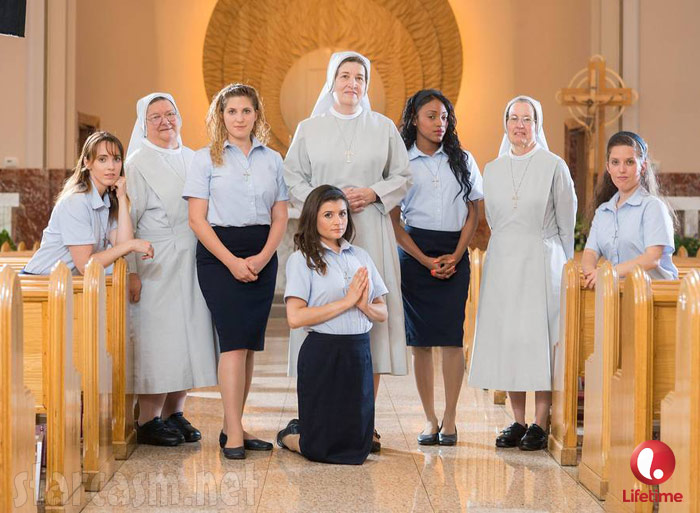
The_Sisterhood_Lifetime_convent_reality_showOk, I’ll admit it … on more than one occasion during the early stages of my religious formation I found myself thinking, this would make for good reality tv. I was living in the alternate reality of a formation house with two other novices, my novice director and a professed sister. We’d all left the lives we were living to form a community together. In the midst of our formation classes and opportunities for ministry, prayer, and discernment, we also had to negotiate the kitchen, sharing common space, and simply learning how to be together.  That line from MTV’s Real World would periodically go through my head: “This is the true story of five strangers picked to live in a house, work together and have their lives taped, to find out what happens when people stop being polite and start getting real.”  Thankfully, there were NO cameras (although I did of course blog the experience myself).

Reality tv is all about “drama” (in quotations because really, how much of reality tv is actually real?) and if anything is dramatic, discerning a major life choice like joining a religious community and professing the vows of poverty, chastity, and obedience to God for life is certainly dramatic. Then there’s just the daily drama of transition, change, and gradual incorporation into religious life. Add in cultural dynamics, generation gaps, and the fact that you’re talking about actual human beings who have a tendency to be human and, well, there were moments that might make for entertaining television.

So, it’s not really a surprise that someone else not only thought about the idea but managed to bring some version of it to television. Despite the subtitle, as far as I understand, Lifetime’s The Sisterhood: Becoming Nunswhich premieres tonight, is not actually about women in religious formation as Sisters. Instead, it follows a group of twenty-something young women who might possibly be interested in religious life as they visit three convents to meet the Sisters and learn more about what it would be like to be a Sister. I suppose it’s more like a prospective student’s college tour where you stay on campus, eat in the dining hall, and go to class. Except that there are cameras and it is scripted into hour long episodes to be broadcast on national television.

My Catholic social media feeds are all abuzz about the show. Some are concerned that it only shows religious communities who wear a habit rather than those like mine who wear simple dress (as it happens, I do know that the producers reached out to a wide variety of communities so I don’t think it’s necessarily an intentional bias, but more a question of who agreed to take the risk of participating in a reality tv show). Others are concerned about the possibility of reinforcing stereotypes about nuns as being strict, austere, and living a life of sacrifice and “giving up” rather than a life of joy, love and service (much of the buzz I’ve seen so far keeps referencing scenes where the young women are told they cannot wear make up or use cell phones during their visit). And others seem to be hopeful, noting that if even one young woman who might have a vocation gives religious life some thought because of the show, then it would be a good thing. These all seem to be valid points to me.

My main caution is that even though the young women are not in formation, they are at least considering walking a very sacred and personal journey of transformation and a major life choice (unless they are actually just actresses but even then, the Holy Spirit can be sneaky so you never know). Having blogged my own way through formation, I know first hand that it is complicated and not so easy to share the call you feel in your heart or the movements of the Spirit. Then add in to the mix a third party producer who is most interested in ratings and advertising revenue, and I think you can understand my cautionary concern. Plus the producers are best known for Breaking Amish which brings a whole lot of different concerns that I will leave to your imagination.

I’ve not watched the show. I’m not sure I will watch the show, although I’m realizing I probably should, if only to see what images are being projected into popular culture about religious life. I do know that a number of younger Catholic Sister friends are planning to live tweet using the hashtags #thesisterhood and #nuntv. If I end up watching it, I might be live tweeting it myself.