Paradox of Waiting

We wait
in joyful hope.
Sometime anxious
for what might come.
Sometimes not sure of
what will be.
Sometimes not sure
we can let go.
But we are ready for
hoping for
new life, renewed love, and …

We wait for what is to come
but we already have so much.
Our hearts yearn to grow.
Our hands reach out to touch.
Our feet stand on the same ground
upon which others have walked
the walk of hope.

We wait
we long
we stretch
towards the One
who is
hope.

waiting

The real meaning of Sisterhood – Love

4churchwmnI will never forget the day when I first learned about the four American church women who were killed in El Salvador 24 years ago today. It was 1988 and I was a junior at a Catholic girls high school. One of the Sisters from the community who sponsored my high school came to our religion class to speak about her work with the people of El Salvador, which was still embroiled in a brutal and bloody civil war. She brought pictures of the children and families she accompanied and shared the story of her ministry.  She also told us the story of Sister Dorothy Kazel, OSU, lay missioner Jean Donovan, Sister Maura Clarke, MM, and Sister Ita Ford, MM who had been beaten, raped, and murdered by five members of the National Guard of El Salvador just a few years before, because of their presence and ministry to the people of that country. Their bodies were left in a shallow grave along an isolated roadside. I remember being shocked by the story. I also remember being overpowered by the realization that this Sister who was talking to us and sharing her own story also put herself at risk of a similar fate. And it became clear to me that her reason was love. Love of God and love of the people of El Salvador.

Love … that’s the real meaning of Sisterhood. Love is worth living for. Love is worth taking risks for. Love is even worth dying for. What else does the life, ministry, death, and resurrection of Jesus teach us?

In the words of Sister Ita Ford in a letter to her goddaughter, written just a few months before her murder:

I hope you come to find that which gives life a deep meaning for you…something worth living for, maybe even worth dying for…something that energizes you, enthuses you, enables you to keep moving ahead. I can’t tell you what it might be — that’s for you to find, to choose, to love. I can just encourage you to start looking, and support you in the search. Maybe this sounds weird and off-the-wall, and maybe, no one else will talk to you like this, but then, too, I’m seeing and living things that others around you aren’t… I want to say to you: don’t waste the gifts and opportunities you have to make yourself and other people happy.

Chances are, most of the people who will tune in to the second episode of the ‘reality’ show The Sisterhood tonight do not know this real life story of the power of Sisterhood.  Hopefully, however, the message still comes across that vowed religious life isn’t about giving up make up, or hiding away from the world, or fleeing the drama that comes with being human. In my experience, it’s about finding something worth living for, something that energizes you and causes you to share your God given gifts in a particular way to help address the unmet needs of the world. It’s about responding to the transformative love of God in a way that challenges, supports and transforms you as you seek to transform the world in the company of your Sisters. It’s about love.

In the words of Pope Francis in his message for the Year of Consecrated Life: “You will find life by giving life, hope by giving hope, love by giving love.”

She had the music in her

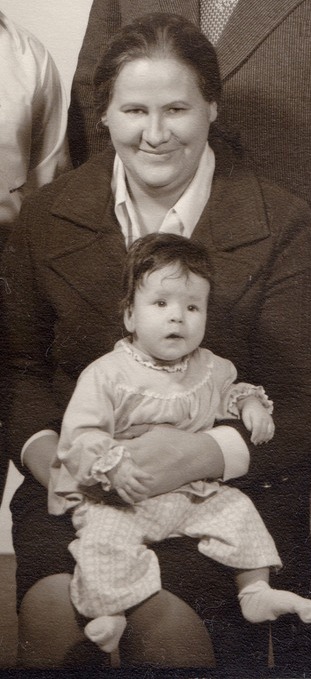
Me an Mom, circa 1973

Today would have been my mom’s 80th birthday. The title of this post comes from a song that’s been stuck in my head today as I’m remembering the gift my mom was in my life and to the world–“You Get What You Give” by the New Radicals.

You’ve got the music in you
Don’t let go
You’ve got the music in you
One dance left
This world is gonna pull through
Don’t give up
You’ve got a reason to live
Can’t forget you only get what you give

It’s a wee bit ironic, because my Mom was basically tone deaf in the musical sense. But she was very in tune with the needs of the world around her, from her own family, to her local community, to our wounded world. She was in tune with the gifts that God had given her and she shared them with a big heart and a belief that things could be better.

My mom raised five children and made it very clear to us that we are supposed to work to make the world a better place, in whatever ways we can.  She loved being a grandmother and how her own kids passed on the dream of a better world.

My mom cared for her own parents through great sacrifice. She modeled the power of presence.

My mom was an equal partner with my Dad, both at home and in the wider world where they were community builders and active participants on behalf of the common good.

My mom campaigned for justice, advocated for the needs of people who were poor, worked on Capitol Hill to help constituents access government resources, and accompanied men and women in prison so that they could rebuild their lives after their release.

It’s hard to believe that it’s been over eleven years since she died. A lot has happened in my own life since then, including the decision to become a Sister of St. Joseph of Peace. Yet I feel her presence and know that she is smiling about the many and varied ways her kids have grown, changed, and done their best to make the world a better place.

In the words of the song that’s stuck in my head as I remember her (not that she would have liked the song, especially not the few “bad” words):

“You’ll be ok follow your heart.”

A wonderful lesson that I learned from my mom’s life, witness, and love.

Pope Francis on Year of Consecrated Life: Younger religious as both present and future

YearofConsecratedLifeLargeLogoTomorrow is the first Sunday of Advent. It is also the first day of the “Year of Consecrated Life,” which Pope Francis has convened and which  finishes in February 2016.  Today, the Vatican released a message from Pope Francis to consecrated men and women on the occasion of the start of the year. It is a beautiful and challenging letter, made even more so perhaps because, as a Jesuit, he is intimately aware of the joys, challenges, and promise of vowed religious life.

In my first read of the letter, I was especially drawn to to one particular passage. Pope Francis outlines three main aims of the year: to look to the past with gratitude, to live the present with passion, and to embrace the future with hope. The passage that caught my attention is in his discussion of this third aim:

“This hope is not based on statistics or accomplishments, but on the One in whom we have put our trust (cf. 2 Tim 1:2), the One for whom ‘nothing is impossible’ (Lk 1:37).  This is the hope which does not disappoint; it is the hope which enables consecrated life to keep writing its great history well into the future.  It is to that future that we must always look, conscious that the Holy Spirit spurs us on so that he can still do great things with us.

So do not yield to the temptation to see things in terms of numbers and efficiency, and even less to trust in your own strength.  In scanning the horizons of your lives and the present moment, be watchful and alert.  Together with Benedict XVI, I urge you not to ‘join the ranks of the prophets of doom who proclaim the end or meaninglessness of the consecrated life in the Church in our day; rather, clothe yourselves in Jesus Christ and put on the armour of light – as Saint Paul urged (cf. Rom 13:11-14) – keeping awake and watchful.’  Let us constantly set out anew, with trust in the Lord.

I would especially like to say a word to those of you who are young.  You are the present, since you are already taking active part in the lives of your Institutes, offering all the freshness and generosity of your ‘yes’.  At the same time you are the future, for soon you will be called to take on roles of leadership in the life, formation, service and mission of your communities.  This Year should see you actively engaged in dialogue with the previous generation.  In fraternal communion you will be enriched by their experiences and wisdom, while at the same time inspiring them, by your own energy and enthusiasm, to recapture their original idealism.  In this way the entire community can join in finding new ways of living the Gospel and responding more effectively to the need for witness and proclamation.

Ok, if I’m honest, it was this line that really drew my attention: “soon you will be called to take on roles of leadership in the life, formation, service, and mission of your communities.” Indeed. That “future” would be in a little over one month for me, as I begin my six year term as a member of our congregation leadership team in January. As you might imagine, I step onto this path with more than a little trepidation. But that is also balanced with a lot of love for my community and belief in the future of religious life. How wonderful to have this letter to reflect on and pray with during Advent, my own time of “waiting” for this new adventure to begin.

This is an unusual time in the history of consecrated life. Granted, the history of religious life is filled with “unusual times,” from the Ammas and Abbas who sought solitude in the desert and instead formed communities, to the call of Francis to rebuild God’s church which lead to a whole new form of religious life, to the suppression of religious during the French revolution which spread religious further into the new world, to the church’s own revolution in the form of the renewal of religious life after the Second Vatican Council which we are still experiencing in echoes and reverberations.

Today’s unusual time, from my perspective as a newer and younger religious, is a precious one. As Pope Francis so beautifully puts it, this is a time for younger religious, who are both part of the present and part of the future, to be “actively engaged in dialogue with the previous generation,” to be “enriched by their experiences and wisdom, while at the same time inspiring them, by [our] own energy and enthusiasm, to recapture their original idealism.”

While there have always been multiple generations in religious life, our current demographic reality means that there are 30 to 40 decades between me and most of my mentors in religious life. That makes this time all the more precious, and makes me grateful to be actively sharing my own energy and enthusiasm at a time when I can mix and mingle that energy and enthusiasm with those who have been living religious life, in some cases, longer than I’ve been alive.  I am so very grateful for the presence, love, support, and friendship of my Sisters of all ages.

Today’s unusual time is also a critical one, for the needs of the world and for the sustainability of our way of life to be a witness to God’s love in that world.  Looking at the reality of demographics and resources and our own ability to cross the divides can make it all seem a little bit crazy. But as Pope Francis reminds us, our hope in the future is not based on statistics or accomplishments or our own abilities. It’s based on “the One for whom ‘nothing is impossible.'”

I’d like to end this post by repeating these words from Pope Francis:

“This is the hope which does not disappoint; it is the hope which enables consecrated life to keep writing its great history well into the future.”

The generations that are living religious life today all believe in that future. We are inspired by the stories that God started in our founders and that continue to be written today. We know that God is still writing that story, and lucky us, spurred on by the Holy Spirit, we have the opportunity and obligation to co-create that future full of hope for all God’s people in need. Amen.
A bit apocalyptic, but sound advice

homer_simpson_end_is_nearToday is the last day of the church year. Advent, believe it or not, starts tomorrow!  The liturgical readings the past few weeks have been, well, a bit apocalyptic, and focused on the end times. A case in point is today’s Gospel (Luke 21.34-36).

“Jesus spoke to his disciples about the end which is to come. He said, ‘Be on guard so that your hearts are not weighed down with dissipation and drunkenness and the worries of this life, and that day catch you unexpectedly, like a trap. For it will come upon all who live on the face of the whole earth. Be alert at all times, praying that you may have the strength to escape all these things that will take place, and to stand before the Son of Man.’”

Is the end of the world coming tomorrow?  Most likely not. Yet it is funny how sometimes we act as if the littlest things are the end of the world, like missing out on a black Friday sale, yet treat life-diminishing realities like embedded structural racism and enduring poverty lightly, if at all.

But Jesus tells us … be alert. Be present in the here and now. Resist the death-dealing and life-diminishing realities.  Live as if you believe … in love, in goodness, in life. We choose so much in our lives, so what would happen of we chose to live them fully as if today is the only day we have, while still believing in the promise of tomorrow?

Those are my hope filled apocalyptic thoughts for this last day of the liturgical year.

Peace

Margaret Anna Fridays – God’s Infinite Love

Mother Francis Clare (Margaret Anna Cusack)

Periodically on Fridays I will share some words of wisdom from the founder of the Sisters of St. Joseph of Peace. Known in religion as Mother Francis Clare, Margaret Anna Cusack was a prolific writer in her day. The following quote comes from a book she wrote on the Beatitudes which I was lucky enough to borrow from the archives during my novitiate.

Everything in our spiritual life is in one sense plain, and yet in another, full of mystery.  Of one thing, indeed, we are sure – that God loves us with an infinite love, that He desires our perfection as well as our salvation, that He is ever helping us to attain that perfection, and that we, alas! are constantly placing obstacles in our way.

~M.F. Cusack, The Book of the Blessed Ones 1874

“Reality” and Discernment – Thoughts on “The Sisterhood”

The_Sisterhood_Lifetime_convent_reality_showOk, I’ll admit it … on more than one occasion during the early stages of my religious formation I found myself thinking, this would make for good reality tv. I was living in the alternate reality of a formation house with two other novices, my novice director and a professed sister. We’d all left the lives we were living to form a community together. In the midst of our formation classes and opportunities for ministry, prayer, and discernment, we also had to negotiate the kitchen, sharing common space, and simply learning how to be together.  That line from MTV’s Real World would periodically go through my head: “This is the true story of five strangers picked to live in a house, work together and have their lives taped, to find out what happens when people stop being polite and start getting real.”  Thankfully, there were NO cameras (although I did of course blog the experience myself).

Reality tv is all about “drama” (in quotations because really, how much of reality tv is actually real?) and if anything is dramatic, discerning a major life choice like joining a religious community and professing the vows of poverty, chastity, and obedience to God for life is certainly dramatic. Then there’s just the daily drama of transition, change, and gradual incorporation into religious life. Add in cultural dynamics, generation gaps, and the fact that you’re talking about actual human beings who have a tendency to be human and, well, there were moments that might make for entertaining television.

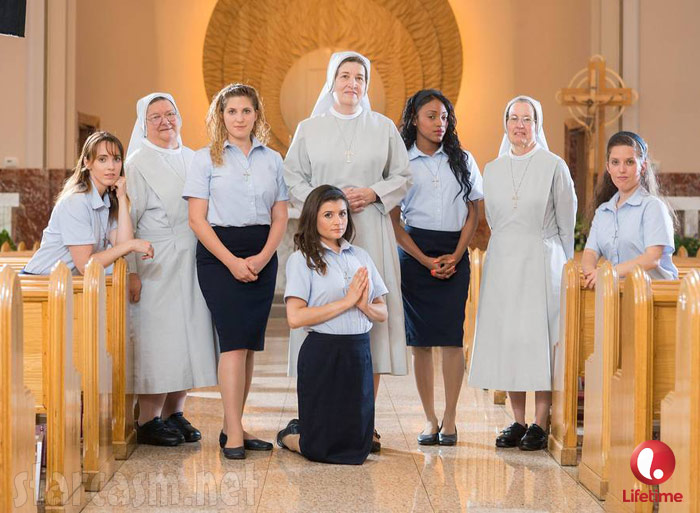
So, it’s not really a surprise that someone else not only thought about the idea but managed to bring some version of it to television. Despite the subtitle, as far as I understand, Lifetime’s The Sisterhood: Becoming Nunswhich premieres tonight, is not actually about women in religious formation as Sisters. Instead, it follows a group of twenty-something young women who might possibly be interested in religious life as they visit three convents to meet the Sisters and learn more about what it would be like to be a Sister. I suppose it’s more like a prospective student’s college tour where you stay on campus, eat in the dining hall, and go to class. Except that there are cameras and it is scripted into hour long episodes to be broadcast on national television.

My Catholic social media feeds are all abuzz about the show. Some are concerned that it only shows religious communities who wear a habit rather than those like mine who wear simple dress (as it happens, I do know that the producers reached out to a wide variety of communities so I don’t think it’s necessarily an intentional bias, but more a question of who agreed to take the risk of participating in a reality tv show). Others are concerned about the possibility of reinforcing stereotypes about nuns as being strict, austere, and living a life of sacrifice and “giving up” rather than a life of joy, love and service (much of the buzz I’ve seen so far keeps referencing scenes where the young women are told they cannot wear make up or use cell phones during their visit). And others seem to be hopeful, noting that if even one young woman who might have a vocation gives religious life some thought because of the show, then it would be a good thing. These all seem to be valid points to me.

My main caution is that even though the young women are not in formation, they are at least considering walking a very sacred and personal journey of transformation and a major life choice (unless they are actually just actresses but even then, the Holy Spirit can be sneaky so you never know). Having blogged my own way through formation, I know first hand that it is complicated and not so easy to share the call you feel in your heart or the movements of the Spirit. Then add in to the mix a third party producer who is most interested in ratings and advertising revenue, and I think you can understand my cautionary concern. Plus the producers are best known for Breaking Amish which brings a whole lot of different concerns that I will leave to your imagination.

I’ve not watched the show. I’m not sure I will watch the show, although I’m realizing I probably should, if only to see what images are being projected into popular culture about religious life. I do know that a number of younger Catholic Sister friends are planning to live tweet using the hashtags #thesisterhood and #nuntv. If I end up watching it, I might be live tweeting it myself.

And Jesus Wept … praying for peace

And Jesus Wept memorial, St. Joseph's Catholic Church across the street from Oklahoma City Bombing Memorial
And Jesus Wept memorial, St. Joseph’s Catholic Church across the street from Oklahoma City Bombing Memorial

Today’s Gospel from Luke is a poignant one:

“As Jesus drew near Jerusalem, he saw the city and wept over it, saying, ‘If this day you only knew what makes for peace–but now it is hidden from your eyes.'”

The headlines of course are filled with the recent killings in Jerusalem and  the continued bloodshed in Iraq and Syria, not to mention the political infighting in Congress. The headlines gloss over or ignore other situations of violence, such as poverty and oppression. There is violence in our streets, our homes, our very hearts.

But Jesus tells us, there is more. More is possible. Peace is possible.

Imagine Jesus standing in our midst today, seeing that we have everything within us which makes peace possible, should we choose to see and live it:

Our goodness. Our love. Our compassion. Our possibility. Our mercy. Our yearning for justice, equality, and reconciliation.

Can we open our eyes and our hearts to the reality that peace is possible?

Can we choose, live, and act for peace, in our our lives?

Can we start today?