Category Archives: reflections

To lead in fog, we must be led

I am spending this week steeped in the wisdom, presence, inspiration and challenge of my sisters in leadership at the Leadership Conference of Women Religious annual assembly. This is my fourth assembly, the second I have attended in my role as an elected leader of my own congregation (the first two I was here representing Giving Voice).  As one sister shared yesterday, this experience of contemplative listening and dialogue with 800 other sisters has been balm for my soul.

Yesterday, Sister Pat Farrell, OSF gave one of the keynote presentations, “Leading from the Allure of Holy Mystery: Contemplation and Transformation.” Pat was of course the president of LCWR during the kerfuffle with Rome. Her integrity and contemplative leadership helped us shift the narrative and reality of our relationship with the hierarchical church from one of conflict to one of faithful dialogue. I was particularly moved by this passage of her talk:

“This is our moment. The world around us teeters on the edge of both peril and promise. Breakdown and breakthrough tussle with each other. The path forward is hidden in fog. It is your time to lead. To do so you must learn to be led and to listen deeply. Together we will discover personal and communal processes for deep prayer and dialogue. We will be given what we need to tend the soul of our communities by nurturing contemplative spaciousness.”

In other words, to lead in fog, we must be led.

Yesterday, another sister shared an image that came out of her small group contemplative dialogue experience.

“When the redwood sits in the fog (rooted in contemplation) it absorbs the moisture within the fog and nourishes the entire tree and allows the moisture to reach the earth which nourishes other creatures. We (LCWR and our congregations) are a forest of redwoods focused on contemplation that the world may thrive.”

A northwesterner at heart, I immediately imagined this picture in my heart, which I took this summer on retreat in Oregon not of redwoods but evergreens in fog.

Fog

Truth be told, I have been feeling a bit lost in the fog of late. The fog of fear, hatred, and isolationism which seems to be taking hold among much of our body politic. The fog of grief and loss that is such a part of religious life these days, as our elders transition to the next phase of their journey with God.  The fog of uncertainty about exactly what the future holds for our communities which are in the midst of yet another period of transition and transformation.  Lots of fog.

This week in Atlanta has given me companions in the fog and given me a clarity in the mist. Contemplation is the way.  And so, once again, I recommit to my own regular contemplative practice, in my own life and in my life in community. As another group shared during our contemplative dialogue process, contemplation is essential to leadership.

I remember many years ago when I was discerning religious life, I felt like I was driving down a mountainous road in the dark, where my headlights only showed the way a few feet ahead. I felt an invitation to trust that when I turned the bend, I would see the next steps, and so it has been. At this particular moment, to be honest, I feel like the high beams would only reflect back to blind me. I cannot see the way forward. And yet, I feel called to stay on the path by my loving God.  Jesus is the way, even in the fog, and it is in the still quiet moments that the Spirit speaks. We need only to listen, to listen often, and to listen deeply.

Hoping with St Martha

martha1Today is the Feast of St. Martha. My latest Global Sisters Report column, published today, includes my musings on St. Martha as a model of hope.

Martha was indeed real, living in a world where some things just needed to get done, even if her sister Mary was too busy to help. She also lived in a world where the people she loved were suffering. I suspect there may have been times when she too wanted to hide under the covers.

Martha certainly had her own doubts about what was possible in such a world. When Jesus asked her to roll away the stone from her brother’s tomb, she warned him that the smell would be overpowering given that her brother had been dead for four days.

Yet Martha — worried, anxious and doubting as any real woman would be in the face of such stark realities — also listened to the hope and promise of Jesus. She made a home for hope in her heart. She helped to roll away the stone, and her brother Lazarus came out, ready to be unbound and free. We have a lot to learn from Martha, who in the end engaged in hopeful action in the midst of her own anxiety, worry and grief.

Read the whole column here.

On Trust

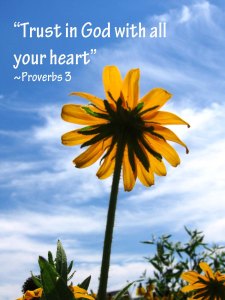
trustThis morning, the prayer booklet I use for my morning prayer included a reading from Proverbs 3.  This was one of the readings that I used for my final vows liturgy, and it played quite a role on the retreat I took before requesting to profess my final YES. (The picture is one I took on that retreat, which I then included on the cover of my final vows liturgy program).

Today during my morning prayer, as I sat with this passage, my heart gave me this:

Trust in God with all your heart.
When all your heart is in the mix,
you open yourself to truly loving,
with all the beauty and challenge,
vulnerability and sweetness,
companionship and loss,
wanting so much to hold on
even as we move toward being able to let go.
With all your heart
you open yourself
to God’s love
to God’s plan
to the hope that points beyond itself
to the fullness of time.
Love makes it all possible,
God’s love for us
our love for God and
one another.
Trust in love.

Retreat Prayer – Love is the Way

I found myself in the company of the disciples on this retreat, sometimes caught by their bumbling attempts to get the message of Jesus, as told in the scripture.  For example, Thomas in the Gospel of John when he does not know where Jesus is going, so how can they know the way?

This retreat in many ways was simple, in the gentle ways that God was present to me and the movement of the heart.  Yes I bring my anxieties and worries and wonderings and vulnerabilities and insecurities and challenges and realities and unknowns to the mix. Yes I often do not get it. Yet my loving and persistent and patient God is there. And the answer is simple … Love. Love is the way.

Words again don’t do the movement of the heart justice, hence this video prayer set to “Perpetual Self” by Sufjan Stevens.

Retreat Notes – Love > Fear (reprised)

A while back I wrote about how Love > Fear. This equation was in my heart and mind during some of my prayer time this week on retreat. It was more of a movement within than something I can capture with words. Hence, this video prayer reflection set to “No Fear in Love” by Steffany Gretzinger. This video prayer is inspired by Ezekiel 36:26, and starring some objects I found on the beach.


Retreat Notes – Texture

I am back from retreat, slowly re-entering my day to day life, such as it is, where really every day is full of its own adventures, flavors and textures.

Speaking of textures, one invitation I experienced this week was to pay attention to the textures. Textures in the pictures I was taking of the beautiful landscape around the Trappist Abbey of Our Lady of Guadalupe in Oregon.


Textures in my life,  relationships, community. Textures in my deepening experiences of God’s love. Textures in my response to my ongoing call.

Some hard. Some soft.
Prickly or smooth.
Moisture on rock–sitting patiently
impervious, or maybe
not.
Some will sink into the deep.
It is in the textures of life
where we touch, feel, and know
We are together,
incarnating in our world
the love that has been given
Gift for all.


Holy Saturday Moments

holy20saturdayLife is filled with many Holy Saturday moments. Time upon time we must let go of what was before we can even begin to be open to what will come.  I think of the way the first Holy Week after my own mother’s death was different than any other before or since. I felt it in my bones. I think of friends who have lost their job and struggled to find their feet again, or friends who have lost a child far too soon, or seen the end of their marriage.  There is always that messy middle space of witnessing the love lived and lost before something new emerges to call us forth to witness to love and life in new ways.
Theologian Shelly Rambo identifies Holy Saturday as the “middle day, as the site of witness to a more complex relationship between death and life” (Spirit and Trauma: A Theology of Remaining, pg. 46.). And what is at the core of this complex relationship? Love of course. “Between death and life, there is a testimony to Spirit, to a love that survives not in victory but in weariness” (pgs. 79-80).

This weariness is real and of the Spirit. It attests to the depth of love that has been lived. But it also can keep us from seeing the new life that is before our eyes. Think of Mary Magdalene at the tomb, mistaking Jesus for the gardener!

I can’t help but ponder the shifting landscape and transformations taking place in religious life through the lens of Holy Saturday. As I wrote in a Global Sisters Report column last year, “Middle space represents this time as an almost Holy Saturday moment. Much is breaking down, we know something new is emerging, but this is a moment pregnant with not yet.”

On this Holy Saturday morning, I found myself reading an article featuring some younger Catholic sisters I know who are members the Sisters of the Holy Redeemer. It is a great article that focuses on the new life that is present and emerging, even as the sisters are letting go of the structures of the past. “Now they are crafting a brave future in which the sisterhood may be minuscule, but its work will go on.”

We are indeed living in a Holy Saturday moment. “We can say, ‘Oh, isn’t it sad, our sisters are aging, nobody is coming, we’re dying out’ – and that’s real,” said Sister Anne Marie Haas, provincial supervisor of the community’s Montgomery County headquarters. “But we have a choice.”

And that choice is love, even in its weariest and messiest forms. As we say in our CSJP Constitutions, “Confident of God’s faithful love, and collaborating with others who work for justice and peace, we face the future with gratitude and hope.”

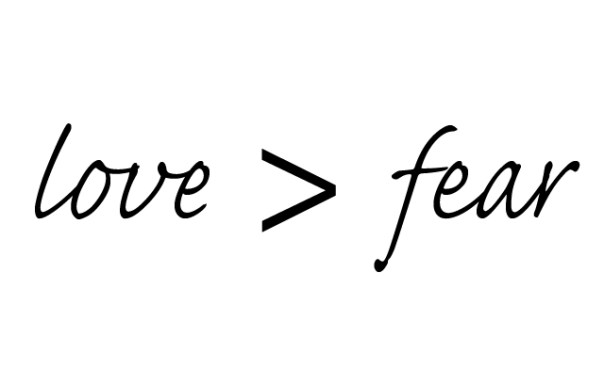
Love > Fear

This morning, after reading much disheartening news on the domestic and international front over breakfast, I spent some quiet time with today’s Scripture readings and my friend Julia Walsh, FSPA’s latest Global Sisters Report column.

In Hosea, I read: “What can I do with you, Ephraim? What can I do with you, Judah? Your piety is like a morning cloud, like the dew that early passes away … For it is love that I desire, not sacrifice, and knowledge of God rather than burnt offerings.”

In Julia’s column, I read: “In this fearful age, God can transform all of us and the ways we feel about each other. We can love in radical ways, guided by our faith that each of us — even the person who scares us the most — are truly children of God deserving to be loved and cherished. Then, freed from the fears that plague our conversations, news, and dynamics, we can powerfully love one another just as God has loved us, sharing transformative mercy and hope.”

Both can be summed up by this equation:

love-greater-than-fear

Worthy of meditation and practice, I think.

It is also important for me to stay abreast of current news and the currents of political discourse. But I can’t let that weigh me down. Fear is not stronger than love. Suffering is not insurmountable. Hatred is a symptom of broken relationships and isolation. We are called to something greater, to community and connection.

We must give voice to love in the face of fear, through our words, our actions, our hopes and desires. Not just in the quiet contemplative moments but in all of our interactions and in our ordinary lives. That is how change happens and how love spreads to dispel fear. Don’t you think?

Lent – That’s What’s Happening

73830c79eb33ab07b328d8a4bdb71f8d-650x422x1During my childhood in the 1970s & 80s, Saturday mornings were a special and almost sacred time, in large part because of Saturday morning cartoons and the bit I looked most forward to–Schoolhouse Rock.

For those who are not in the know, and I am always surprised when folks cannot sing the preamble to the Constitution or know that zero is my hero, Schoolhouse Rock was a series of catchy songs set to animated cartoons. The series helped a generation of children understand complicated concepts such as how a bill becomes a law, the values of immigration for society, or the function of a conjunction in a sentence. Music is a great way to learn, and there have been many times in my adult life when I have returned to what I learned via song and cartoon  all those decades ago on Saturday morning.

This Lent, for example, I’ve been playing around in my head and heart with some of what I learned from Schoolhouse Rock about grammar.

Think about it … Lent itself is a funny word.  The online Merriam-Webster Dictionary defines Lent as the “40 weekdays from Ash Wednesday to Easter observed by the Roman Catholic, Eastern, and some Protestant churches as a period of penitence and fasting,” with the origin coming from the Middle English word for springtime. Living on the East Coast as I am these days, where there is still frost in the mornings and the possibility of snow, it is easy to understand why this season of anticipation took its name from the hope for spring!

Of course, the word lent has other meanings as well.  In French the letters l-e-n-t  become and an adjective meaning slow, which is entirely appropriate for the Lenten Season. Adjectives, as the “Unpack Your Adjectives” Schoolhouse rock video taught me as a child, “are words you use to really describe things, handy words to carry around.”

I carry lots of things around these days, mainly a growing list of urgent things that need to be done. Yet the wisdom of the Lenten season is that, as a church, we set aside a time each year which carries with it the higher priorities of slowing down through prayer, fasting, and almsgiving. The French adjective lent is a good word to carry around in my heart as I slow down during these 40 days.

Lent also has other meanings in English. For example, it can be the past simple tense or past participle of the irregular verb to lend. Verbs, as the Schoolhouse Rock video “Verb, That’s What’s Happenin’” reminds me, put “my heart in action … to work, to live, to play, to love.”   This is both a lovely and very challenging concept, especially when I consider the ways my heart is lent in action.

Who puts my heart into action? Who am I lent by?  Where do I lend my energy?

Lent, that’s what’s happening.